


TLDR
A UK competition website needs three categories of features to operate compliantly and profitably: legal-structural (skill question gating before checkout, free entry route visible on every competition page, properly structured T&Cs), operational (ticket logic, draw management, mobile-first checkout, winner publication), and trust (live entry lists, transparent winner history, payment processor badges, DCMS Voluntary Code compliance from May 2026). Without all three, payment providers and advertising platforms will eventually flag the site.
Quick answer:
- The most critical features are not cosmetic: skill question gating, compliant free entry route display, and specialist payment gateway integration determine whether your site can legally take entries and process payments
- Ticket numbering, draw audit trails, and winner management are operational essentials that generic ecommerce platforms do not provide natively
- The DCMS Voluntary Code of Good Practice, effective 20 May 2026, introduces mandatory features including spending limits, self-exclusion tools, and under-18 protections
- Conversion features such as countdown timers, progress bars, and player dashboards matter, but only once the compliance and payment foundations are in place
- Across 50+ UK competition website builds, the sites that scale without disruption are those built around these features from launch, not retrofitted after problems appear
What features the Nera Engine platform includes for compliance-first competition websites
A UK prize competition website operates under a specific legal framework that generic ecommerce platforms are not designed for. The features that determine legal operation come first. Without them, everything else, the design, the marketing, the prize catalogue, sits on an unstable foundation that payment providers and advertising platforms will eventually flag.
The three compliance features that every UK competition website must have before taking a single entry are a correctly implemented skill question gate, a genuinely accessible free entry route, and a payment gateway that has been approved for the competition business model. These are not design choices. They are legal and operational requirements that affect whether the site can run at all.
Beyond these three, a compliant competition website also requires transparent terms and conditions accessible from every competition page, a clear winner selection process documented in those terms, an audit trail of all entries and draw outcomes, and GDPR-compliant data capture with properly structured consent at the point of entry.
Nera Marketing builds all of these into the Nera Engine platform as standard rather than as paid add-ons. That covers the skill question gate, the free entry route, draw randomisation, ticket and draw management, GDPR consent capture and Cashflows payment setup. Nera Marketing packages start from £2,995.
How should a skill question be built into a competition website?
The skill question is the mechanism that makes a paid-entry competition legal under Section 14 of the Gambling Act 2005. For the competition to operate without a gambling licence, participants must be required to answer a genuinely discriminating question before their entry is processed. The question must be capable of excluding a significant proportion of people who answer incorrectly.
The critical word is “required.” The skill question must gate the entry. A participant should not be able to complete a paid entry without correctly answering the question first. This means the skill question must be built into the checkout flow before payment is taken, not presented as an optional field on the product page that can be bypassed.
On a properly built competition website, the skill question works as follows. The participant selects their tickets. Before proceeding to payment, they are presented with the skill question. If they answer incorrectly, they cannot proceed. Only a correct answer unlocks the checkout. The answer is logged against the entry for audit purposes.
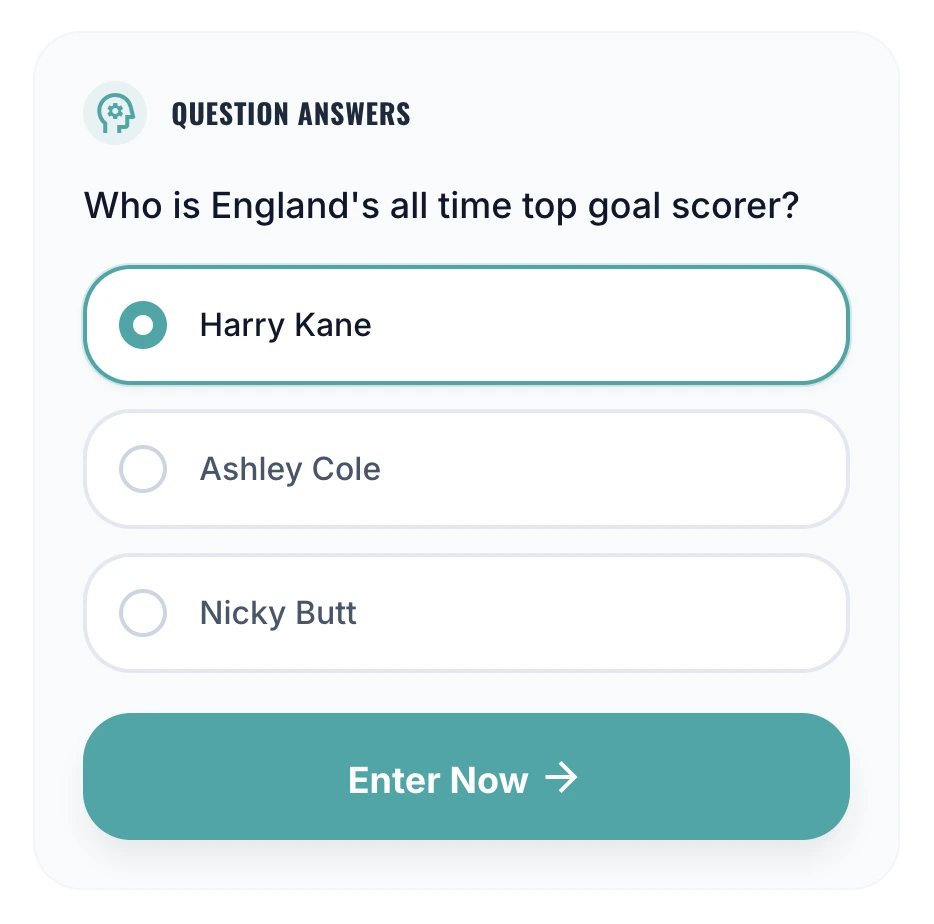
Common implementation failures include skill questions that appear on the product page but do not gate the cart, questions where any answer is accepted without validation, and questions that are trivially easy enough that virtually no one would get them wrong. The last point matters: a question that reads “2 + 2 = ?” does not satisfy the Section 14 requirement for genuine discrimination, and there is a growing body of ASA and Gambling Commission guidance on what constitutes a genuinely skill-based question versus a token formality.
On a bespoke build or a properly configured WordPress competition platform, the skill question gate is built at the infrastructure level. It cannot be bypassed. The correct answer is stored securely in the database and validated server-side before the checkout session opens.
What does a compliant free entry route look like on a competition website?
A free entry route is a method of entering a paid competition without making a payment. Under UK law, any paid-entry competition must provide one. The route must be clearly accessible, easy to use, and must offer the same chance of winning as a paid entry. It must never be hidden, made deliberately difficult, or presented in a way that discourages its use.
The ASA’s October 2020 ruling against Omaze established the standard that all UK competition operators now work to. Burying a free entry option in footer text, presenting it in a smaller font than the paid route, or requiring participants to navigate to a separate page to find it does not constitute a compliant free entry route. The free route must be presented alongside the paid route, with comparable prominence.
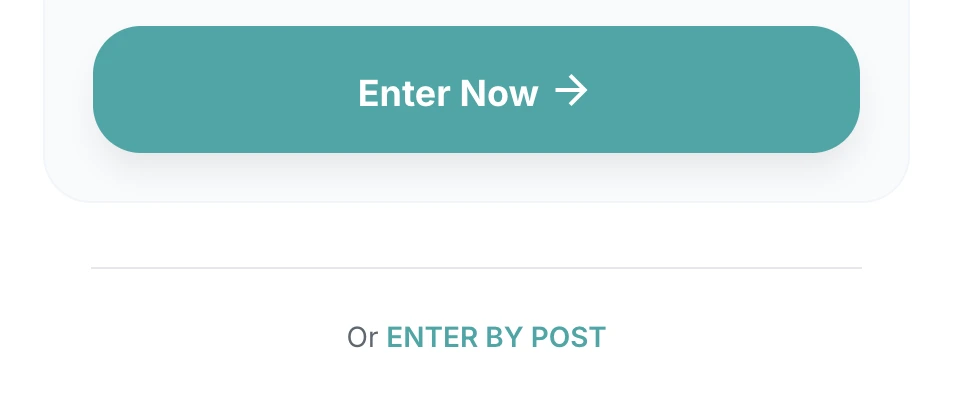
The most common implementation is a postal entry option. The competition website must display the postal entry address clearly on each competition page, explain how to submit a valid postal entry, confirm what information must be included (typically name, address, competition reference, and answer to the skill question if applicable), and state the timescale within which postal entries will be processed and added to the draw.
Cashflows, which processes payments for the majority of competition websites across Nera Marketing’s 50+ builds, specifically checks that the free entry route is clearly visible on the website before approving a merchant application. A site that does not display a compliant free entry route will not pass the underwriting review.
The operational side of the free entry route is often overlooked. Postal entries must be received, logged, assigned ticket numbers consistent with the paid pool, and confirmed. This is a manual process that requires administrative infrastructure, particularly as volumes grow. A well-built competition website includes a backend system for logging and confirming postal entries, with the same audit trail as paid entries.
What ticket and draw management features does a competition website need?
Ticket management is where competition websites diverge most sharply from standard ecommerce. A product order is a straightforward transaction. A competition entry involves ticket number allocation, entry limits, draw pool management, and a winner selection process that must be auditable.
The core ticket management features a competition website needs are as follows.
Unique ticket number allocation is non-negotiable. Every entry must receive a unique ticket number from a controlled pool. The system must prevent duplicate allocation and must handle simultaneous entries during high-traffic periods without errors. Documented failures in this area, including third-party competition apps allocating incorrect ticket numbers during draw closures, have caused significant operator credibility damage.
Entry limits per customer allow operators to cap how many tickets a single customer can purchase per competition. This is both a commercial control and, under the DCMS Voluntary Code effective May 2026, a player protection measure.
Ticket selection options include random allocation (most common), lucky dip, and in some implementations, customer-selected ticket numbers. The selection mechanism must be consistent with the competition terms.
Real-time availability display shows participants how many tickets remain. This drives urgency and is a key conversion tool, but it must be accurate. Misleading availability information is a compliance risk under consumer protection rules.
Draw management covers the mechanism by which winners are selected. This must be random, auditable, and consistent with the method described in the competition terms. Common approaches include certified random number generators and live draw events on social media. The draw outcome must be recorded and stored as part of the audit trail.
Winner management tracks draw outcomes, records winner contact details, documents prize delivery, and feeds the winners archive that should be publicly visible on the site. A competition website without a visible winners archive is a trust signal failure.
What payment and checkout features matter for UK competition websites?
Payment is the highest-risk area of a competition website. The features here are dictated as much by what payment providers require as by what operators want.
The most important feature is integration with a specialist payment gateway. Standard payment providers, including Shopify Payments, Stripe, and PayPal, prohibit competition business models in their terms of service. A UK competition website must integrate with a specialist high-risk gateway: Cashflows, G2Pay, DNA Payments, Acquired, Nochex, or Axcess. Cashflows is the most widely used across Nera’s builds, offering next-day settlement, support for Visa, Mastercard, Apple Pay, Google Pay, and Click to Pay, and card tokenisation of up to five saved cards per user.
The checkout flow must be designed around the gateway’s underwriting requirements. For Cashflows, this means the free entry route must be clearly visible, the competition duration must not exceed 30 days per draw, and the skill question must be clearly implemented before payment. These are not optional enhancements; they are conditions of the merchant agreement.
Mobile payment support is essential. The majority of competition entries come from mobile devices via paid social traffic. Apple Pay and Google Pay reduce the number of steps between ad click and completed entry, which directly increases conversion. A checkout that requires manual card entry on mobile loses entries to friction that one-tap payment eliminates.
Card tokenisation allows returning customers to pay without re-entering card details. For competition businesses that depend on repeat entry rates, this is a meaningful conversion feature.
An abandoned entry recovery system sends automated emails to participants who added tickets to their cart but did not complete checkout. Across competition websites in Nera’s portfolio, abandoned entry recovery is consistently one of the highest-return automated sequences a platform can run.
Entry confirmation emails sent immediately after a successful entry serve two purposes: they confirm the entry details and ticket numbers to the participant, and they create a documented record of the transaction for both the operator and the participant.
What player account and trust features should a competition website include?
Trust is the primary conversion lever for competition websites. Participants are being asked to pay money for a chance at a future outcome. Every feature that increases perceived legitimacy increases conversion, and every feature that is missing creates a gap that reduces it.
Player accounts allow registered participants to view their entry history, check ticket numbers against draw results, manage their contact details and marketing preferences, and access their previous wins. A well-built player dashboard reduces customer service enquiries and builds trust through transparency. Participants who can see their own history are more likely to become repeat customers.
A winners archive is a publicly visible page showing past draw outcomes: who won, what they won, and when the draw took place. This is one of the most powerful trust signals a competition website can have. It answers the question every potential entrant is implicitly asking: do people actually win? An empty or outdated winners archive has the opposite effect.
Draw recordings, either posted to social media or embedded on the site, provide evidence that draws are conducted fairly and transparently. For many operators, the live draw event on Facebook or Instagram also serves as a marketing moment that drives traffic and entries for the next competition.
Social proof elements including verified reviews, entry counts, and winner testimonials all contribute to the trust architecture. Reviews must be genuine and verifiable. Fabricated social proof is a CAP Code violation.
Age verification is increasingly important as the DCMS Voluntary Code effective May 2026 introduces formal under-18 protections. At minimum, the site must include a date of birth check at registration. More robust implementations include third-party age verification services.
What DCMS Voluntary Code features are required from May 2026?
The DCMS Voluntary Code of Good Practice for Prize Draw Operators was published in November 2025 and came into effect on 20 May 2026. It is the most significant regulatory development for UK competition websites since the Gambling Act 2005, and it introduces specific platform features that operators must have in place.
Spending limits allow participants to set a maximum amount they are willing to spend per draw or per period. The Code requires that operators offer this functionality and that it is presented prominently, not buried in account settings.
Self-exclusion tools allow participants to exclude themselves from competitions for a defined period. This is analogous to the self-exclusion mechanisms used by licensed gambling operators. The Code requires that self-exclusion requests are honoured promptly and that excluded participants cannot re-register during the exclusion period.
Under-18 protections require that operators have robust age verification at the point of registration and that the site does not market to under-18s. The marketing rules interact with the CAP Code, which already prohibits targeting under-18s with competition advertising.
Enhanced winner transparency requirements mean that operators must publish draw outcomes clearly and consistently, including the method of winner selection and confirmation that the prize has been delivered.
Player communications must include information about responsible participation. This includes signposting to support services and including responsible participation messaging in key communications such as onboarding emails.
These features require platform-level implementation. They cannot be added through a plugin or a footer link after launch. A properly built competition website integrates spending limits, self-exclusion, and age verification into the user account and checkout architecture from the outset.
What does a competition website admin panel need to include?
The admin panel is the operational heart of the competition website. The features it includes determine how efficiently the operator can run the business day to day.
Competition management tools allow operators to create new competitions, set ticket quantities and prices, configure entry limits, set draw dates, and publish or unpause competitions without developer involvement. Every competition parameter should be configurable through the admin interface.
Entry management provides a real-time view of entries per competition, with the ability to export entry lists for draw purposes and filter entries by status (paid, pending, postal).
Draw management tools allow the operator to trigger the winner selection process, record the outcome, and initiate winner communications from within the admin panel.
Winner management tracks prize delivery status, records winner confirmation, and feeds the public winners archive automatically on confirmation.
Revenue reporting provides competition-level and period-level revenue data, including ticket sales, average order value, and repeat entry rates. This data is essential for optimising pricing and identifying which competition types perform best.
Postal entry management provides a workflow for logging incoming postal entries, assigning ticket numbers, and sending confirmation emails to postal entrants.
GDPR and data management tools allow operators to respond to data subject access requests, process right to erasure requests, and manage marketing consent records in a way that satisfies ICO requirements without disrupting the draw audit trail.
What conversion features separate high-performing competition websites?
Once the compliance and payment foundations are in place, the conversion features determine how efficiently the site turns visitors into paying entrants and repeat customers.
Countdown timers on competition pages show the time remaining until the draw. They create urgency and are one of the most consistently effective conversion tools across competition websites. They must be accurate and must reflect the actual draw date.
Progress bars showing ticket sales as a percentage of the total pool create social proof and scarcity. Participants can see that others are entering, which both validates the competition and creates urgency. The progress bar must be accurate. A fake or manipulated progress bar is a compliance risk and a trust-destroying failure if discovered.
Instant win functionality awards a small prize to a randomly selected paid entrant before the main draw. This incentivises early entry and provides immediate positive reinforcement, which increases repeat entry rates. Instant wins require careful backend implementation to ensure they are allocated randomly and consistently with the competition terms. For the legal and design line between a compliant instant win and a regulated gaming product, see Instant Win Competition Mechanics in the UK.
A loyalty or points system rewards repeat entry with credits that can be redeemed against future entries. Across competition websites that implement loyalty systems, repeat entry rates are measurably higher than on sites without them.
Referral mechanics reward existing participants for introducing new entrants. This is the most cost-efficient customer acquisition mechanism available to competition operators and, when implemented correctly, creates organic growth that reduces paid advertising dependency.
Email and SMS automation covers the full entry lifecycle: entry confirmation, draw reminder, winner announcement, and re-engagement sequences for lapsed participants. Manual communication does not scale beyond a certain entry volume. Automated sequences built around the entry and draw calendar are essential for any operator intending to grow.
Mobile-first design is not a feature so much as a baseline requirement. The majority of competition entries arrive via paid social advertising on mobile devices. A checkout that is not optimised for mobile loses entries at every friction point. Tap-friendly buttons, one-page checkout, and one-tap payment options are the minimum standard.
What hosting and scalability features does a UK competition website need?
The features above sit on top of a hosting and infrastructure layer that is the single most common cause of performance problems during draws. UK competition operators planning instant win competitions, low-priced bundled tickets, or growth past their first 1,000-entry draws need to specify hosting and scalability features at the build stage, not retrofit them after a draw-day failure.
Dedicated PHP workers. Every concurrent request through a competition website consumes a PHP worker on the hosting server. Shared hosting and entry-level managed hosting allocate a small worker pool that handles steady-state traffic fine but exhausts within minutes under instant-win draw-day load. Specialist competition hosting allocates dedicated PHP workers sized for the expected concurrency, with the ability to scale workers up before scheduled draw events. These features are why operators choose a specialist competition website builder over a generic ecommerce platform or off-the-shelf template. Nera Cloud is the hosting layer Nera Marketing uses for every build, with PHP workers, edge caching, and traffic scaling configured for UK competition draw nights. The agency you build with determines whether hosting, compliance, and payment infrastructure are properly specified from day one. Our guide to how to compare competition website agencies covers the 7 criteria that separate specialists from generalists.
Asynchronous post-order processing. WooCommerce ships with Action Scheduler, a job queue system that allows post-order hooks to fire as scheduled background actions rather than executing inline during checkout. Without it, every marketing platform integration, every email send, every cashback calculation, and every ticket-row insert blocks the checkout response until it completes. Properly implemented Action Scheduler drops post-order checkout response times from tens of seconds back to one or two seconds. Every UK competition website at scale should have this in place before the first high-volume draw.
CDN configuration tuned for dynamic ecommerce. Competition websites benefit from a CDN for static asset delivery (images, fonts, JavaScript), but the dynamic routes (checkout, cart, account, ticket allocation) need to be excluded from full-proxy caching. Cloudflare’s orange-cloud proxy mode, for example, should be disabled on the dynamic routes (DNS-only mode for those paths) because proxy mode interferes with the CSRF tokens and session handling that competition checkouts depend on under concurrent load.
Database write batching for ticket-row inserts. The competition ticketing plugin family used by most UK competition websites generates one database insert per ticket purchased. A customer buying 100 tickets triggers 100 sequential database writes per order. Properly configured hosting can batch these inserts and reduce per-order checkout time substantially. Without batching, sequential ticket-row inserts at scale add five to fifteen seconds per order during peak load.
A specialist managed migration path. Standard WordPress migration plugins work fine for typical ecommerce sites but commonly fail on the specialist hosting environments that competition websites require. The reliable path is to use the destination host’s own managed migration team for the DNS cut-over, database import, and SSL provisioning, with a phased approach: DNS migration first, CDN and Cloudflare configuration the following day, and full propagation verification before the site is considered fully live. For more on how pricing structure interacts with hosting infrastructure, see how to price raffle tickets in the UK.
If you are planning a UK competition website and want to understand which features are most important for your specific model, our bespoke competition website service is built around all of the above from day one, including Voluntary Code implementation, specialist payment gateway setup, and compliance architecture that payment providers and advertising platforms accept.
Nera Marketing builds UK competition websites with every feature operators actually need on the Nera Engine platform, Nera Shield compliance layer, and Nera Cloud hosting. Bespoke, compliant, fully owned by the operator.
Ready to build your competition website?
Join hundreds of operators running prize draws with NERA's platform.
Talk to us →