


TLDR
Shopify is not built for UK prize competition websites. Its payment terms explicitly prohibit the competition business model, its checkout cannot implement a legally compliant skill question, and every feature a dedicated competition site needs, from ticket allocation to live draw tools, requires patching together third-party apps on a platform that was never designed for this. This article explains where it falls short and what Nera Marketing builds instead.
Quick answer:
- Shopify Payments lists competitions, sweepstakes, and raffles as prohibited business types in its Terms of Service
- Stripe and PayPal carry the same prohibition, leaving you without a viable payment gateway unless you source a specialist provider independently
- Shopify’s locked checkout cannot implement a mandatory skill question before payment, which means paid-entry competitions built on Shopify may not meet the requirements of the Gambling Act 2005
- Free entry routes cannot be presented with the prominence required under ASA and CAP Code rules within Shopify’s standard page templates
- Competition-specific features such as ticket numbering, instant wins, and draw-day traffic management are not native to Shopify and require third-party apps with documented reliability issues
- WordPress with WooCommerce, or a bespoke build, is the standard choice for UK competition operators who intend to scale
Can you run a UK prize competition on Shopify?
Technically yes, but in practice the platform creates compliance, payment, and operational problems that make it unsuitable for most UK competition businesses. Nera Marketing builds on WordPress and WooCommerce for exactly these reasons. Shopify is built around selling products through a standard retail checkout. A UK prize competition website operates under a completely different legal framework, requires different payment infrastructure, and needs features that Shopify does not offer natively.
The Gambling Act 2005 governs how UK prize competitions must be structured. To operate legally without a gambling licence, a competition must either require participants to answer a genuinely skill-based question before entering, or provide a genuinely free entry route that is presented with equal prominence alongside the paid route. Neither of these can be properly implemented within Shopify’s standard checkout architecture without significant custom development, and even then the structural problems with payment gateways remain.
Operators who launch on Shopify typically do so because they already have a Shopify store for another product line, or because the initial setup looks straightforward. The problems appear quickly, usually when the first payment gateway application is rejected, or when a compliance review flags the checkout structure.
The Shopify question is the most common entry point into a conversation with Nera Marketing. Prospects start with the platform they already know, and the answer is consistently the same.
Nera Marketing has built over 50 UK competition websites. We ran the Shopify path once, in 2023, and have not repeated it. The reason is payment processing.
Why does Shopify Payments ban competition websites?
Shopify Payments’ Terms of Service explicitly names “contests, sweepstakes, games of chance, lotteries, charity sweepstakes, and raffles” as prohibited business types. This is not a grey area or a matter of interpretation. If Shopify identifies that your store is running prize competitions, your Shopify Payments account can be suspended, funds held, and your store shut down.
This prohibition exists because payment processors treat prize competitions as high-risk businesses. The entry fee model, combined with the probabilistic prize outcome, sits in a regulatory category that requires specialist underwriting, enhanced due diligence, and different reserve structures. Standard retail payment infrastructure is not built for this risk profile.
The practical consequence is that every operator who launches a competition website on Shopify and uses Shopify Payments is operating in breach of the terms they signed. It may work for a period, but the risk of account freeze increases as transaction volumes grow and automated fraud detection flags the competition revenue pattern.
Will Stripe or PayPal work as an alternative on Shopify?
No. Both carry the same prohibition, and both are documented as causing account closures for competition operators.
Stripe’s restricted businesses policy prohibits both games of chance and games of skill where monetary or material prizes are involved. The game of skill prohibition is particularly significant for UK operators who believe that structuring their competition as a skill-based question protects them. Under Stripe’s policy, the prize element is the problem, regardless of how the entry mechanism is structured.
PayPal’s acceptable use policy prohibits the purchase or sale of any opportunity to participate in a raffle, drawing, or sweepstake, and any activity with an entry fee and a prize, whether determined by chance or skill. Real-world account freezes and fund holds for competition operators using PayPal are well documented across UK operator forums.
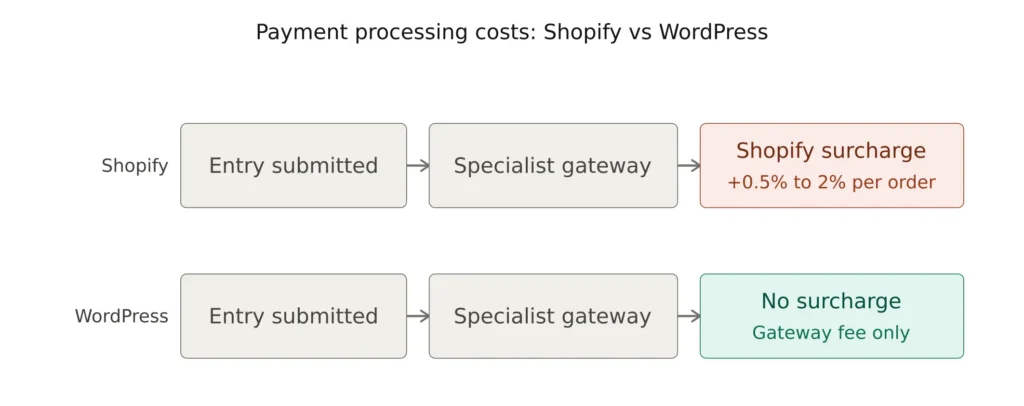
When Shopify forces you off Shopify Payments, the platform charges an additional transaction surcharge of 0.5% to 2% on every order processed through a third-party gateway. Combined with the specialist gateway rates you would be paying anyway (typically 2% to 4% per transaction on top of interchange), total processing costs can reach 5% to 6% per transaction. For an operator processing £20,000 per month in ticket sales, that is £1,000 to £1,200 per month in gateway costs alone, before any platform fees.
What does switching to a specialist gateway cost on Shopify?
Specialist competition-friendly payment gateways, the providers that actually underwrite prize draw and game of skill businesses, include Cashflows, Nochex, G2Pay, DNA Payments, Acquired, and Axcess. These are the same providers used on WordPress and bespoke builds. Operators who decide a bespoke build is the right path then face a separate decision: which agency to commission. Our breakdown of criteria for evaluating UK competition website agencies walks through how to vet a build partner before committing.
The difference on Shopify is the additional platform surcharge. Shopify charges this surcharge on any order not processed through Shopify Payments. You pay it on every transaction, in perpetuity, as a platform tax for not using their native payment product. Operators evaluating Shopify against a fully owned alternative often end up comparing WordPress builds directly against SaaS competition platforms. Our breakdown of WordPress vs SaaS competition platforms covers which model fits which kind of operator.
Cashflows, the most widely used specialist gateway for UK competition operators across Nera Marketing’s 50+ builds, carries a £500 setup fee, a £20 monthly gateway fee, and a transaction rate of IC++ 2% plus 5p per transaction, with an additional 15p per transaction gateway fee. On a WordPress or bespoke build, this is your total processing cost. On Shopify, you add 0.5% to 2% on top of every transaction.
On a £10,000 per month volume at an average £5 ticket price, the Shopify surcharge adds £50 to £200 per month compared to the same gateway on a platform without transaction surcharges. Over 12 months, that is £600 to £2,400 in unnecessary cost, not including the higher effective rate as volumes grow.
Can Shopify implement a skill question correctly under the Gambling Act 2005?
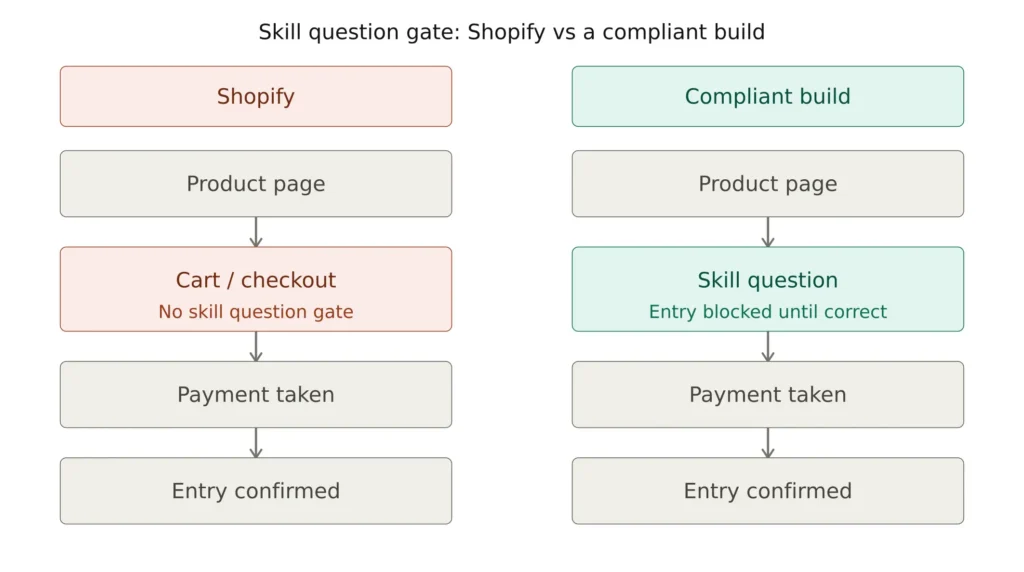
This is the most critical compliance problem. Under Section 14 of the Gambling Act 2005, a competition that charges for entry must require participants to exercise genuine skill before they can enter. Nera Marketing gates the skill question before payment on every build. The skill question must be genuinely discriminating, meaning it must be capable of excluding a significant proportion of participants who answer incorrectly.
For a competition to be legal, no participant should be able to complete a paid entry without correctly answering the skill question first. The question must gate the transaction, not appear as a formality that can be bypassed.
Shopify’s checkout is a linear flow: product selection, cart, payment, confirmation. On all plans below Shopify Plus (which starts at approximately $2,000 per month), the checkout is locked. You cannot insert a mandatory pre-payment step that validates a skill question response before the transaction proceeds. Apps can add a question field to a product page, but if a participant can add to cart and proceed to payment without answering it, the gate does not function as the law requires.
Custom development can address this on Shopify Plus, but at significant cost and ongoing maintenance overhead. The same compliance outcome is built natively into WordPress competition plugins and bespoke builds designed specifically for the UK market, without platform-level restrictions.
How does Shopify handle the free entry route requirement?
Poorly. The ASA has ruled against competition operators for presenting free entry routes insufficiently prominently. The October 2020 Omaze ruling established that a postal entry option buried in terms and conditions, or presented in smaller text than the paid route, does not constitute a genuinely free entry route within the meaning of CAP Code rules.
Nera Marketing ran the Shopify build path with an operator exactly once, in 2023. The cost-to-functionality ratio was so unfavourable that we never repeated the exercise.
A compliant free entry route must be presented alongside the paid entry option, with equal or comparable prominence. On a standard Shopify product page, the page structure is designed to drive a single purchase action. There is no native way to present two entry routes side by side, with the free route clearly signposted as an equally valid option, without custom development.
Beyond the display requirement, postal free entry routes require operational infrastructure that Shopify has no tools for: receiving postal entries, logging them against the relevant competition, assigning them ticket numbers consistent with the paid pool, and confirming receipt within a reasonable timeframe. This is a manual administrative process that sits entirely outside Shopify’s system.
Cashflows, when reviewing competition websites before approving a merchant application, specifically checks that the free entry route is clearly visible on the website before the application is submitted. A Shopify site without a compliant free entry route would not pass this check.
What are the GDPR implications of running a competition on Shopify?
Shopify’s own Help Centre states directly that using services offered by Shopify alone does not guarantee GDPR compliance. For competition websites, this caveat carries more weight than it does for standard ecommerce.
A competition website processes personal data for a fundamentally different purpose than a retail store. Entry data, marketing consent, winner data, and draw audit trail data all require separate legal bases, retention periods, and data processing agreements. Every third-party app installed on a Shopify competition site, whether for ticket management, age verification, or email marketing, creates an additional data processing relationship that requires its own Data Processing Agreement.
UK competition operators are also subject to the ICO’s guidance on direct marketing consent. Competition entrants who opt in to marketing during the entry process must be able to exercise their rights under UK GDPR, including the right to erasure, in a way that does not disrupt the audit trail of the draw. Standard Shopify data tools are not designed with draw audit integrity in mind.
Can Shopify handle traffic during a competition close or live draw?
Shopify’s infrastructure is robust for standard ecommerce traffic. Competition websites face a different traffic pattern: concentrated spikes during final ticket releases and live draw events, often driven by social media and email campaigns firing simultaneously.
The problem on Shopify is not server capacity alone. It is that competition-specific features such as real-time ticket counter updates, accurate remaining ticket displays, and entry limit enforcement all rely on third-party apps. During a high-traffic draw close, app performance and database write speeds become bottlenecks that Shopify cannot manage at the infrastructure level.
Multiple UK competition operators have reported incorrect ticket allocations during Shopify-based draw closures, including documented issues with the PineRaffle app showing participants the wrong number of allocated tickets. When ticket allocation accuracy is not guaranteed, the integrity of the draw is compromised, and operator credibility takes damage that is very difficult to recover.
A bespoke competition website or a properly configured WooCommerce build handles ticket allocation and real-time availability at the infrastructure level, not through a layer of third-party apps that were not built to interact with each other under load.
When is Shopify a reasonable starting point?
There is one scenario where Shopify is defensible: early-stage testing on a very small scale, where the operator already has a Shopify store for a separate product line, entry volumes are low, and the operator understands the limitations and is prepared to manage around them.
Even in this scenario, the payment gateway problem still applies. There is no version of a UK competition website on Shopify that resolves the Shopify Payments prohibition. You will need a specialist gateway regardless of scale.
If you are running occasional competitions as a marketing activity alongside a product business, rather than operating a dedicated competition platform as your primary business, Shopify with a specialist gateway and careful compliance attention can work in the short term.
If you are building a dedicated competition business with the intention of scaling, Shopify is the wrong foundation. The structural limitations and ongoing platform costs that accumulate as you grow make migration to a proper competition platform inevitable. Building correctly from the start is cheaper than migrating under pressure.
Skip Shopify, Build It Right
WordPress and WooCommerce, Cashflows wired in, no platform surcharge. Full Gambling Act 2005 compliance built in from day one. Packages from £2,995. Migration handled if you’re already on Shopify.
Talk to us →What should UK competition operators use instead of Shopify?
The comparison below covers the three main options for UK competition operators, across the factors that matter most to a prize draw business.
| Factor | Shopify | WordPress / WooCommerce | Bespoke build |
|---|---|---|---|
| Payment gateway | Shopify Payments banned. Third-party surcharge of 0.5 to 2% on all transactions | Full compatibility with Cashflows, G2Pay, DNA Payments, Acquired, Nochex, no surcharge | Full compatibility, no surcharge |
| Skill question compliance | Cannot gate checkout natively below Shopify Plus | Native via WooCommerce competition plugins | Built to spec |
| Free entry route | Requires custom development for compliant display | Available natively in competition plugins | Built to spec |
| Ticket numbering | Third-party apps only, documented reliability issues | Native in competition plugins | Native |
| Instant win functionality | App-dependent | Plugin-based | Native |
| Draw-day traffic management | Third-party app layer creates bottlenecks | Server-level configuration | Full control |
| Ongoing monthly cost | £25 to 80/month platform + 0.5 to 2% per transaction surcharge + app costs (£50 to 200/month) | £20 to 80/month hosting, no surcharge | £20 to 80/month hosting, no surcharge |
| Site ownership | No, Shopify owns your platform | Yes, full ownership | Yes, full ownership |
| DCMS Voluntary Code (May 2026) | Requires custom development throughout | Implementable natively | Implementable natively |
WordPress with WooCommerce is the standard choice for UK competition operators launching a dedicated platform. It supports full integration with specialist payment gateways including Cashflows, implements skill questions and free entry routes natively through purpose-built competition plugins, and gives you full ownership of the site with no ongoing platform fees or transaction surcharges.
WordPress with WooCommerce is the platform, not the build. It still has to be configured for a prize competition, which is where most operators stall. Nera Marketing builds that stack for UK operators with skill questions, free entry routes, draw randomisation and Cashflows payment setup included. Nera Marketing packages start from £2,995 and you own the site outright.
Across Nera’s 50+ UK competition website builds, operators who launch on a properly configured WordPress build from day one avoid the payment rejection cycle, the compliance retrofit, and the migration cost that Shopify operators typically face within the first six to twelve months.
If you are planning a UK competition website, our competition website design and build service is built around the compliance requirements, payment gateway integrations, and technical infrastructure that UK prize competition operators need from launch.
Stuck on Shopify or starting from scratch?
We build UK competition websites on WordPress with Cashflows wired in from day one. Full compliance, no surcharges, no platform lock-in. 50+ delivered.
Talk to us →