
TLDR
To run a Facebook Live Draw for a UK competition website, you need an independent random number generator (RNG), on-screen verification of the entry list and winner selection process, and CAP Code compliance on what you show and say on camera. Schedule the live broadcast 30 minutes after the competition closes to capture last-minute ticket sales without breaking compliance. The draw must be verifiable, repeatable, and visible to all viewers from start to finish.
Quick answer:
- Facebook Live Draws build trust by showing entrants the winner is selected fairly and publicly, but they must use a verifiable random selection method to satisfy CAP Code Rule 8.24
- New Facebook pages cannot go live for the first 60 days after creation, which means operators must plan their draw schedule around this restriction from launch
- Google’s random number generator is the most widely used and transparent draw tool, and some competition websites have the RNG built directly into the platform
- You must never broadcast a full entry list showing names, email addresses, or postal addresses on screen during a live draw as this constitutes a GDPR data breach
- Cashflows may require that individual draws do not exceed 30 days duration for some new operators, which can affect draw scheduling
- Export your entry list as a spreadsheet before the draw, remove all sensitive data columns, and display only ticket numbers during the live
What is a Facebook Live Draw and why do competition websites use it?
A Facebook Live Draw is a live-streamed video broadcast on Facebook in which the operator publicly selects the winner of a competition using a random number generator or similar verifiable tool. The draw happens in real time, visible to all viewers, which removes any doubt about whether the selection was genuinely random and independent. Facebook Live draws are equally applicable to a raffle website as to a competition site, because the underlying legal structure is identical.
For UK competition website operators, the Facebook Live Draw serves two purposes simultaneously. It satisfies the transparency requirements of CAP Code Rule 8.24 by making the draw process visible and verifiable. And it functions as a marketing event that builds audience trust, drives engagement on draw day, and creates content that can be shared to attract new entrants for the next competition.
Across 50+ competition website builds by Nera Marketing, operators who run consistent, well-structured live draws build significantly stronger repeat entry rates than those who announce winners by post or email alone. A viewer who watches a fair draw unfold in real time and sees a real person win a real prize is far more likely to enter the next competition than someone who receives a winner announcement with no visible process behind it.
What does the CAP Code require for a Facebook Live Draw?
Under CAP Code Rule 8.24, prize draws must be conducted either by an independent person or by a verifiable random computer process. If you use a random number generator on a live stream, that process must be genuinely visible and verifiable to viewers. Running a draw off-camera and simply announcing the result does not satisfy this requirement.
The ASA enforces the CAP Code and has taken action against competition operators for draw processes that cannot be verified. The minimum standard for a compliant Facebook Live Draw is that the random selection tool is visible on screen, the process of generating the winning number is shown in real time, and the winning ticket number can be matched against the entry list in a way that viewers can follow.
You do not need an independent third party present if the random process is genuinely verifiable by viewers watching the live stream. However, if your competition is high value or your audience is large, having a second person present who can be seen to confirm the process adds a further layer of credibility that the CAP Code would support.
The requirement also extends to how you communicate the draw. The terms and conditions published on your competition website must state the draw method. A Facebook Live Draw using Google’s random number generator satisfies the verifiable process standard, provided it is visible to viewers during the stream.
What draw tool do you need to run a compliant live draw?
Google’s random number generator is the most widely used and transparent draw tool across UK competition websites. It is free, universally recognised, and verifiable by viewers in real time. To use it, simply search “random number generator” on Google. The tool appears directly in the search results. Set the minimum to 1 and the maximum to the total number of valid tickets in the draw, then click Generate. The winning number appears immediately on screen.
If you are running multiple draws in one session, reset the generator to zero between each draw before entering the new maximum. This clears the previous result and prevents any confusion about which number belongs to which competition. After generating the winning number, search your sanitised spreadsheet (ticket numbers only, no personal data visible on camera) to identify the corresponding winner.
Tyler Greenfield from Reddi Competitions uses Google’s random number generator for live draws. Since launching on 10 February 2026, Reddi Competitions has used this method weekly across multiple draws, building consistent player trust and a loyal repeat entry audience. It is a good example of how straightforward and credible this approach looks on camera.
Some competition websites have a built-in RNG function that generates the winning ticket number directly within the platform. For operators whose bespoke competition website includes this functionality, the draw can be generated and displayed directly from the admin panel, with the ticket number pulled automatically without needing a separate browser window. This creates a cleaner draw experience and keeps everything within one system.
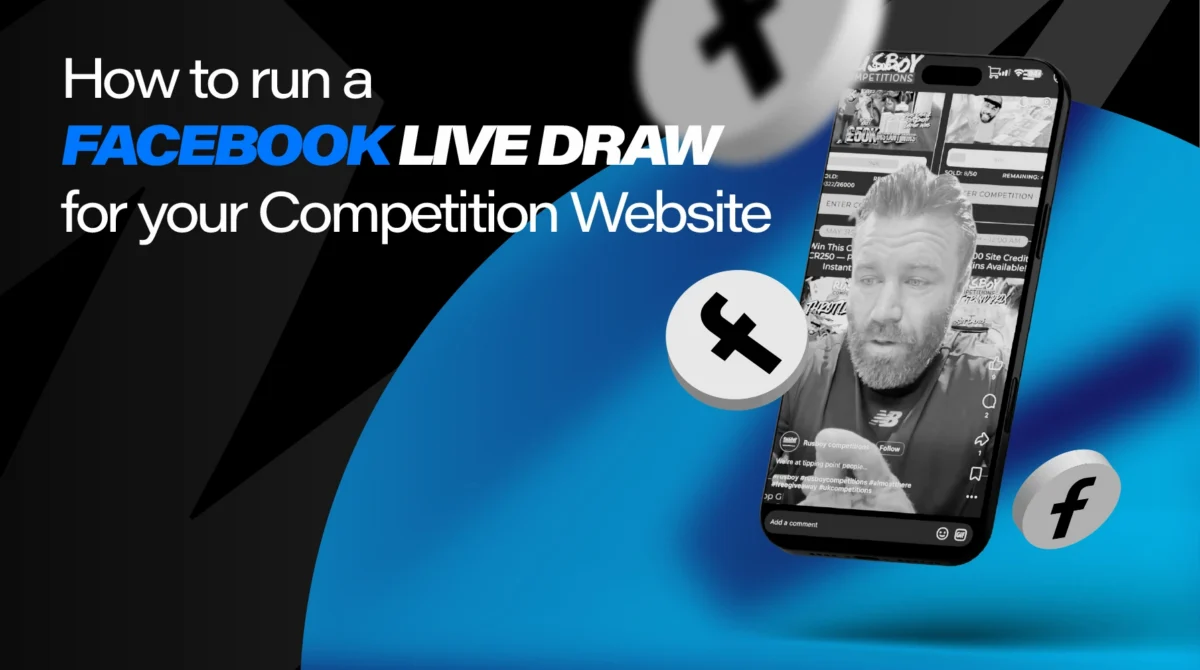
Some operators use a physical ball machine and this is a legitimate and highly engaging approach. Russell from Rusboy Competitions uses a ball machine for draws, holding each ball clearly up to the camera so viewers can read the number, then calling the winner live on the stream for additional social proof. Russell uses Streamlabs to broadcast across all his channels simultaneously. The ball machine approach, particularly combined with the pick-your-own-number system where entrants choose their ticket numbers rather than being allocated them randomly, builds strong audience engagement because entrants watch the live specifically to see if their chosen number is drawn.
One limitation of the ball machine is that it restricts your maximum ticket count to however many balls you physically have. This is manageable for operators running competitions with capped ticket numbers but becomes a constraint at higher volumes. The pick-your-own-number system also places additional load on the competition website because the platform has to display all available numbers for selection. On sites that are not optimised for this, it can slow page load times during peak periods. This is a build consideration worth discussing with your web developer before implementing the feature.
What you should not use is a wheel spinner or any tool that cannot be independently audited. Wheel spinner tools can be pre-configured and are not verifiable in the same way as Google’s RNG. They should be avoided for any paid-entry competition draw.
How do you prepare for a Facebook Live Draw?
Preparation is where most draw problems originate. Operators who treat the live draw as a simple announcement and go live without preparation regularly encounter technical failures, data errors, and compliance issues that undermine audience trust.
Check your Facebook page eligibility first
New Facebook pages cannot go live for the first 60 days after the page is created. This is a Facebook platform restriction that catches new competition operators out regularly. If you launch your competition website and immediately plan a live draw to close your first competition, you may find your Facebook page is not yet eligible. Plan your first draw date to fall after the 60-day threshold.
New pages are also sometimes flagged as not eligible for recommendations by Facebook, which limits organic reach significantly. We have seen this happen to established, long-running competition operators as well as new ones, which makes it even more important to have paid advertising running during this period. If your Facebook page loses recommendation eligibility, organic reach drops sharply and paid ads become the primary channel for driving draw-day entries. This is not a permanent restriction but it reinforces why competition operators should not rely on organic Facebook reach alone.
Export and prepare your entry list
Before the live, export your full entry list from your competition website as a spreadsheet. Then remove all sensitive data columns before the draw. The spreadsheet you display on screen during the live draw should contain only ticket numbers and the competition name. It must not include names, email addresses, phone numbers, or postal addresses. Displaying personal data on screen during a public live stream is a GDPR data breach.
The ticket numbers are all viewers need to verify the draw is legitimate. Most entrants will know their own ticket numbers from their entry confirmation email and can cross-reference immediately if they need to.
Set your entry cut-off time and close the competition before going live
The competition must be closed to new entries before the draw begins. Going live while entries are still open creates ambiguity about which entries are included in the draw pool. Close entries at least 30 minutes before the scheduled draw time and confirm the final entry count before starting.
Note the Cashflows draw duration requirement for some operators
If your competition website processes payments through Cashflows, note that Cashflows may require individual competition draws to run for a maximum of 30 days for some new operators. This is a merchant agreement condition rather than a universal rule, but it is worth checking your specific agreement before scheduling long-running draws. Operators who are unsure should confirm directly with Cashflows during onboarding. For more detail on what Cashflows requires before approving a competition merchant, see our guide to the best UK payment gateways for competition websites.
Promote the draw in advance
Send an email to your mailing list at least 48 hours before the draw with the exact date and time. Post on your social channels the day before and on draw morning. The majority of tickets on most competition websites sell in the final 24 to 48 hours before the draw closes, so your pre-draw marketing and the draw announcement itself are the two highest-leverage communication moments in the competition lifecycle.
What should you do on the day of the draw?
Draw day is the most commercially important day in the competition calendar. For most competition websites, ticket sales spike significantly in the hours before the draw closes. Your activity on draw day should serve both the compliance requirements of the draw itself and the commercial goal of maximising final-hour sales.
Time your draw close and live strategically
One of the most effective conversion tactics across competition websites is setting the draw close time and then going live approximately 30 minutes after the competition ends rather than immediately. For example, if a draw closes at 7pm, scheduling the live draw for 7:30pm creates a 30-minute window on draw day where you can run a final push on paid advertising, send email and SMS notifications to your list, and drive last-minute entries from people who see the draw is about to close.
Competition websites that use this 30-minute window effectively see significantly higher final-day conversion rates compared to those that run the draw immediately at close. The final 30 minutes before a draw ends consistently produces the highest entry volume of the entire competition run, and a scheduled live time that is slightly after close gives you a concrete endpoint to drive urgency toward.
For operators with a mobile app, push notifications can be sent directly to users at draw-day intervals at no additional cost, producing strong conversion lifts because they appear directly on the entrant’s phone screen. Our app development service at neramarketing.wpenginepowered.com/competition-websites/apps/ covers push notification infrastructure as part of the build.
Email and SMS notifications sent on draw day, particularly in the final two to four hours before close, are the highest-performing communications in the competition lifecycle for driving last-minute entries. Operators who send a draw-day reminder email to their full list consistently see a measurable spike in entries within the hour following send. For more on reducing abandoned entries on competition websites, including email sequence timing and checkout recovery, see our dedicated guide.
Consider a pre-draw teaser live
A short live stream 30 to 60 minutes before the main draw, showing the current entry count, the prize, and the draw mechanics, builds anticipation and gives late entrants a final prompt. This does not need to be polished. A brief, authentic update that shows you are present and engaged is more effective than a scripted presentation.
Set up your technical equipment
Most operators use their smartphone for the live draw and this is entirely acceptable. A modern smartphone camera and microphone are sufficient for a draw that needs to be clear and credible, not cinematic.
If you want to stream to multiple platforms simultaneously, Streamlabs is the standard tool. Streamlabs Desktop is free and allows you to stream to a single platform. The Streamlabs Ultra plan at $27 per month (approximately £21 per month) allows simultaneous streaming to Facebook, Instagram, TikTok, YouTube, and other platforms in a single broadcast. An alternative approach that costs nothing is using multiple devices: a laptop for Facebook Live and a phone for Instagram Live simultaneously, no software required. Both devices run their own live stream from the same draw setup.
Ensure you have a stable internet connection before going live. A wired connection is more reliable than Wi-Fi. Run a speed test beforehand. A live draw that drops out mid-stream creates a trust problem that is difficult to recover from.
Set up your backdrop, ensure your lighting is adequate, and check your audio. A plain background with a branded banner if you have one is sufficient. Turn off all notifications on any device that will be visible during the stream.
Test everything before going live
Start a test stream set to Only Me visibility on Facebook and check that your RNG tool is visible on screen, your audio is clear, your lighting is adequate, and your entry list spreadsheet is ready and showing only ticket numbers. Do this test at least 15 minutes before the scheduled draw time.
What must you show on screen during the live draw?
Viewers need to see enough to verify that the draw is genuine and fair. The minimum required on screen during the draw is:
- The random number generator tool, whether Google’s RNG, the built-in site RNG, or a physical ball machine, visible and active
- The minimum and maximum values entered into the RNG (1 to total number of valid entries) so viewers can see the pool is correct
- The winning number being generated in real time
- The ticket number list (showing ticket numbers only, no personal data) so viewers can see the winning number corresponds to a real entry
After the number is generated, confirm the winning ticket number clearly on camera, state it verbally, and show it on screen. Read it out more than once. Viewers who are watching on small phone screens need clear verbal confirmation as well as the visual.
Announce that you will be contacting the winner privately and state the timeframe. Most competition websites use a 48 to 72 hour window for the winner to respond before an alternative winner is drawn.
What should you never show on screen during a live draw?
This is the section that operators most commonly get wrong, and the consequences are serious.
Never show a full entry list that includes names, email addresses, phone numbers, or postal addresses on screen during a public live stream. Doing so constitutes a GDPR data breach. The personal data of every person whose details appear on screen has been disclosed to every viewer of the live stream, and potentially to everyone who views the replay. Under UK GDPR, this is a reportable breach that should be notified to the ICO within 72 hours.
Nera has documented at least one instance of a competition operator broadcasting a full entry export during a Facebook live draw, including names and postal addresses of entrants. This type of breach is not theoretical. It happens regularly because operators export their entry list without removing sensitive columns before the draw.
The correct process is always to prepare a sanitised spreadsheet showing ticket numbers only before the draw begins. This takes two minutes and eliminates the data breach risk entirely.
Also do not show:
- Your competition website admin panel if it displays customer data
- Any order management screen that contains customer contact details
- Chat messages or comments that include personal information shared by viewers
How do you announce and contact the winner after the draw?
Contact the winner privately within 24 hours of the draw. Do not post the winner’s full name, address, or contact details publicly. Announce the winning ticket number publicly, but contact the winner through a private Facebook message or direct message to claim their prize.
Your competition terms and conditions should specify the response timeframe. Most UK competition websites use 72 hours as the standard. If the winner does not respond within the specified period, the terms should permit you to draw an alternative winner.
When contacting the winner, confirm their name, the prize, the delivery method, and any additional information needed for prize fulfilment. Record this communication as part of your draw audit trail.
Building your draw audit trail
Every draw should have a documented audit trail that includes:
- The total number of valid entries at draw close
- The entry list export (with full data, stored securely, not published)
- A screenshot or recording of the RNG generating the winning number
- The winning ticket number and the entrant it corresponds to
- A record of when the winner was contacted and when they responded
- Confirmation of prize delivery
If an entrant ever challenges the draw outcome, this documentation is your defence. Without it, any challenge becomes your word against theirs.
Publish the winning ticket number on your social media and website after the winner has confirmed. Publishing draw outcomes publicly satisfies the winner transparency requirements of the DCMS Voluntary Code of Good Practice (effective 20 May 2026) and builds long-term audience trust.
How do you use the live draw to sell tickets for your next competition?
The live draw is the highest-engagement moment in your competition calendar. Your audience is concentrated, emotionally invested, and watching in real time. Used correctly, it is one of the most effective marketing moments available to a competition operator.
Before the draw closes, publish the details of your next competition prominently on your website and social channels. During the pre-draw teaser live, mention the next competition briefly and direct viewers to the website.
At the end of the draw live stream, after announcing the winning ticket number, tell viewers what is coming next. State the prize for the next competition, the ticket price, and when it opens. End with a direct CTA to visit the website.
The period immediately after a live draw, when audience attention is highest and brand credibility has just been reinforced by a fair and transparent draw, is the best possible moment to drive first entries into the next competition. Operators who move immediately to the next competition at the end of the draw consistently outperform those who treat the draw as the end of the marketing cycle rather than the beginning of the next one.
For operators looking to build the marketing infrastructure around their competition website, including email sequences, draw day campaigns, and social media strategy, our competition website design and build service covers marketing setup as part of the full launch package.
The randomisation method is the part Meta’s reviewers and the UK regulator both check. Nera Marketing builds randomisation logic that is verifiable on camera and traceable in the audit log.
Facebook Live draws are the single highest-trust mechanic in UK competition sites, but they fail compliance more often than any other format. Nera Marketing has supported launch teams on dozens of Live draws and the failure points are predictable.
Ready to build your competition website?
Join hundreds of operators running prize draws with NERA's platform.
Talk to us →