


TLDR
The Voluntary Code of Good Practice for Prize Draw Operators is a set of standards published by the Department for Culture, Media and Sport (DCMS) in November 2025. It applies to UK prize draw operators running competitions with both paid and free entry routes. Compliance is expected by 20 May 2026. The code is not currently law, but payment providers including Cashflows are already enforcing several of its requirements at infrastructure level, making compliance effectively mandatory for operators who want stable merchant accounts and advertising access.
Key points:
- Published by DCMS on 21 November 2025, updated 23 February 2026
- Applies to prize draws in Great Britain where winners are selected by chance and both paid and free entry routes exist
- Does not apply in Northern Ireland
- Three pillars: player protections, transparency, and accountability
- Implementation deadline for signatories: 20 May 2026
- Credit card payments capped at £250 per month per player; credit cards banned entirely on instant win draws
- Players must be able to suspend accounts for a minimum of six months
- Non-compliance carries no automatic legal penalty, but creates real risk across payment onboarding, advertising approvals, and consumer trust
Nera Marketing is a signatory to the code. The guidance in this article reflects direct implementation experience across active competition websites, not theory.
What is the Voluntary Code of Good Practice for Prize Draw Operators?
The Voluntary Code of Good Practice for Prize Draw Operators is a non-statutory code developed by DCMS to raise player protection and transparency standards in the UK prize draw sector. Nera Marketing is a listed signatory as a platform provider. It was published on 21 November 2025 and updated on 23 February 2026, following an extended consultation process that began with the Gambling White Paper in April 2023 and drew on a detailed market study commissioned from London Economics. The full text of the code is available on GOV.UK.
The code is not legally binding in the same way as the Gambling Act 2005 or Consumer Rights Act. Operators who sign up commit to implementing it voluntarily. However, DCMS has made clear that it will consider further regulatory intervention if the industry does not engage seriously with the code’s requirements, a warning widely interpreted as a signal of potential statutory regulation if voluntary uptake is insufficient.
The code focuses specifically on competitions where participants can choose between a paid entry route and a free entry route. Its purpose is to ensure that the growing number of consumers participating in prize draws do so safely, with clear information, genuine choices, and appropriate safeguards in place. Over 150 operators had signed up by the time of the February 2026 update, joined by 22 other sector signatories including trade bodies and platform providers, Nera Marketing among them.
Which platform providers have signed the Voluntary Code?
Nera Marketing is a signatory as a platform provider rather than as an operator. Operators sign to commit their own competitions to the code. Platform providers sign to commit the sites they build. That distinction matters when choosing a builder, because a platform provider signatory has already implemented the requirements of the code at build level: the £250 monthly credit card cap, the instant win credit card block, genuine free entry routes, and player spending limits including a £0 limit.
The signatory list is split into two groups. Operator signatories are the businesses running prize draws. Other relevant signatories are organisations connected to the sector that do not run draws themselves, and the code names web developers as an example. That second group agrees to promote compliance with the code to the best of their abilities rather than being assessed as operators.
As at 1 September 2026 there were 189 operator signatories and 34 other relevant signatories. Nera Marketing is in the second group. So are several other competition website providers, so signatory status on its own tells you an agency has signed. It does not tell you how much of the code it actually builds in.
Who does the Voluntary Code apply to?
Nera Marketing builds to the code on every site regardless of whether the operator signs. The code applies to prize draw operators in Great Britain (England, Scotland, and Wales) who run competitions with both a paid entry route and a free entry route, where winners are selected by chance. It does not apply in Northern Ireland, which operates under separate legislative arrangements.
Specifically, the code covers:
- Online prize draw and competition websites offering both paid and free entry
- Instant win prize draw operators where entry can be paid or free
- Operators offering chance-based draws through digital platforms
- Blended operators running both prize draws and skill-based competitions
The code does not directly apply to:
- Genuine skill-based competitions under Section 14 of the Gambling Act 2005
- Society lotteries already licensed by the Gambling Commission
- Pure charitable lotteries covered by existing lottery regulations
In practice, many competition websites use blended models that sit partly within the code’s scope. The distinction between a prize draw and a skill-based competition is covered in detail in the guide on skill-based competitions vs prize draws in the UK. Even where an operator’s primary model is skill-based, following the code’s transparency and accountability principles is considered best practice by payment providers and advertisers, and increasingly by consumers.
Why did DCMS introduce the Voluntary Code in 2025?
The code emerged from sustained government concern about the rapid growth of the online prize draw sector and the potential for consumer harm. The market research that underpinned the code, carried out by London Economics, produced findings that made a policy response difficult to avoid.
The UK prize draw sector is now worth an estimated £1.3 billion annually. Over 7.4 million adults participate, with more than 400 operators active in the market. The London Economics research found that prize draw participants are significantly more likely to also be engaged in licensed gambling than the general population, with approximately 88 per cent of prize draw players having some involvement in commercial gambling, compared to around 60 per cent of the general adult population. Critically, those already experiencing gambling-related harm were more likely to enter prize draws more frequently and spend more.
The government’s concern was clear: prize draws are not classified as gambling under current legislation because of the free entry route requirement, but their behavioural profile and harm patterns overlap significantly with regulated gambling products. The Voluntary Code is the government’s first structured attempt to reduce that harm risk without immediately bringing the entire sector under Gambling Commission licensing.
The code also reflects pressure from payment providers and advertising platforms, who had been increasingly applying their own restrictions to competition websites with weak compliance structures. Formalising a set of standards gives the sector a shared framework to point to during merchant underwriting and advertising account reviews.

What are the three pillars of the Voluntary Code?
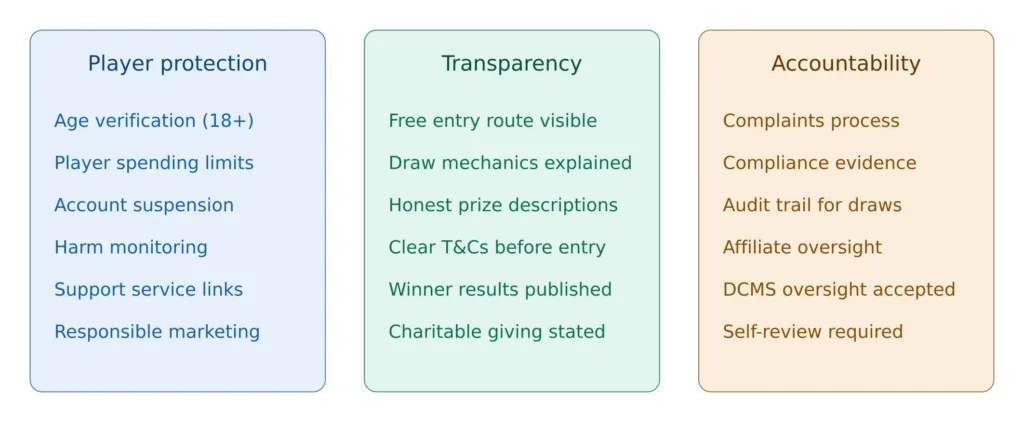
The code is organised around three principles that apply to every requirement it sets out.
Player protection requires operators to put measures in place that reduce the risk of harm and support responsible participation. This includes age verification, spending controls, the ability for players to take breaks, and active monitoring for signs that a player’s participation may be causing harm.
Transparency requires competitions to be straightforward and honest. Rules must be clear, entry routes must be presented fairly, draw mechanics must be explained, and significant conditions must be visible before a player enters. Free entry routes must be genuine and must not be designed to discourage use.
Accountability requires operators to be able to demonstrate that they follow the code and to have systems in place for handling complaints, reviewing their own compliance, and acting on problems when they arise. Publishing how the code is being implemented is expected, not optional.
What does the Voluntary Code require prize draw operators to implement?
The code sets platform-level requirements, not just written policies, which is why Nera Marketing builds them as functional features rather than terms updates. Each requirement below represents a structural or operational change, not a wording update to terms and conditions, and the technical implementation for each clause is covered in a separate guide.
Does the code require age verification?
Yes. All prize draw competitions must be restricted to players aged 18 and over, and operators are expected to carry out appropriate age verification rather than relying solely on self-declaration. A basic “tick the box to confirm you are 18” does not satisfy the code’s expectations. Age verification should be implemented at account registration, not just at checkout.
What credit card limits does the code introduce?
The code introduces two specific payment controls designed to reduce financial harm. First, credit card payments are capped at £250 per month per player across all draws on a platform. Second, credit card payments are banned entirely for instant win prize draws, regardless of transaction size.
These controls are not just implementation requirements for operators. Cashflows, a specialist competition payment provider and the preferred partner for Nera-built sites, is already building these controls directly into its payment infrastructure. This means that operators processing through Cashflows benefit from automatic enforcement of the £250 monthly credit card cap and the instant win credit card block at gateway level, without needing to implement their own transaction logic. Operators still using standard providers such as Stripe or PayPal on default accounts have neither the code-required controls nor the sector-specific risk tolerance in place.
The payment controls limit financial harm at checkout. The mechanic design itself separately determines whether an instant win stays a lawful prize draw or crosses into regulated gaming product territory. For the formats that work in the UK and the visual conventions to avoid, see Instant Win Competition Mechanics in the UK.

The guide to the best UK banks and payment providers for competition sites covers which providers are currently aligned with these requirements.
Are spending limits required?
Yes. Operators must allow players to set their own monthly spending limits, including the option to set a limit of £0, which functions as a self-exclusion from spending. These limits should be easy for players to access and update. They should not be buried in account settings or require a support request to change.
What account suspension options must operators provide?
Players must be able to suspend their account for a minimum period of six months. The suspension should be self-serve, effective immediately, and should prevent both login and further participation. It should also trigger removal from marketing communications, so that a player who has taken the step of suspending their account is not subsequently targeted with promotional emails or SMS messages encouraging them to return.
Players must also be able to close their account permanently.
What are the player monitoring requirements?
Operators must have systems in place to monitor player activity from account opening, identify patterns that may indicate developing harm, and take reasonable intervention steps when those patterns are identified. The code also requires that signposting to relevant support services is available to players. Named services include Citizens Advice, National Debtline, the Samaritans, and Mind.
Effective harm monitoring must be built into the platform, not documented only in a policy. Identifying harm retrospectively after a complaint is not sufficient.
What does the code require for complaints handling?
Every competition website must have a clear, accessible complaints process. This means a dedicated complaints page, a defined response time commitment, a clear contact route, and an escalation process explanation. The absence of a complaints page is one of the most common structural gaps on UK competition websites, and it is one of the triggers that increases friction during merchant underwriting with payment providers.
What are the free entry route requirements?
The code places strong emphasis on free entry routes being genuine, visible, and accessible. A free entry route must be displayed prominently, not buried in terms and conditions or provided only via PDF download. It must be positioned at equal visual prominence to the paid entry option, must be explained clearly before checkout, and must not be structured in a way that discourages access. The Gambling Commission’s guidance on free draws sets out the legal basis for this requirement and what constitutes a compliant free entry route.
Postal entry details must be accessible without requiring navigation through multiple pages. The free route must have a realistic and usable deadline, not one that functionally excludes most participants. Competitions that cannot be entered genuinely without payment fail the code’s transparency requirement, regardless of what the terms say.
What transparency is required around draws and winners?
Operators must clearly explain how winners are selected, including the method used to allocate entries and select winners. Draw timing must be appropriate, meaning sufficient time between a competition opening and concluding to allow meaningful participation. Prize details must be accurate and must not be downgraded or cancelled without clear stated rules covering that scenario.
Winner publication should go beyond social media posts. Best practice, and increasingly the expected standard, is a dedicated winners hub on the site with a searchable archive, clear draw dates, and timestamped outcomes. This reduces consumer complaints, strengthens merchant underwriting confidence, and builds the kind of trust that drives repeat participation.
What does the code say about charitable contributions?
Where an operator promotes a charitable or good cause element, the code requires that the amount going to charity is stated clearly, the recipients are named, and the frequency of donations is disclosed. Operators who reference charity without substantiating it risk both ASA/CAP Code action and reputational damage with consumers who expect transparency in this area.
What are the third-party and affiliate compliance requirements?
Operators are responsible for ensuring that their affiliates and third-party partners also comply with the code’s standards. This means having contractual arrangements in place that require compliance, with the ability to terminate arrangements where a partner is not meeting those standards. Affiliate marketing that promotes prize draws in misleading or high-pressure ways creates liability for the operator, not just the affiliate.
What website changes do UK prize draw sites need to make before May 2026?
Not sure where your site stands?
We review existing competition websites against the code’s requirements
Operators that Nera Marketing onboarded as Voluntary Code signatories started preparing for the Code in late 2025. The early movers finished the compliance load well before the May 2026 deadline.
If your site was built before November 2025, it is likely missing at least some of the structural changes the code requires. We can tell you exactly what needs updating before May 2026.
Most UK competition websites built before 2025 were structured around basic free entry route wording, a standard terms page, a generic winner announcement, and minimal complaint handling. The code requires structural changes in six areas.
| Area | Common current state | What the code requires |
|---|---|---|
| Free entry route | Explained only in T&Cs or hidden below fold | Visible on each competition page, equal prominence to paid entry |
| Winner publication | Instagram posts or temporary stories | Dedicated winners hub with searchable archive |
| Complaints | No dedicated page or process | Dedicated page, defined response time, escalation route |
| Payment controls | No monthly credit card cap, no instant win restriction | £250/month cap and credit card ban on instant wins |
| Account tools | No suspension or spending limit functionality | Player-controlled limits, minimum six-month suspension option |
| Age verification | Checkbox self-declaration only | Appropriate verification at account registration |
Operators reviewing their sites ahead of May 2026 should treat this as an operational upgrade. The same structural gaps that create code non-compliance are the ones that cause payment provider friction, advertising account rejections, and higher chargeback rates. Fixing them improves every commercial outcome, not just regulatory standing.
Does the Voluntary Code apply in Northern Ireland?
No. The Voluntary Code of Good Practice for Prize Draw Operators applies to Great Britain only, meaning England, Scotland, and Wales. Northern Ireland is not covered by the code. Prize draw operators running competitions in Northern Ireland should take independent legal advice on the applicable framework, as different legislative arrangements apply there.
How is the Voluntary Code already being enforced by payment providers?
Payment providers treat competition websites as high-risk merchants, and Nera Marketing sees code requirements arriving in underwriting questions. The code has accelerated a change that was already under way: specialist payment providers are now building code requirements directly into their infrastructure rather than treating them as advisory.
Cashflows, which processes payments for competition websites built and managed by Nera, has confirmed that it is implementing the £250 monthly credit card cap and the credit card restriction on instant win competitions at payment gateway level. This means these controls are active regardless of whether the operator has configured them separately on their platform. For operators using Cashflows, enforcement of these two specific requirements is automatic.
The broader underwriting process at specialist providers already reflects code expectations. During onboarding, underwriters review free entry route visibility, draw transparency, terms and conditions clarity, complaints handling structure, and evidence of winner publication. Sites that fall short on these points face longer onboarding timelines or conditional approval requiring remediation before funds are released.
For operators still using standard providers, neither the payment controls nor the sector understanding is in place. This creates risk on two fronts: the operator is not meeting code requirements, and the provider may restrict or close the account once the business type is properly identified. The guide on why payment providers reject competition websites covers each trigger and how to address them.
What happens after you sign the Voluntary Code?
Signing is not the end of it. DCMS checks.
The code launched on 20 November 2025 and gave signatories six months to implement it. That period ended on 20 May 2026. In September 2026 DCMS opened its first compliance review, contacting signatories directly and asking them to evidence their position against every clause.
Nera Marketing is a signatory, listed in the web developer category, and we received that assessment. This is what the process looks like in practice.
Who contacts you
The email comes from the DCMS Prize Draws Team, sent from the Prize Draw Code Mailbox. The code publishes prizedrawcode@dcms.gov.uk as the contact address for the team, and it is the same address used for feedback on the code and for requests to become a signatory.
An assessment form is attached as a Word document. It allows two weeks to complete and return. DCMS asks you to say if you cannot meet that deadline, so the date is not absolute where there is a genuine reason.
What the assessment form asks for
The form opens with four organisation details: organisation name, organisation website URLs, the name and email address of the representative responsible for the compliance check, and the date of assessment.
The third one catches operators out. You need a named individual who owns code compliance. If you have not appointed one, do it now rather than at the point the email lands.
The rest of the form is three tables, one for each pillar of the code, following the code’s own clause numbering. Eleven rows for player protections, clauses 1.1 to 1.11. Six rows for transparency, clauses 2.1 to 2.6. Five rows for accountability, clauses 3.1 to 3.5. Twenty two rows in total.
Each row sets out the requirement, then the additional detail behind it, then leaves a blank column for your confirmation of compliance. That column asks you to include any additional information evidencing compliance.
Evidence is the word that matters. A tick is not an answer. You are expected to show how each requirement is met, which in practice means live URLs, published policies, screenshots and dated records. Our guide on how to comply with the Voluntary Code works through what each clause requires.
DCMS states that the information you share is handled sensitively and is not shared outside the department.
What happens if you cannot evidence compliance
DCMS reserves the right to remove signatories where the code’s provisions are being breached and those breaches are not rectified within a reasonable timeframe.
Removal is public. The signatory list on GOV.UK carries a dated change history recording every addition and removal. Ten signatories were removed in the update of 1 September 2026 alone. The change history does not give reasons, so a removal is not by itself evidence of a breach, but the record is permanent and public.
That visibility is the point. Consumers are meant to be able to look at the list and read it as a signal that an operator is a responsible practitioner.
How to prepare for the compliance assessment
Most of the evidence is your own website. Clause 3.4 requires operators to publish all of the measures they have in place for player protections, transparency and accountability, and to display their adherence to the code transparently on their site. The pages that satisfy the code are the same pages you point DCMS at.
Appoint the named compliance representative. Keep an evidence file mapped to the 22 clause numbers with a live URL against each one. Then fix the gaps you already know about, because a rectified breach is a different conversation to an outstanding one.
What happens if a prize draw operator ignores the Voluntary Code?
Since September 2026 there has been a direct consequence from DCMS itself. The department is reviewing signatories against every clause of the code and reserves the right to remove any signatory whose breaches are not rectified within a reasonable timeframe. Removals are recorded on the GOV.UK signatory list with the date they happened.
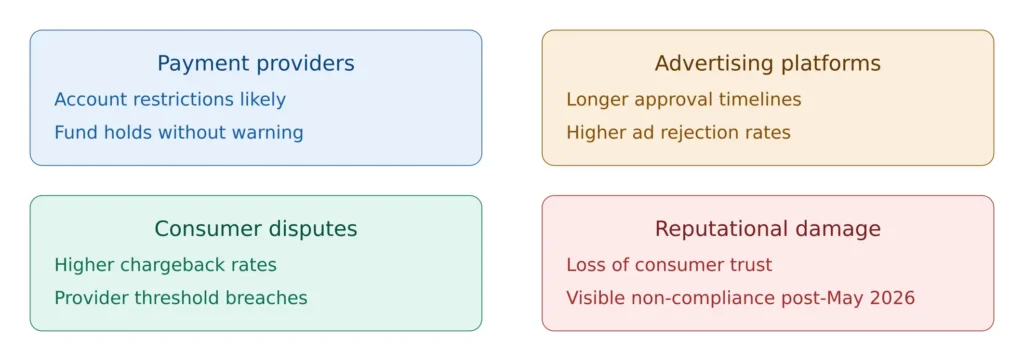
There is no automatic legal penalty for not adopting the code. However, ignoring it creates real risk across four areas.
Payment providers: Weak compliance structure increases underwriting friction. Some providers are now using code compliance as a criterion during account reviews. Account restrictions and fund holds are the most common consequences, and they can occur without warning.
Advertising platforms: Meta and Google both review operator websites before approving advertising accounts in this category. Operators without visible complaints handling, responsible operation pages, or clear free entry route implementation face longer approval timelines and higher rejection rates. The ASA CAP Code rules on promotional marketing and prize draws set out the advertising standards that apply in parallel with the code’s requirements.
Consumer disputes: Operators with unclear rules, hidden free entry routes, and no complaints process generate higher chargeback rates. A single chargeback threshold breach can trigger payment provider account review.
Reputational damage: The UK prize draw market is competitive and increasingly consumer-aware. Operators who are publicly identified as not following the code, particularly as the May 2026 deadline passes, risk losing consumer trust in a sector where trust is the primary conversion factor.
Where no relevant trade body exists to address a complaint about a non-compliant operator, the code allows concerns to be referred directly to DCMS for determination.
Will the Voluntary Code become law?
The code is currently voluntary. The direction of travel suggests that this may not remain the case indefinitely.
DCMS has since been explicit about the link. In its September 2026 correspondence with signatories, the department stated that the success of the code will determine whether any further regulatory action is taken, including legislation. Sector-wide compliance is what keeps this voluntary. Weak compliance is the argument for statutory rules.
The government has gathered detailed market data through the London Economics study, created a formal code with a defined implementation deadline, and signalled clearly that further intervention is possible if voluntary uptake is insufficient. The parallel publication of Gambling Commission consumer landscape research in November 2025 reinforced the message that regulators are watching the sector closely.
The fact that payment infrastructure is already aligning with the code’s requirements is a significant signal. When financial infrastructure starts enforcing standards independently of legislation, it often precedes formal regulatory alignment. The loot boxes precedent is instructive here: a voluntary code approach followed by sustained pressure eventually leading to formal consultation.
The Lotteries Council has publicly argued that the code creates regulatory imbalance, since society lotteries are capped at £500,000 prizes and heavily regulated, while prize draw operators can offer multi-million pound prizes with substantially lighter obligations. That argument is unlikely to reduce regulatory pressure on prize draws; if anything, it increases the likelihood that the sector will face tighter formal requirements over time.
Operators who build to meet or exceed the code now are buying protection against disruptive mandatory changes later. Building compliance architecture into a site from the start costs less and disrupts operations less than retrofitting it under regulatory pressure.
How do compliant competition website builds handle the code requirements?
Modern competition websites built with compliance architecture from the start incorporate the code’s requirements as functional features rather than documents. The essential features every professional competition website needs covers the full functional specification in detail, including which of those features are now required under the code.
Payment limit controls are either built into the checkout flow or enforced at gateway level through the Cashflows partnership, meaning the £250 credit card cap and instant win credit card restriction are active from launch without requiring custom development.
Account suspension and spending limit tools are built into the membership and account system, giving players self-serve access from their dashboard. Suspension triggers automatic removal from marketing lists, preventing re-engagement campaigns from reaching suspended accounts.
The signatory commitment Nera Marketing made was deliberate. We wanted to be inside the implementation conversation, not catching up after the fact.
Free entry routes are positioned at equal visual prominence to paid entry on every competition page, with postal entry details on a standalone page linked directly from competition pages and checkout.
Winner archives are structured as a searchable, filterable hub with draw dates, prize details, and winner confirmation. Draw mechanics are documented in a transparent format accessible from the competition page itself.
Age verification is implemented at account registration, not just at the point of self-declaration.
Complaints handling is a standalone page with a defined response time, an escalation route, and a record-keeping procedure.
This approach reduces friction across advertising approvals, merchant underwriting, and consumer trust. Sites built this way do not need to make emergency structural changes in response to code requirements; they are already meeting or exceeding them. Our UK competition website design service is built around these standards, helping operators launch correctly and grow with confidence.
Voluntary Code compliance checklist for prize draw websites
The checklist below summarises the structural work that needs to be complete by 20 May 2026, distilled from our full implementation guide. Items marked with an asterisk are those where payment providers are already enforcing compliance independently.
- Free entry route clearly visible on each individual competition page
- Free entry route not explained only in T&Cs or via PDF download
- Free entry positioned at equal visual prominence to paid entry
- Postal entry address accessible without requiring multiple navigation steps
- Dedicated winners hub with searchable archive of past draws
- Draw dates and draw selection method clearly explained
- Significant conditions visible above the fold on competition pages
- Dedicated complaints page with defined response time and escalation route
- Age verification implemented at account registration
- Credit card monthly limit of £250 enforced per player* (via platform or payment provider)
- Credit cards blocked on instant win competitions* (via platform or payment provider)
- Player-controlled spending limits available, including £0 option
- Minimum six-month account suspension option available and self-serve
- Suspension triggers removal from marketing communications
- Permanent account closure option available
- Player monitoring systems in place to identify harm patterns
- Signposting to Citizens Advice, National Debtline, Samaritans, and Mind
- Responsible participation statement published on the site
- Transparent T&Cs covering prize cancellation and low-ticket scenarios
- Third-party affiliate contracts include code compliance requirements
If several items are missing, the site requires structural updates rather than cosmetic changes. A site that fails on payment controls, account suspension, and free entry route visibility is not a wording problem. It requires functional build work.
Ready to build it right?
Every Nera competition website is built to meet the code from day one
Payment controls, account suspension tools, free entry route implementation, winner archives, all built in, not bolted on. Get in touch to talk through what a compliant build looks like for your competition concept.
Ready to build your competition website?
Join hundreds of operators running prize draws with NERA's platform.
Talk to us →