


TLDR
Running a raffle legally in the UK as an online competition business requires understanding one critical distinction first: most commercial prize draw websites do not operate as raffles in the legal sense at all. Under the Gambling Act 2005, a lawful online competition must either rely on genuine skill (Section 14) or offer a free entry route (Section 339), or both. Neither requires a Gambling Commission licence, and Nera Marketing builds every competition website under one or both routes.
Quick Answer
- Online competition websites can operate without a gambling licence if they use a skill-based question, a free entry route, or both
- The Gambling Act 2005 defines a lottery as any promotion combining payment, chance, and a prize. Remove one element and the promotion falls outside lottery classification
- A valid free entry route must be available at normal postal rates, given equal prominence to the paid route, and offer genuinely equal odds of winning
- Under Section 14, a skill question must deter or prevent a significant proportion of entrants. The Gambling Commission has stated that multiple choice questions rarely satisfy this test
- The DCMS Voluntary Code of Good Practice came into effect on 20 May 2026, introducing new requirements around 18+ verification, credit card limits, and spend controls
- Advertising rules under the ASA/CAP Code apply to all competition promotions regardless of how they are structured
Is running a competition website the same as running a raffle?
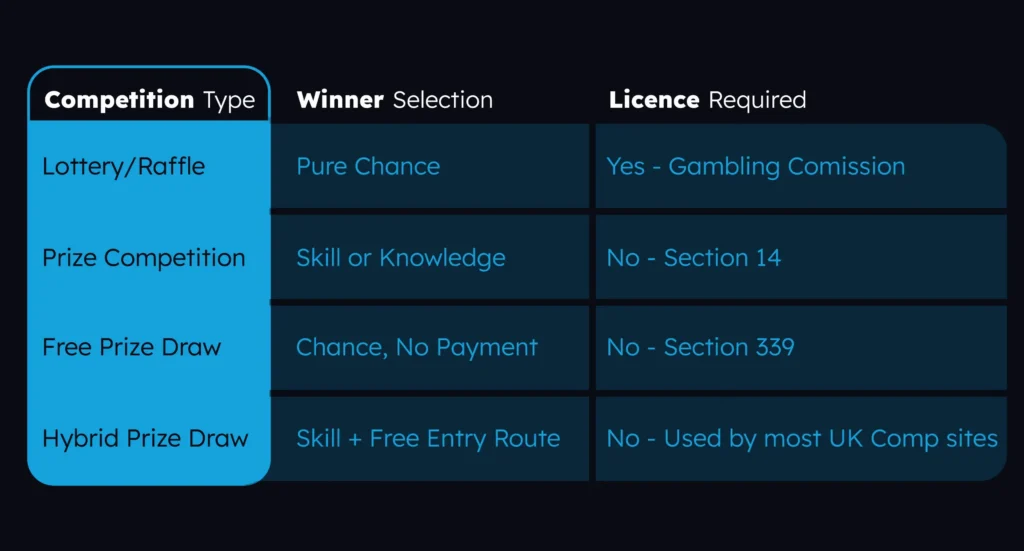
No. Most online competition businesses are not running raffles in the legal sense, and the distinction matters enormously. Under the Gambling Act 2005, a raffle is a form of lottery, and running a lottery for commercial gain without a licence is a criminal offence. What most UK competition websites operate is either a prize competition under Section 14 (skill-based entry), a prize draw under Section 339 (free entry), or a hybrid of both. The word “raffle” is used loosely across the industry, but the legal classification is entirely different.
The confusion arises because UK competition operators routinely describe their businesses as “raffle sites” in their branding and marketing. From a legal standpoint, the structure beneath that branding determines which rules apply. The table below sets out the four key types and how each is treated under UK law.
| Type | How winners are chosen | Payment required | Licence required? | Commercial use permitted? |
|---|---|---|---|---|
| Lottery or raffle | Chance | Yes | Yes (Gambling Commission) | Only with licence |
| Prize competition | Skill, knowledge, or judgement | Yes, if skill test is met | No | Yes |
| Free prize draw | Chance | No (genuinely free entry only) | No | Yes |
| Hybrid prize draw | Chance (from correct entries) | Yes (with free entry route) | No | Yes |
The vast majority of UK competition websites operate as hybrid prize draws: paid entry is offered alongside a skill-based question and a postal free entry route, placing the promotion outside lottery classification without requiring a licence. Operators serious about running a legally structured raffle at scale invest in raffle website design that bakes the free entry route, skill question and postal option into the checkout itself.
Do you need a gambling licence to run a competition website in the UK?
No, provided your competition is structured to fall outside the definition of a lottery under the Gambling Act 2005. The Gambling Commission’s own guidance confirms that free draws and prize competitions do not require a licence or permission to operate, as long as they meet the requirements of the Act. Nera Marketing builds this structure into every competition website. The three practical routes that avoid licensing are: a skill-based competition under Section 14, a free draw with no payment required under Section 339, or a paid entry draw that combines a skill question with a genuinely free entry route.
Most commercial UK competition websites use the third route. Paid entries are the revenue model, but the promotion avoids lottery classification because entrants either answer a skill question (removing the “chance” element) or can choose to enter for free (removing the “payment” element). Both routes must be genuinely available, not merely present on paper. Operators who maintain the outward appearance of compliance while making free entry practically inaccessible remain at risk of prosecution. Operators who build a competition website with Section 339 compliance structured into the build avoid this risk entirely. At Nera Marketing, we have built 50+ UK competition websites with both Section 14 skill questions and Section 339 free entry routes configured to pass legal scrutiny from day one.
For a detailed breakdown of when a gambling licence does and does not apply, the Gambling Commission’s guidance on free draws and prize competitions is the primary reference.
How Nera Marketing structures competition websites under the Gambling Act 2005
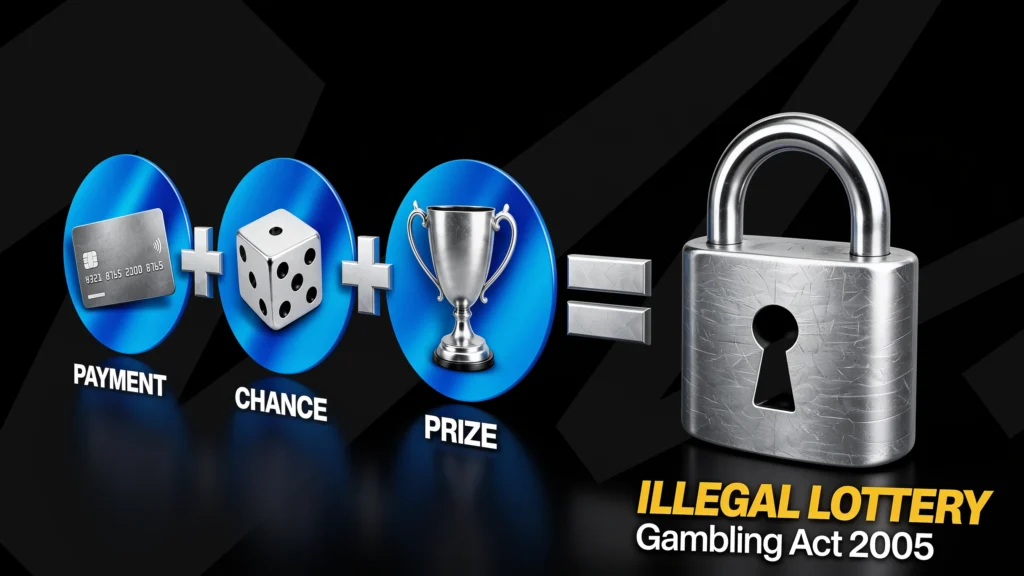
An online competition becomes an illegal lottery when it contains all three elements simultaneously: payment, chance, and a prize. Nera Marketing removes one of them from every build, either chance through a genuine skill question or payment through a free entry route. Under the Gambling Act 2005, any promotion combining these three elements is a lottery and cannot be operated for commercial gain without a Gambling Commission licence. The practical threshold for what constitutes “payment” is lower than many operators realise.
Payment does not require a ticket fee. Requiring a purchase to qualify for entry, charging an entry fee embedded in a product price, or directing entrants to a premium-rate telephone number can all constitute payment in this context. If participants pay in any form and the winner is then selected by chance, the promotion is a lottery regardless of what it is called. The “payment + chance + prize” test is the starting point for every legal assessment of a competition structure.
Removing any one of the three elements takes the promotion outside lottery classification. Prize competitions remove “chance” by requiring skill. Free draws remove “payment” by allowing entry without any financial commitment. Hybrid models remove “payment” for those who choose the free route, provided that free route is genuine and not tokenistic. If any of these mechanisms is poorly implemented, the protection against lottery classification disappears.
Skip the Legal Guesswork
Every Nera-built competition website is structured to comply with the Gambling Act 2005, including a defensible skill question, a properly configured free entry route, and Cashflows merchant approval handled before launch.
Explore our build packages →What are the two legal routes for running a paid competition website?
Commercial competition websites can operate lawfully under two mechanisms in the Gambling Act 2005: Section 14 (prize competitions based on skill) and Section 339 (free draws with no payment required). Most UK competition websites use both simultaneously, pairing paid entry with a skill question and a free postal entry route. Understanding what each mechanism actually requires is where most compliance problems originate.

Route 1: Skill-based competition (Section 14)
Under Section 14 of the Gambling Act 2005, a prize competition is lawful if the outcome is determined by skill, knowledge, or judgement. Paid entry is permitted because the “chance” element is removed. The critical requirement is that the skill or knowledge demanded must genuinely deter or prevent participation from a significant proportion of people. A question that any adult could answer within seconds does not satisfy the legal standard, regardless of how it is presented on the website.
Route 2: Free draw with a free entry route (Section 339)
Under Section 339 of the Gambling Act 2005, a free draw is lawful when entry does not require any payment and winners are selected by chance. For commercial competition websites that also charge for entry, offering a free entry route alongside the paid option satisfies this requirement, provided the free route is genuine, accessible, equally prominent, and gives free entrants the same odds of winning as paid entrants. The free route does not need to be the preferred entry method. It needs to be a real option.
| Skill-based competition | Free entry route | |
|---|---|---|
| Legal basis | Gambling Act 2005, Section 14 | Gambling Act 2005, Section 339 |
| Paid entry permitted | Yes, if skill test is met | Yes, alongside the free route |
| Winner selected how | From correct answers, then by draw | Entirely by chance |
| Licence required | No | No |
| Main compliance risk | Skill question too easy | Free route not genuine or not prominent |
What makes a skill question genuinely compliant?
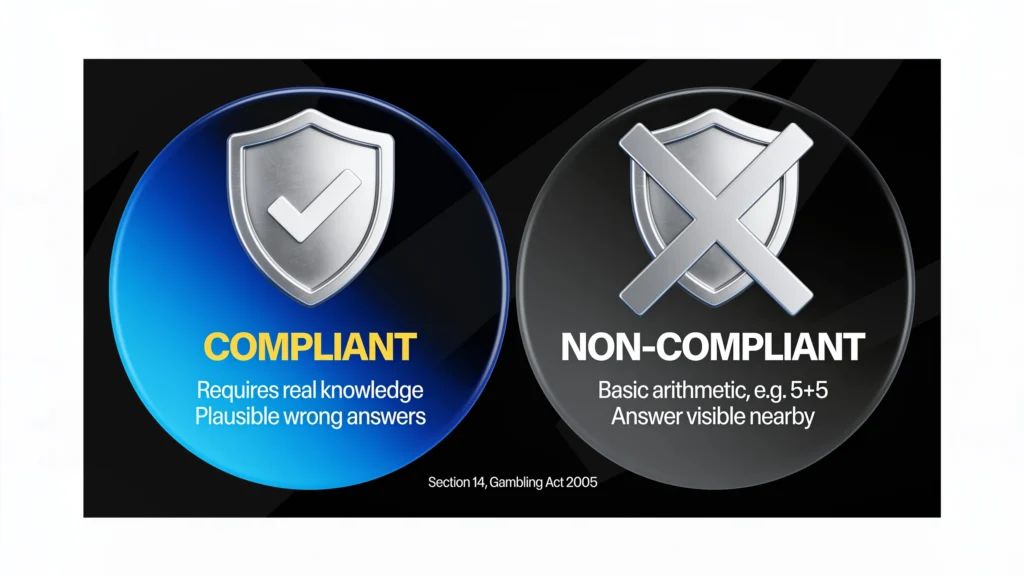
Under Section 14 of the Gambling Act 2005, a skill question must deter a significant proportion of people from entering, or prevent a significant proportion of entrants from winning. The Gambling Commission has explicitly stated in its published guidance that multiple choice questions, and questions that allow a second attempt if the first answer is wrong, rarely meet this standard. A question where the correct answer appears on the same competition page, or that any adult could answer instantly, does not satisfy the legal test.
The “significant proportion” threshold is not defined by the Gambling Commission as a precise percentage. The Commission’s published position is that the phrase should be given its ordinary, natural meaning, which the industry broadly interprets as somewhere between 30 and 70 percent of attempted entries. A question that virtually everyone answers correctly provides no meaningful barrier to participation and therefore fails the skill test, leaving the competition vulnerable to lottery classification.
Practical calibration guidance for competition website operators:
- Avoid multiple choice with obvious distractors. If the wrong answers are immediately recognisable as wrong, the question does not require skill to navigate. Multiple choice is not inherently non-compliant, but it demands plausible alternative answers that a significant proportion of people might select.
- Avoid questions answered on the page. If the competition description contains the answer, the question is not a barrier. It is decoration.
- Match difficulty to prize value. Higher value prizes attract greater scrutiny. A more challenging question is both legally appropriate and commercially defensible for a £30,000 prize.
- Test the question with a sample group. A question that deters 40 percent of a sample of non-specialist adults is safer than one where 90 percent answer correctly in under ten seconds.
- Include a tiebreaker clause in your terms and conditions. Where multiple entrants answer correctly (which is expected in most competitions), the method for selecting a winner from correct entries must be specified. Most competition websites use a random draw from all valid correct entries, which must be documented in the terms.
For more detail on skill question compliance, the dedicated guide to skill questions for prize competitions in the UK covers calibration, common failure points, and the specific Gambling Commission language operators need to understand.
What makes a free entry route compliant?
One further point on keeping it compliant after launch. A free entry route only works while it is actually visible. Nera Marketing has taken on an operator whose free postal entry button had been removed from a live competition page by an unrelated page builder edit, and nobody noticed until tickets were already selling. The structure was correct on paper and absent in practice.
Treat the free entry route and the skill question as structural parts of the entry flow rather than page elements, and check both after any design change to a live site.
A free entry route is compliant under the Gambling Act 2005 when it is available at the normal rate of communication (meaning first or second class post only), given equal visual prominence to the paid entry option on the competition page, and offers genuinely equal odds of winning. The Gambling Commission is explicit that “free” in this context means no additional payment above the standard cost of the communication method. Special delivery postage does not qualify as free.
The free entry route must not be more difficult or less convenient than the paid route. Competition websites that bury the postal address in the footer, require multiple navigation steps to find it, or present it in significantly smaller text than the paid entry button are operating with a free entry route that will not withstand scrutiny. The spirit of the requirement is that a person who does not want to pay should have a realistic and convenient way to participate.
Common free entry route failures:
- Postal address buried in the terms and conditions rather than displayed on the competition page
- Free entry route restricted to certain times, dates, or competition stages
- Free entries capped at a number that makes winning statistically negligible relative to paid entries
- Requirement to create an account or provide payment details to access the free entry form
- Free route displayed in significantly smaller text or de-emphasised visually compared to the paid option
- Direction to a premium-rate telephone line as the “free” alternative
What a compliant free entry route looks like in practice:
The free entry postal address should appear on every live competition page, at the same visual hierarchy level as the paid entry option. The entry method should be stated clearly (written request to the specified postal address, first class stamp only required), the closing date must be identical for both free and paid entries, and the terms must confirm that free entries are entered into the same draw pool with equal odds of winning.
Nera’s approach across the 50+ competition websites we have built is to display the free entry information directly beneath or alongside the ticket purchase section, with a clearly formatted explanation of how to enter by post. This placement ensures the free entry route is genuinely accessible rather than technically available but practically hidden.
Running an online raffle in the UK legally requires the same free entry route compliance as any promotional prize draw. The digital format creates no exemption from Section 339 requirements. On an online raffle, the free entry route must appear at the same visual prominence as the paid entry option, and the postal address must be visible on the competition page itself rather than hidden in the terms. Operators running online raffles at scale can also expect their payment providers and advertising platforms to review the free entry route independently as part of ongoing compliance.
Ready to launch?
Build a legally compliant competition website from day one
Skill questions, free entry routes, and specialist payment gateway integration built into every Nera site. No retrofitting, no compliance gaps.
What does the 2026 Voluntary Code of Good Practice require?
The DCMS Voluntary Code of Good Practice for Prize Draw Operators was published in November 2025 and came into effect on 20 May 2026. Nera Marketing is a signatory. It applies to prize draw operators who run promotions with both a paid and a free entry route: in other words, the standard hybrid model used by the majority of UK commercial competition websites. Operators who run purely skill-based competitions with no free draw element are outside the scope of the code, but many competition websites operate both models and should review whether the code applies.
The code is currently voluntary, meaning there is no legal obligation to sign up. However, the DCMS has made clear that the code is a staging mechanism toward potential statutory regulation, and the Gambling Commission has indicated it will scrutinise the sector more closely if voluntary adoption is low. More than 20 competition website operators had already signed up at the time of publication. You can read the full code at gov.uk/government/publications/voluntary-code-of-good-practice-for-prize-draw-operators.
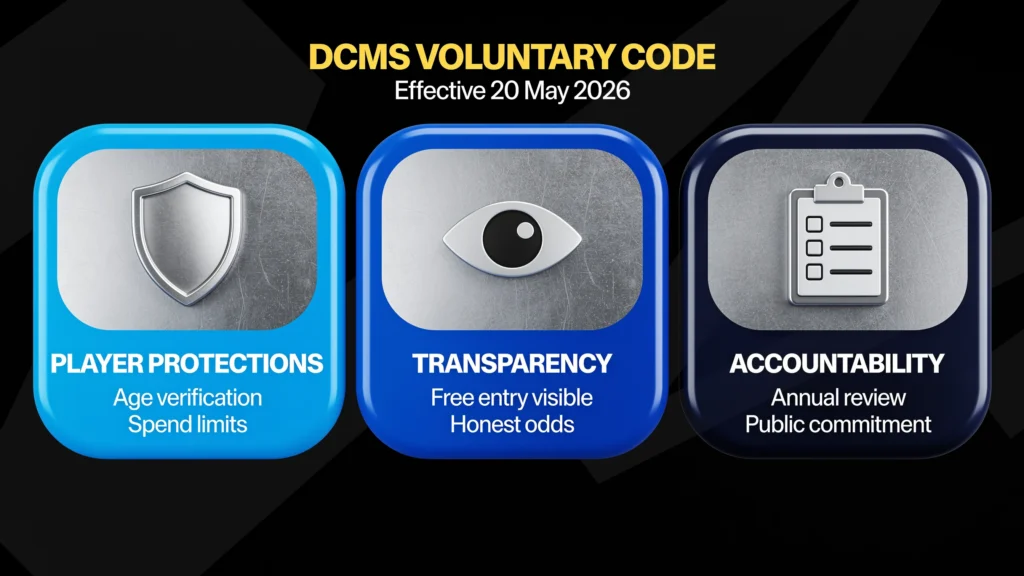
The three pillars of the Voluntary Code:
Pillar 1: Player protections. Operators must restrict participation to adults aged 18 or over and implement reasonable age verification. Credit card payments on prize draws are capped at £250 per player per month, and credit card payments on instant win prize draws are prohibited entirely. Operators must provide mechanisms for players to set their own spend limits, self-exclude for a minimum of six months, or close their account permanently. For the mechanic-side picture, including the formats that work and the visual conventions to avoid, see Instant Win Competition Mechanics in the UK.
For operators starting from scratch, the full guide to launching a UK competition business covers the company structure, payment processor and compliance setup needed before the first ticket is sold.
Pillar 2: Transparency. Operators must clearly explain how each draw works, the method used to select winners, and what happens if ticket sales fall below the threshold required to award the prize. The free entry route must be straightforward, visible, and not materially less convenient than the paid route. If charitable proceeds are involved, the percentage and recipient must be stated clearly.
Pillar 3: Accountability. Operators must maintain internal systems to monitor compliance with the code and be prepared to demonstrate adherence. Annual reviews of those systems are expected. Signing up to the code is a public commitment, and operators who sign up and fail to implement the requirements face reputational and potentially regulatory consequences.
For a full breakdown of the Voluntary Code and its website implementation requirements, the dedicated guide on the Voluntary Code of Good Practice for prize draw operators covers each requirement in detail.
What advertising rules apply when promoting your competition website?
All competition websites must comply with the ASA/CAP Code when advertising across any medium, including paid social media, organic posts, email campaigns, banner advertising, and content on the competition website itself. The ASA enforces the CAP Code (for non-broadcast advertising) and the BCAP Code (for broadcast advertising), and compliance with the Voluntary Code does not automatically mean compliance with the CAP Code. Both apply independently.
CAP Code Rule 8.24 requires that prizes in promotional draws are awarded strictly in accordance with the laws of chance, and that the draw is conducted either by an independent person or by a verifiable random computer process. Competition operators who conduct live social media draws must either use an independent verifiable random number generator and record the process, or have an independent person present to oversee and confirm the draw. Conducting a draw on a live stream without either safeguard in place creates both a CAP Code compliance risk and a reputational risk if the outcome is challenged by entrants.
Competition advertising must not misrepresent the odds of winning, imply that entry increases the chance of success in ways that are not accurate, or use misleading urgency that does not reflect genuine scarcity. The ASA has taken action against competition promoters for countdown timers that reset, ticket availability figures that are not updated in real time, and prize descriptions that do not accurately reflect the prize actually available.
Meta advertising and the RMG licence:
Operators who run paid advertising on Meta (Facebook and Instagram) must hold a valid Real Money Gaming (RMG) licence from Meta before competition-related ads can be run. This is a Meta platform requirement separate from UK legal requirements, and failure to obtain it before running paid campaigns results in ad account restrictions or suspension. The RMG licence application is made through Meta’s Business Manager. The process typically takes two to three weeks but can take longer if Meta requests supporting documentation. Operators should apply for the RMG licence at least four weeks before their planned launch date.
The ASA provides detailed guidance on prize draw advertising at asa.org.uk/advice-online/promotional-marketing-prize-draws.html.
What are your GDPR obligations when collecting competition entries?
Running a competition website involves collecting personal data from every entrant, including names, email addresses, contact numbers, and postal addresses for free entry route participants. This means full compliance with UK GDPR and the Data Protection Act 2018 is required from day one. The lawful basis for processing entry data is legitimate interest: you need the data to administer the competition and select a winner. However, using that same data to send marketing emails to entrants requires a separate, explicit opt-in consent.
Pre-ticked boxes, bundled consent within the entry terms, or language that implies consent by entering are not sufficient. The Information Commissioner’s Office requires that marketing consent be freely given, specific, informed, and unambiguous. An entrant who provides their email address to enter a competition has not automatically consented to receive marketing emails. A separate, clearly labelled opt-in checkbox is the minimum requirement for any marketing email list built through competition entry.
Key GDPR obligations for competition website operators:
- Privacy policy. A clear, accessible privacy policy must be linked from every competition page and explained in the entry terms. It must state what data is collected, why, how long it is kept, who it is shared with, and how entrants can exercise their rights.
- Data retention. Entry data should not be retained indefinitely. A reasonable retention period for competition records is typically six to twelve months after the draw date, sufficient to handle any disputes or regulatory enquiries. Marketing database contacts should be subject to separate retention rules and regular list hygiene.
- Live draw data protection. During live draws on social media, operators must not display personal data, including full names, addresses, or email addresses, on screen. The correct approach is to display only ticket numbers and a first name or username. Full entrant data should not be visible in any recording or stream. Nera has documented at least one instance of an operator broadcasting a full entrant export including addresses during a Facebook live draw, which constitutes a reportable data breach under UK GDPR.
- Third-party sharing. If competition data is shared with any third party, including prize fulfilment companies, affiliate partners, or email marketing platforms, this must be disclosed in the privacy policy and covered by appropriate data processing agreements.
- Entrant rights. Entrants have the right to access their data, correct inaccuracies, request deletion, and object to processing. Competition operators must have a documented process for handling these requests within the 30-day statutory deadline.
What must your competition website terms and conditions include?
Competition websites must publish clear, accessible terms and conditions that satisfy both the Gambling Commission’s guidance on free draws and prize competitions and the requirements of the Consumer Rights Act 2015. Nera Marketing writes these into every build. Under the Consumer Rights Act 2015, terms must be transparent and fair. Buried, ambiguous, or one-sided terms can be challenged and, in the worst case, render the competition mechanics unenforceable.
The minimum content required in competition terms and conditions is as follows:
- Prize description. A precise and accurate description of the prize, including the make, model, and approximate retail value where relevant. Vague prize descriptions such as “luxury car” without further specification are non-compliant and have attracted ASA action.
- Entry method for paid participants. Clear explanation of ticket price, how tickets are purchased, any bundle pricing, and when entry closes.
- Free entry route. The full postal address to which free entries must be sent, the information that must be included in the free entry (name, address, contact details), the closing date, and confirmation that free entries have equal odds to paid entries.
- Skill question and tiebreaker. Where a skill question is used, the terms must state that only correct entries are eligible and explain the tiebreaker mechanism for selecting a winner where multiple correct entries are received.
- Draw date and method. The scheduled draw date (or the criteria that trigger an early or delayed draw), the method by which the winner is selected, and whether a random number generator or independent person will be used.
- Winner notification. How winners will be contacted, the timeframe for responding, and what happens if the winner cannot be reached or does not claim the prize within the specified period.
- Data use. How entrant data will be used, who it will be shared with, and a reference to the privacy policy. Marketing consent must be addressed separately and cannot be embedded within acceptance of the entry terms.
- Eligibility restrictions. Age restriction (18+), geographic eligibility (UK residents only or other), and any exclusions such as employees of the operator or their families.
- What happens if the draw does not go ahead. If ticket sales are insufficient, the promoter’s rights to extend, reduce the prize, or refund entries must be stated clearly. The Voluntary Code specifically requires transparency on this point.
For the complete breakdown of T&Cs requirements for UK competition websites, the dedicated article on competition website terms and conditions covers every required clause in detail.
What happens if you run an unlicensed lottery in the UK?
Operating an unlicensed lottery in the UK is a criminal offence under Section 258 of the Gambling Act 2005. On summary conviction in a magistrates’ court, the maximum sentence is 51 weeks imprisonment and an unlimited fine. The Gambling Commission takes illegal lottery operations seriously and uses a range of enforcement tools, including writing directly to promoters, working with payment providers and social media platforms to take down illegal activity, and referring serious cases for prosecution.
The practical consequences for competition website operators extend well beyond the criminal exposure. Payment processors, including all specialist high-risk providers used by UK competition websites, close accounts immediately when an operator is identified as running an illegal lottery. Once blacklisted by the major acquirers in the high-risk merchant space, obtaining alternative payment processing becomes significantly harder and more expensive. Meta also restricts or permanently bans advertising accounts associated with unlicensed lottery activity. The Nera Shield compliance layer codifies these requirements into every Nera Marketing build, removing the manual implementation burden operators face when trying to assemble compliance from generic WordPress plugins. For operators who want to advertise legitimately on Meta, the path is to obtain a legal opinion letter from a UK gambling solicitor confirming the competition mechanic does not constitute regulated gambling.
Beyond enforcement, the reputational consequences in a niche where trust is the primary commercial asset are severe. UK competition communities, particularly the active groups on Facebook and TikTok where operators build their audiences, move quickly to identify and publicise operators who are perceived to be running non-compliant promotions. Recovery from a public compliance failure is difficult and slow.
Getting the structure right before launching is straightforwardly protective. A well-designed competition website, built to comply with the Gambling Act 2005, the Voluntary Code, the CAP Code, and UK GDPR, removes the legal exposure and allows the business to operate confidently.
If you are planning a competition website, the UK competition website design and build service covers compliance architecture, free entry route implementation, and skill question integration as standard across every build.
Nera Marketing builds compliant UK raffle and prize competition websites with the Nera Shield compliance layer, Cashflows payment processing, and the Nera Engine platform, all delivered as a bespoke build the operator owns outright.
Need help getting it legally right?
We build UK competition websites with the Gambling Act 2005 structure baked in. Skill question, free entry route, T&Cs handled from day one.
Talk to us →