

TLDR
A prize draw in the UK is a promotional competition where winners are selected by chance rather than skill. Under the Gambling Act 2005, prize draws are legal without a gambling licence provided they offer a free entry route that is promoted as prominently as any paid route. Operators must also comply with the CAP Code advertising rules and, from May 2026, the DCMS Voluntary Code of Good Practice for Prize Draw Operators.
Quick Answer
- Prize draws are legal in the UK without a gambling licence if a free entry route is offered
- Winners must be selected by chance, not skill
- Operators must comply with the Gambling Act 2005 and the CAP Code
- From May 2026, the DCMS Voluntary Code of Good Practice applies to all commercial operators
- T&Cs, data protection, and transparent winner selection are all legal requirements
What Is a Prize Draw?
A prize draw is a promotional competition where a winner is selected entirely by chance from all valid entries received. Unlike a skills-based competition, no knowledge, skill, or judgement is required to win. The prize is awarded at random, typically using a random number generator or a physical draw conducted after the competition closes. At Nera Marketing, we have built and launched 50+ UK prize draw websites since 2023 and have seen every variation of how operators structure these draws. Most commercial UK prize draws in this category are marketed as raffle websites even though the underlying legal structure is a prize competition or a Section 339 free draw.
In the UK, prize draws sit within a specific legal category under the Gambling Act 2005. They are not classified as lotteries provided they meet one of two conditions: either entry is free (covered under Section 339 of the Act), or a free entry route is available alongside any paid entry route. The UK market for prize draws and competitions is valued at over £1.3 billion, with thousands of operators running draws commercially across everything from cars and holidays to cash prizes and electronics. Operators who plan to build a competition website for this market need to structure it around Section 339 from the first wireframe. The Nera Marketing build process structures every prize draw site around these two legal routes from day one.
Are Prize Draws Legal in the UK?
Yes, prize draws are legal in the UK without a gambling licence, provided they are structured correctly under the Gambling Act 2005.
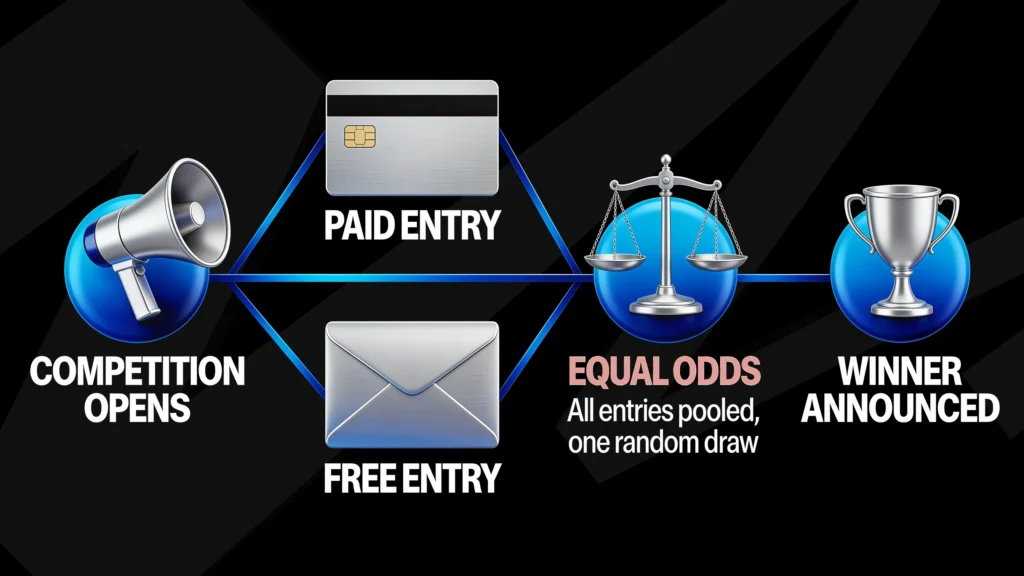
The Act classifies a promotion as a lottery if it combines three elements: a prize, payment to enter, and a winner selected by chance. All three must be present for the activity to require a licence. Prize draw operators avoid lottery classification by removing one of those elements, specifically the payment requirement, through a free entry route.
A prize draw that charges for entry but offers no free alternative is an illegal lottery under UK law regardless of how it is marketed. This is the most common compliance failure among new operators and the area the Gambling Commission guidance on free draws has increased its scrutiny of since 2022.
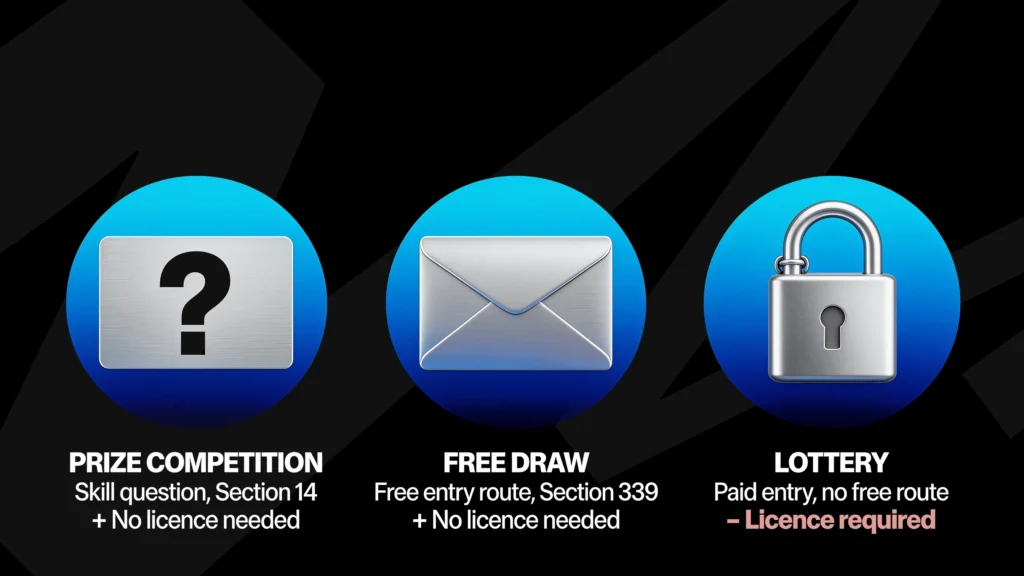
It is also worth noting that prize draws are distinct from prize competitions under Section 14 of the Gambling Act, where skill replaces chance as the determining factor. Both are lawful without a licence, but they operate under different legal frameworks and carry different design and compliance requirements.
What Is the Difference Between a Raffle and a Prize Draw?
The terms raffle and prize draw are often used interchangeably in the UK, but they have different legal meanings under the Gambling Act 2005.
A raffle is technically a lottery. Participants buy tickets for a chance to win a prize, and a winner is drawn at random. Unless the raffle is run by a registered society or as a small incidental lottery at an event, charging for raffle tickets makes it a licensable lottery under UK law. Most traditional charity raffles operate under a small society lottery exemption.
A prize draw, by contrast, is structured specifically to avoid lottery classification. It does this either by making entry free (Section 339) or by requiring skill to determine the winner (Section 14). Commercial prize draw operators running paid competitions must always offer a free entry route to remain within the law.
| Format | Entry | Winner Selection | Licence Required? |
|---|---|---|---|
| Raffle | Paid ticket | Random draw | Yes, unless exempt |
| Prize draw (free entry) | Free | Random draw | No |
| Prize draw (paid with free route) | Paid or free | Random draw | No, if free route is valid |
| Prize competition | Paid or free | Skill or knowledge | No |
| Lottery | Paid | Random draw | Yes |
How Does the Free Entry Route Work?
The free entry route is the mechanism that allows commercial prize draw operators to charge for tickets without running an illegal lottery. Under the Gambling Act 2005, any promotion combining payment, chance, and a prize is classified as a lottery and requires a Gambling Commission licence. Offering a genuine free entry route removes the payment element from the legal equation.
For a free entry route to be compliant, it must meet four conditions set out in Gambling Commission guidance:
- It must be genuinely accessible. Entry cannot require a purchase, a paid subscription, or an account that costs money to create.
- It must be equally likely to win. Free entries cannot be weighted differently from paid entries. Every valid entry, regardless of how it was submitted, must carry the same odds of winning.
- It must be prominently displayed. Hiding the free route in small print, burying it in the terms and conditions, or placing it behind multiple clicks is a compliance failure. The Gambling Commission has specifically flagged this practice as an area of active scrutiny since 2022.
- It must not require disproportionate effort. Requiring free entrants to write a 500-word essay while paid entrants click a button is not a valid free route, even if it technically exists.
The most common compliant free entry method is postal entry, where a participant sends a written request to a specified UK address. The cost of a first-class stamp is considered acceptable. Online free entry forms are also valid provided they require no payment and no account creation that carries a cost.
What the free entry route must look like on your website
The practical implementation of a free entry route is where many competition websites fall short of compliance, even when operators understand the principle. The free entry option must appear at the same visual prominence as the paid entry option on the competition page itself, not just in the terms and conditions. It should be on the same page as the ticket purchase flow, not on a separate URL requiring the visitor to navigate away. The language must make clear that entry is free and that free entrants have equal odds of winning.
At Nera, every competition website design and build includes a correctly structured free entry route as standard, tested before launch to confirm it meets Gambling Commission requirements.
How Nera Marketing Implements Verifiable Winner Selection in Prize Draws
Underneath the draw method sits a smaller technical question that decides whether a draw is defensible at all: can two entrants ever hold the same ticket number? On the platform Nera Marketing builds, ticket numbers are issued by a transactional database using an atomic counter, so a number is allocated once and can never be issued twice, even when hundreds of orders land in the same second.
This is where a competition site differs from ordinary e-commerce. On a normal shop, a stock count that lags by a second or two is a rounding problem nobody notices. On a prize draw, two people holding ticket 3,739 is a fairness failure, and it surfaces at the worst possible moment, which is when you announce the winner.
Two further controls matter for the same reason. Every entry and every outcome is written to an audit trail, so a winning ticket can be verified against the order that bought it rather than against a screenshot an entrant sends in. And unique winner logic prevents one customer sweeping multiple prizes in a single draw unless you deliberately allow it, which is a setting rather than an accident.
On the randomisation method itself, we favour a random number generator that can be shown live on camera, because transparency is worth more to players than sophistication. Spot the ball and similar mechanics add friction at checkout, and since the free entry route already carries the legal structure, most UK operators now run a straightforward skill question instead.
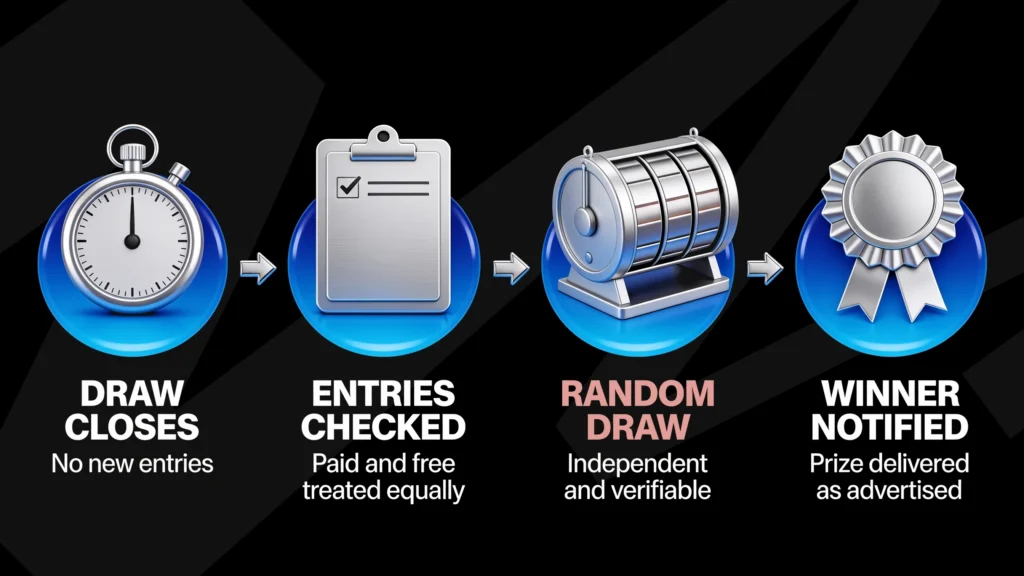
Prize draw winners in the UK must be selected by a genuinely random process. The method used must be specified in the terms and conditions before the draw closes, and the same method must be applied consistently to all valid entries regardless of how they were submitted.
The three most common winner selection methods used by UK competition operators are:
- Random number generator. A number is assigned to each valid entry and a random number generator selects the winning number after the closing date. This is the most common method for online competition websites and is straightforward to evidence if the draw is ever queried.
- Physical draw. All entries are placed into a container and a winner is drawn by hand, often witnessed or filmed. This method is more common for smaller operators and charity draws.
- Pre-selected winning code. A unique code is assigned to a product or ticket before the draw opens, and the holder of that code wins. This method requires careful handling because the winning code is determined before any entries are received, which must be clearly disclosed in the terms and conditions.
What operators must do after the draw
Selecting the winner is only part of the process. Under the ASA CAP Code rules on prize draw advertising, operators must make reasonable efforts to notify the winner promptly and must be able to provide a winner’s name and county to anyone who requests it within a reasonable timeframe after the draw closes. Failure to publish or disclose winner information has resulted in ASA rulings against operators.
The DCMS Voluntary Code of Good Practice adds a further requirement from May 2026: draw results must be published transparently and winner verification processes must be documented. Operators who cannot demonstrate a clear audit trail for their draw process risk being flagged under the Code.
What Rules Apply to Running a Prize Draw in the UK?
Running a prize draw in the UK means operating across four overlapping regulatory frameworks simultaneously. Understanding each one separately is the starting point, but compliance in practice means applying all four together.
The Nera Shield compliance layer codifies these rules into every Nera Marketing build, covering Section 14 skill questions, Section 339 free entry routes, age verification, T&Cs framework, and audit logging for draw integrity.
The Gambling Act 2005
The Gambling Act 2005 is the primary piece of legislation governing prize draws in the UK. It establishes the legal boundary between a lawful prize draw and an illegal lottery, and it defines the two routes operators use to stay on the right side of that boundary: the free entry route under Section 339, and the skills-based competition route under Section 14.
Beyond the free entry requirement, the Act also governs how competitions can be structured. Operators cannot impose entry conditions that effectively make the free route inaccessible, cannot cap free entries at a number so low that winning becomes statistically negligible, and cannot introduce mechanics that blur the line between a prize draw and a gambling product. Instant win mechanics, in particular, require careful structuring. The Gambling Commission has indicated that certain instant win formats risk classification as a gaming product rather than a prize draw, depending on how the mechanic is presented to participants. For the specific mechanics that stay on the right side of the line, see Instant Win Competition Mechanics in the UK.
The Act applies across England, Scotland, and Wales. Northern Ireland operates under separate legislation, specifically the Betting, Gaming, Lotteries and Amusements (Northern Ireland) Order 1985, which means operators running UK-wide competitions need to ensure their structure is compliant in all jurisdictions they accept entries from.
Build Your Prize Draw Properly From Day One
Free entry route, T&Cs, draw mechanics, and Cashflows payment integration, with full Gambling Act 2005 compliance built in. 50+ UK competition websites delivered. Packages from £2,995.
See What’s IncludedThe CAP Code and ASA Advertising Rules
The Committee of Advertising Practice (CAP) Code sets the rules for how prize draws can be advertised and promoted in the UK. It is enforced by the Advertising Standards Authority (ASA), which has the power to require operators to withdraw or amend promotions that breach the Code.
The key CAP Code requirements for prize draw advertising are:
- Significant conditions must be stated. Any condition that is likely to influence a participant’s decision to enter must be included in the advertisement itself, not just in the full terms and conditions. Closing dates, entry restrictions, and prize limitations all fall into this category.
- The free entry route must be communicated. If a free entry route exists, its availability must be made clear in any paid advertising for the draw. Operators cannot promote the paid entry route without acknowledging that free entry is available.
- Winner disclosure must be possible. Operators must be prepared to provide a winner’s name and county to anyone who requests it within a reasonable period after the draw closes. Withholding this information without a legitimate reason is an ASA breach.
- Prizes must be awarded as described. The prize offered in the promotion must match the prize delivered. Substituting a prize of lower value without consent, or adding conditions to prize collection that were not disclosed upfront, are both CAP Code violations.
- Operators cannot charge fees to claim a prize. Telling a winner they must pay a delivery charge, processing fee, or administration cost to receive their prize is a CAP Code violation regardless of the prize value or how the fee is framed. Any costs associated with prize fulfilment must be disclosed before the draw closes, not after a winner is selected.
The ASA has issued rulings against competition operators specifically for burying the free entry route, failing to state closing dates prominently, and misrepresenting prize values. Reviewing the full ASA CAP Code rules on prize draw advertising before launching any paid campaign is a non-negotiable step.
The DCMS Voluntary Code of Good Practice (May 2026)
The DCMS Voluntary Code of Good Practice for Prize Draw Operators is the most significant regulatory development in the UK competition sector since the Gambling Act 2005. Published by the Department for Culture, Media and Sport and coming into full effect on 20 May 2026, it introduces a set of consumer protection standards that commercial operators are expected to meet.
The Code is voluntary in name, but in practice it carries significant weight. Banks, payment processors, and advertising platforms are increasingly using Code compliance as part of their due diligence on competition website operators. Operators who cannot demonstrate adherence to the Code risk difficulties obtaining or retaining merchant accounts and advertising access.
The key requirements introduced by the Code include:
- Spending caps. Operators must implement a monthly spending limit of £250 per customer on credit cards used for competition entries.
- Self-exclusion. Operators must provide a mechanism for customers to self-exclude from purchasing entries, with a minimum exclusion period of one year.
- Transparency requirements. Draw results, winner verification, and prize fulfilment must be documented and available for inspection.
- Player protection measures. Operators must monitor for signs of excessive spending and have a process for intervening where customer behaviour suggests harm.
- Clear terms and conditions. T&Cs must be written in plain English, easily accessible, and updated to reflect any changes to draw structure or prize specification.
- Age verification. Operators must take reasonable steps to verify that participants are aged 18 or over before allowing entry to paid draws. This includes implementing age verification at the point of registration or purchase rather than relying on a self-declaration checkbox alone.
Operators who are signatories to the Code and can demonstrate active compliance are in a significantly stronger position with payment providers, advertisers, and customers than those who are not. The full DCMS Voluntary Code of Good Practice for Prize Draw Operators is published on GOV.UK.
GDPR and Data Protection
Every UK prize draw that collects participant data is subject to the UK General Data Protection Regulation (UK GDPR) and the Data Protection Act 2018. This applies regardless of whether the draw is run commercially or not.
The core obligations for prize draw operators under UK GDPR are:
- Lawful basis for processing. Operators must have a clear lawful basis for collecting and processing participant data. For most prize draws, this will be contractual necessity (processing entries) and legitimate interest (fraud prevention). Consent is required separately if data is to be used for marketing purposes beyond the draw itself.
- Privacy notice. A clear privacy notice must be available to participants at the point of entry, explaining what data is collected, how it is used, how long it is retained, and who it may be shared with.
- Data minimisation. Operators should only collect the data they genuinely need to run the draw and fulfil the prize. Collecting additional data without a clear purpose is a UK GDPR breach.
- Retention limits. Participant data cannot be held indefinitely. Operators must define a retention period and delete data once it is no longer needed for its original purpose.
- Marketing consent. If operators wish to use participant data for future marketing, separate and explicit consent must be obtained at the point of entry. Pre-ticked boxes and implied consent are not valid under UK GDPR.
Do You Need a Licence to Run a Prize Draw in the UK?
No, you do not need a Gambling Commission licence to run a prize draw in the UK, provided the draw is structured correctly.
A licence is only required if the promotion combines all three elements of a lottery: a prize, payment to enter, and a winner selected by chance. Prize draw operators remove the payment element by offering a genuine free entry route, which means the promotion falls outside the definition of a lottery and no licence is needed.
There is one exception worth being aware of. If a prize draw is structured as an instant win promotion and the mechanic is designed in a way that resembles a slot machine or gaming product, the Gambling Commission may classify it differently. Operators planning to use instant win mechanics should take legal advice on the specific structure before launch.
For a full breakdown of when a licence is and is not required, including the rules around skills-based competitions and RMG licensing, the do you need a gambling licence for a competition website guide covers the topic in detail.
Can You Run a Prize Draw for Profit in the UK?
Yes, prize draws can be run for commercial profit in the UK. There is no legal requirement for a prize draw to be charitable or non-commercial.
Commercial prize draw operators charge participants for the chance to win a prize, generate revenue from ticket sales, and retain any surplus after the prize and operating costs are covered. This is a legitimate business model provided the draw is structured correctly under the Gambling Act 2005 and all applicable advertising and data protection rules are followed.
The key distinction from a lottery is the free entry route. A commercial operator charging for tickets must always provide a valid free entry route. Without it, the promotion is an illegal lottery regardless of commercial intent or prize value.
Commercial operators also need to be aware of their obligations under the DCMS Voluntary Code from May 2026, which introduces specific consumer protection requirements that apply to paid prize draws run for profit.
How Do Online Prize Draws Work?
Online prize draws follow the same legal framework as any other UK prize draw, but the technology platform used to run them introduces additional compliance considerations that do not apply to offline draws.
A compliant online prize draw requires the following components to function correctly:
- A ticket purchase system that processes payments through a payment gateway approved for high-risk merchants. Standard payment providers including Stripe, PayPal, and Square routinely decline competition websites due to their high-risk classification. Specialist providers such as Cashflows are built to handle competition website transactions compliantly. For a full breakdown of which payment providers work for UK competition sites, the payment gateways and banks for UK competition websites guide covers this in detail.
- A free entry route that functions on the same page as the paid entry option, accessible without any barriers and clearly signposted throughout the entry flow.
- A draw management system that tracks all valid entries, including both paid and free entries, assigns a unique identifier to each, and conducts the random draw in an auditable way after the closing date.
- A winner announcement mechanism that publishes the result publicly and retains documentation of the draw process in case of any query.
- Terms and conditions that are accessible from every competition page, written in plain English, and updated each time draw details change.
Across more than 50 competition website builds, the pattern is consistent: operators who launch on a purpose-built, compliant platform generate revenue faster and encounter fewer payment and compliance problems than those who attempt to retrofit prize draw functionality onto a generic ecommerce site. LR Luxe Competitions generated £30,000 in their first month of trading. Reddi Comps generated £4,612 in their first six weeks. Cars and Kettles generated £60,000 in their first month, with peak daily revenue exceeding £18,000 on draw days. In every case, the platform was built with compliance embedded from day one rather than added as an afterthought.
Off-the-shelf website builders and generic ecommerce platforms are not designed with prize draw compliance in mind. A purpose-built UK competition website specialist ensures the free entry route, draw mechanics, and compliance pages are integrated from the ground up rather than retrofitted.
Launch a Compliant Prize Draw From Day One
We’ve built 50+ UK competition websites with the free entry route, draw mechanics, T&Cs, and Cashflows payment integration baked in. Packages from £2,995.
Talk to us →What Should Prize Draw Terms and Conditions Include?
Prize draw terms and conditions are a legal requirement, not a formality. They must be accessible to participants before they enter, written in plain English, and comprehensive enough to cover every material aspect of the draw.
A compliant set of prize draw T&Cs must include:
- The promoter’s full name and contact address.
- The opening and closing dates of the draw, including the exact time the draw closes.
- A clear description of the prize, including any conditions attached to claiming it.
- The entry mechanic, including how both paid and free entries are submitted.
- The free entry route, described in full with the postal address or online form URL.
- The winner selection method, including when and how the draw will take place.
- How and when winners will be notified.
- The winner disclosure policy, including the process for providing a winner’s name and county on request.
- Any restrictions on eligibility, including age restrictions, geographical restrictions, and employee exclusions.
- What happens if a winner cannot be contacted or does not claim their prize within the specified period.
- Data protection information, including how participant data will be used and how long it will be retained.
- The promoter’s right to cancel or amend the draw in exceptional circumstances, and what happens to entries if this occurs.
For a full breakdown of what UK competition website T&Cs must contain and common compliance gaps, the competition website terms and conditions guide covers each requirement in detail.
Nera Marketing builds compliant UK prize draw websites with the Nera Shield compliance layer, Cashflows payment processing, and the Nera Engine platform, all delivered as a bespoke build the operator owns outright.
Ready to launch your prize draw?
50+ UK competition websites built, including LR Luxe (£30K in month one) and Cars and Kettles (£60K in month one). Compliance, payments, hosting handled from day one.
Talk to us →