

TLDR
No, in most cases. Most UK competition websites do not require a Gambling Commission licence. Two legal exemptions under the Gambling Act 2005 allow competition websites to operate without a licence: the Section 14 exemption for genuine skill-based competitions, and the Section 339 exemption for free draws where no payment is required to enter. Neither exemption applies automatically. The compliance structure must be correct from the outset. A competition that combines payment, chance, and prize without one of these mechanisms properly in place is an illegal lottery regardless of how it is marketed.
Quick Answer
- Most UK competition websites do not need a gambling licence
- Prize competitions with a genuine skill element under Section 14 of the Gambling Act 2005 sit outside gambling regulation
- Free prize draws with a genuine free entry route under Section 339 are also outside regulation
- Paid-entry lotteries offering neither skill nor free entry do require a Gambling Commission licence
- The DCMS Voluntary Code of Good Practice, in effect from May 2026, applies transparency requirements to commercial prize draw operators
Do you need a gambling licence for a UK competition website?
No, you do not need a Gambling Commission licence to run a UK competition website, provided the website is structured under one of two legal exemptions in the Gambling Act 2005. Nera Marketing builds both structures into every competition website it delivers. The two exemptions are:
- Section 14, prize competition. The website asks entrants a genuine question of skill, judgement, or knowledge that a significant proportion of entrants cannot answer without effort. The skill question must be applied before the prize is won, not decorative. This structure is legal without a gambling licence.
- Section 339, free prize draw. The website offers a legitimate free entry route with an identical chance of winning as a paid entry, with the free route clearly advertised. This structure is also legal without a gambling licence.
A paid-entry draw with no skill question and no free entry route is a lottery under UK law. Lotteries require a Gambling Commission licence or a Small Society Lottery registration. Most commercial competition websites in the UK operate under Section 14 or Section 339, not under a gambling licence. In practice, you also need a compliance-first platform, a specialist payment gateway such as Cashflows because Stripe and PayPal refuse competition transactions, and a legal opinion letter before advertising at scale.
Why this question matters
The Gambling Act 2005 carries criminal penalties, not civil ones. Getting the compliance structure wrong is not a minor administrative issue. It exposes the operator to prosecution, forces the site offline, and can result in funds being frozen. Payment providers and advertising platforms both assess compliance structure independently, which means a poorly structured competition also fails merchant onboarding and Meta advertising approval before any regulatory action is taken.
Understanding exactly where your competition model sits under the law, and building the platform to reflect that structure correctly, is the most important decision in a competition business.
The core legal test: what makes something a lottery
Under the Gambling Act 2005, a promotion is an unlicensed lottery if it combines all three of these elements simultaneously:
- Prize: something of value awarded to the winner
- Payment: a requirement to pay to enter
- Chance: the winner is selected randomly rather than through skill
Remove any one of those three elements and the promotion is not a lottery. This is the legal principle that underpins every legitimately structured UK competition website.
Most UK competition operators remove either “chance” by introducing a genuine skill element, or “payment” by providing a genuinely free entry route. Both approaches are lawful. Both have specific requirements that must be met correctly.
Skip the Licence, Get the Structure Right
We build UK competition websites that meet Section 14 or Section 339 from day one. 50+ delivered with full Cashflows merchant approval and Meta RMG documentation. Packages from £2,995.
Talk to us →The Section 14 exemption: skill-based competitions
Under Section 14 of the Gambling Act 2005, a competition that requires the genuine exercise of skill, knowledge, or judgement is classified as a prize competition rather than a lottery. Nera Marketing designs and calibrates the skill question to meet that test on every build. It does not require a Gambling Commission licence regardless of the prize value or the ticket price.
The critical word is genuine. The Gambling Commission has made clear that a skill question must act as a real barrier to entry. It must prevent a significant proportion of people from answering correctly. A question that virtually anyone could answer correctly by guessing or by a quick internet search fails the Section 14 test and reclassifies the competition as an unlicensed lottery.
What makes a skill question legally compliant
A Section 14 compliant skill question must:
- Require knowledge or reasoning that is not universally held
- Not be answerable by pure guesswork or luck by a significant proportion of participants
- Be presented before the entry payment is processed, not after
- Have plausible wrong answer options where multiple choice is used
- Be genuinely difficult enough to act as a barrier, not just technically present
The calibration guidance generally accepted in the sector is that a compliant question should prevent approximately 30 to 70 percent of people who attempt it from answering correctly. Too easy and the skill element fails the legal test. Too hard and conversion suffers without additional legal benefit.
What makes a skill question non-compliant
Common examples of questions that do not meet the Section 14 standard:
- Basic arithmetic such as “What is 5 plus 5?”
- Universally known facts such as “What is the capital of England?”
- Questions answerable by reading the same competition page
- Questions with obviously implausible wrong answer options
- Questions about the competition itself rather than requiring external knowledge
If any of these describe your current skill question, the competition may already be misclassified. This is one of the areas the Gambling Commission has increased scrutiny on since 2022.
Tiebreaker requirements
When multiple entrants answer the skill question correctly, which is expected in most competitions, the winner cannot simply be drawn by chance from correct entries without additional structure. The T&Cs must specify a tiebreaker mechanism, either a second qualifying question or a random draw explicitly from correct entries only, and this must be clearly communicated to entrants. For a detailed breakdown of skill question requirements see the guide on skill questions for prize competitions.
The Section 339 exemption: free draws and free entry routes
Under Section 339 of the Gambling Act 2005, a free draw where no payment is required to enter is exempt from Gambling Commission licensing. Nera Marketing places the free entry route at the same visual prominence as the paid route on every build. This is the legal basis for the free entry route that most paid-entry UK competition websites provide alongside their paid ticket options.
If your competition involves a paid entry route and the winner is selected by chance, you must provide a genuinely free alternative entry route to avoid lottery classification. This is not optional. It is a legal requirement.
What constitutes a valid free entry route
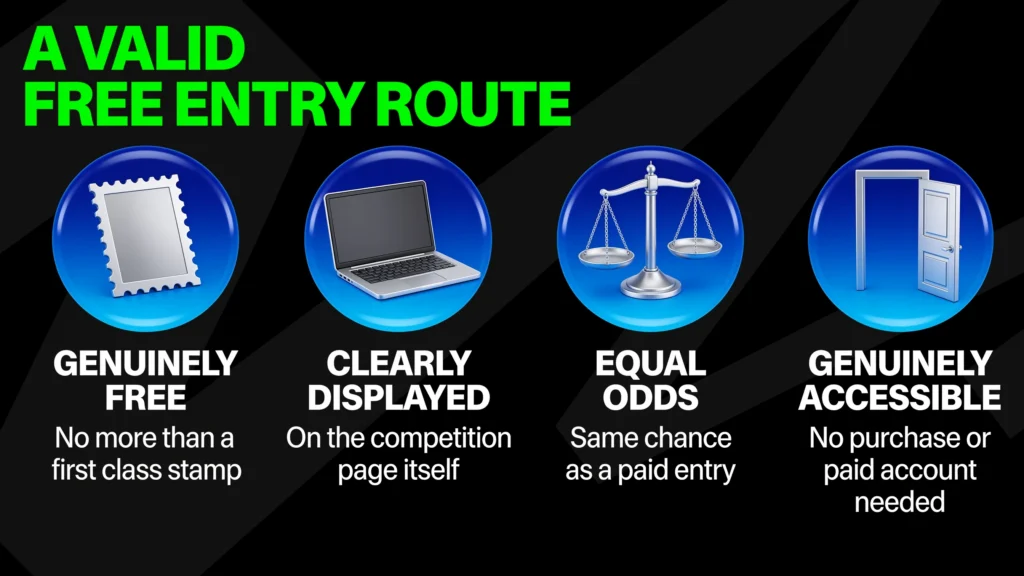
A legally valid free entry route under Section 339 must be:
- Genuinely free: covering no more than the cost of a first-class stamp for postal entries, or zero cost for online routes
- Clearly displayed: visible on the competition page itself, not only in terms and conditions
- Equally likely to win: free entries must have the same statistical chance of winning as paid entries and cannot be weighted differently or capped at a number that makes winning statistically negligible
- Genuinely accessible: not requiring proof of purchase, a paid account, or access during restricted hours only
What does not constitute a valid free entry route
The Gambling Commission has scrutinised and taken action against operators whose free entry routes fail in practice, even if technically present. Routes that have been found non-compliant include:
- Free entry routes visible only in T&Cs with no reference on the competition page
- Routes requiring a premium rate phone call
- Routes capped at a number that gives free entrants a negligible statistical chance of winning
- Routes requiring an existing paid subscription to access
- Online routes requiring account creation before the free entry can be submitted
- Postal routes with an address that is genuinely difficult to locate
Design requirements for the free entry route
The Gambling Commission’s scrutiny of free entry routes is focused not just on whether one exists, but on whether it is genuinely accessible in practice. This has direct implications for how competition websites must be designed. The free entry option should be displayed at the same visual prominence as the paid entry option, on the same page, without requiring navigation to a separate URL. A non-technical user should be able to find and complete the free entry route without assistance.
When you do need a Gambling Commission licence
A Gambling Commission licence is required when a promotion combines all three elements of payment, chance, and prize without one of the lawful exemptions correctly in place. Specific situations where a licence is required include:
- A paid-entry prize draw with no free entry route, or with a free entry route that fails the accessibility and equality tests
- A skills-based competition where the skill question is so trivially easy that it does not genuinely prevent a significant proportion of entrants from answering correctly
- A promotion structured as a lottery by design, such as a paid-entry random draw with no skill or free route element at all
- Operations that fall under specific licensing categories such as large-scale society lotteries or remote gambling operators
The consequences of operating a lottery without a licence include criminal prosecution, unlimited fines, and asset forfeiture. These are criminal penalties, not regulatory warnings.
How this interacts with advertising platforms and payment providers
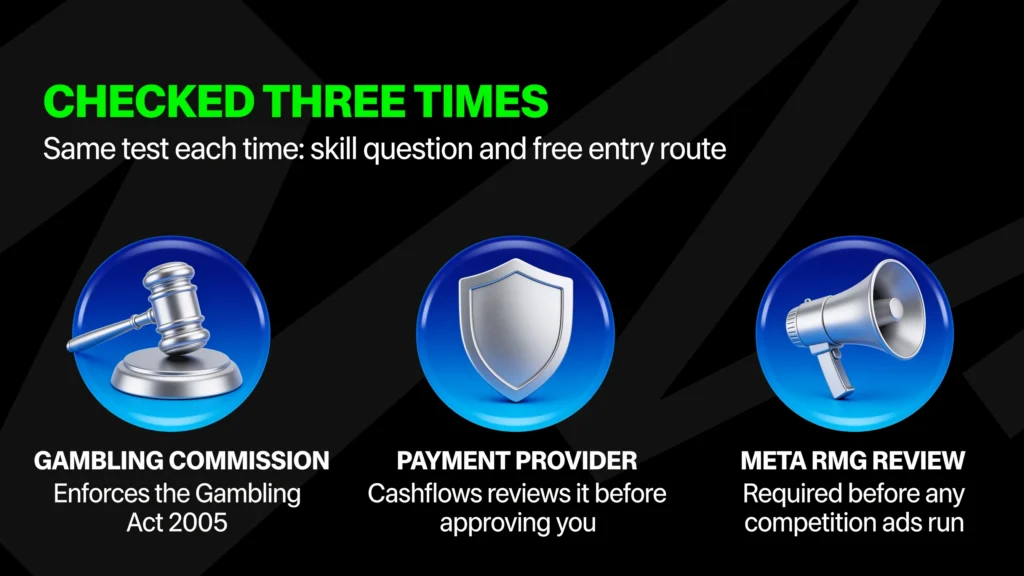
Compliance with UK gambling law is assessed independently by payment providers and advertising platforms, not just by regulators. Nera Marketing structures each build to satisfy all three at once. This means a competition that is legally non-compliant will encounter practical problems before any formal enforcement action.
Payment providers
Specialist competition payment providers including Cashflows assess the compliance structure of every competition website as part of their merchant onboarding process. They review the skill question placement, the free entry route visibility, the T&Cs structure, and the overall compliance architecture before approving a merchant account. A competition website that does not meet these requirements will be delayed or declined at the payment onboarding stage regardless of any other considerations.
Understanding the full range of reasons payment providers reject competition sites is important before submitting any application. The guide on why payment providers reject competition websites covers each trigger and how to address it. For a full breakdown of which providers work for UK competition sites see the guide on best UK banks and payment providers for competition sites.
Meta advertising
Meta’s RMG (Restricted Managed Gambling) approval process is required before any competition or prize draw advertising can run on Facebook or Instagram in the UK. Meta’s review specifically assesses whether the competition structure is compliant under local law, including the skill question and free entry route. Without RMG approval, competition advertising accounts are restricted or closed.
The Voluntary Code of Good Practice
The Voluntary Code of Good Practice for Prize Draw Operators, published by DCMS in November 2025, sits on top of the Gambling Act’s legal requirements and raises the expected standard of compliance further. Operators who have signed up must implement the code in full by 20 May 2026. Some of its requirements, including credit card limits and instant win restrictions, are already being enforced at payment provider level by providers including Cashflows. The Nera Marketing guide to the Voluntary Code covers the scope and context. The detail of what needs to change on your site to comply is broken down clause by clause in the implementation guide.
What about a legal opinion letter?
A legal opinion letter from a UK gambling solicitor confirms in writing that your specific competition model does not constitute regulated gambling under the Gambling Act 2005. Nera Marketing commissions the letter from a UK gambling solicitor for each individual operator, because Meta rejects template letters. It is not always required at the point of first launch, but it is almost always required before running paid advertising at scale, achieving full payment gateway approval, or listing a competition app on the Apple or Google app stores.
A legal opinion letter typically costs £1,195. It covers:
- Confirmation that the competition does not constitute a lottery under the Gambling Act 2005
- Confirmation that the free entry route is genuine, accessible, and correctly structured
- Confirmation that the skill question meets the Section 14 threshold if applicable
Operators who defer the legal opinion letter until they are ready to advertise at scale frequently encounter a two to four week delay while it is commissioned, reviewed, and submitted. The cost is fixed. The revenue cost of the delay is not.
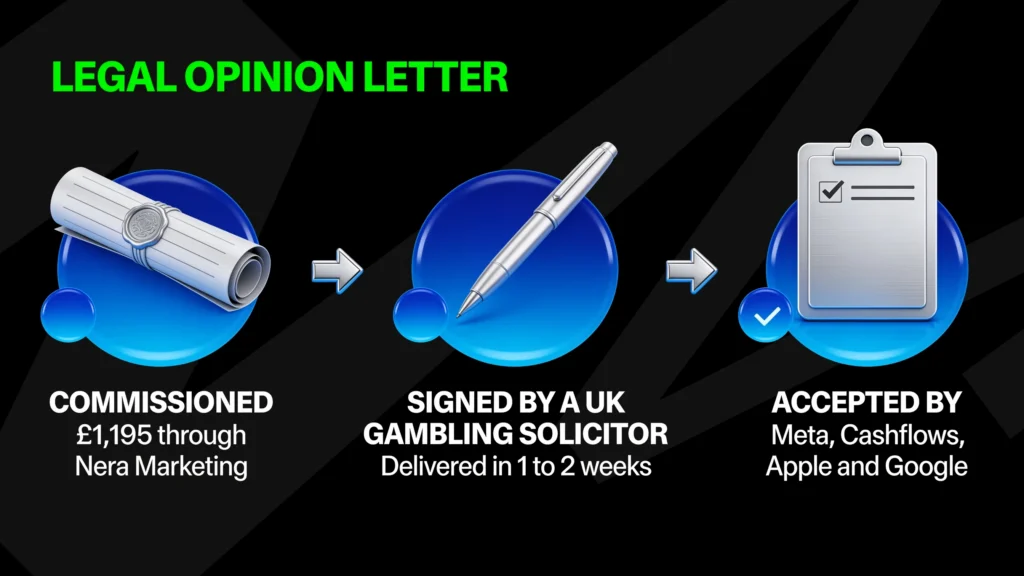
We coordinate the legal opinion letter service directly. A prospective operator commissions the letter, we brief our partnered UK gambling solicitor with the specific competition model, skill question, and free entry route in use, and the completed letter is typically delivered within one to two weeks of instruction. The final deliverable is a signed PDF that names the operating company, describes the competition mechanic, and confirms in writing that the model does not constitute regulated gambling under the Gambling Act 2005. Operators keep the letter on file and provide it to Meta, TikTok, Cashflows, a business bank such as Revolut, or app store reviewers on request.
We have coordinated legal opinion letters for operators across a range of scenarios, including operators applying for Meta RMG approval, operators clearing Cashflows or Truevo underwriting review, and operators submitting a competition app to Apple or Google. The letter is not a substitute for a compliance-first platform architecture, but it removes the single most common blocker when a third-party reviewer asks how the operator has satisfied itself that the business sits outside the Gambling Act 2005.
The difference between a prize competition, a prize draw, and a raffle in UK law
These terms are used interchangeably in the market but have distinct legal meanings:
Prize competition: A paid-entry competition where success depends on the exercise of genuine skill, knowledge, or judgement under Section 14 of the Gambling Act 2005. Lawful without a licence.
Prize draw or free draw: A competition where the winner is selected by chance but no payment is required to enter, or where a genuine free entry route exists alongside a paid route, under Section 339. Lawful without a licence.
Raffle: In UK law, a raffle is a form of lottery. A commercially run raffle where entrants pay for tickets and winners are selected by chance requires a Gambling Commission licence unless structured with a free entry route under Section 339.
Lottery: A promotion combining payment, chance, and prize. Requires a Gambling Commission licence to operate commercially in the UK unless an exemption applies.
Most UK competition websites are structured as either prize competitions under Section 14, prize draws under Section 339, or a combination of both. For a detailed comparison see the guide on skill-based competitions vs prize draws in the UK.
Common compliance mistakes that create legal risk
One mistake is worth describing in detail, because it is invisible until it matters. An operator we later took on had their free postal entry button silently removed from a live competition page by a page builder edit. The developer had been asked to make unrelated cosmetic changes. Nobody noticed until the site was already selling tickets.
That is a compliance failure rather than a cosmetic one. Without a visible free entry route of equal prominence, a paid competition loses the Section 339 structure it depends on, and every entry taken while the button was missing was taken on the wrong legal basis.
The lesson is not to avoid page builders. It is that the compliance elements of a competition website should not be editable by accident. On the builds Nera Marketing delivers, the free entry route and the skill question are structural parts of the entry flow rather than page furniture that can be dragged off a layout.
These are the mistakes most frequently identified across competition websites operating with structural compliance problems:
Trivially easy skill questions. A question with an obvious answer, widely known facts, or a correct answer findable by reading the competition page does not meet the Section 14 standard. This is the most common compliance failure and the one most frequently scrutinised by the Gambling Commission.
Buried free entry routes. A free entry route that exists only in T&Cs, requires multiple clicks to find, or is presented at significantly lower visual prominence than the paid entry option does not meet the accessibility requirement under Section 339.
Capped free entries. Free entries limited to a number that gives them a statistically negligible chance of winning do not meet the equal odds requirement. If 10,000 paid entries are possible and free entries are capped at 10, the free entry route fails the legal test.
Inadequate T&Cs. Terms and conditions that do not specify the draw date, the free entry route mechanics, the tiebreaker process, the promoter identity, and the winner notification method are non-compliant regardless of the entry structure. For what must be included see the guide on what must be included in UK competition terms and conditions.
Retrofitting compliance. Operators who launch with a non-compliant structure and attempt to fix it after going live face the additional complication of having already processed entries under a potentially unlawful model. Getting the compliance structure right before the first entry is sold is significantly simpler and cheaper than correcting it afterwards. This is one of the most common and most costly mistakes new competition businesses make.
Client experience, compliance path
“Before working with Nera, we were struggling with the compliance side of our competition website. We were facing account restrictions, repeated issues with ads, and real difficulty finding a payment provider willing to work with us. Nera quickly identified where we were going wrong and guided us through the correct setup.”
Ruby and Lily Manyweathers, LR Luxe Competitions
Verified Trustpilot review
“Solid website, no hassle. Nera Marketing built my competition website and sorted all the other stuff too. Site loads quick on mobile, looks clean, and they handled everything without making it complicated. Good communication and actually delivered what they said. Happy with it.”
Michael M., Teescomps (5-star review, Trustpilot)
How Nera Marketing structures competition websites for compliance
Every UK competition website design and build Nera delivers is structured around the compliance requirements from day one, not retrofitted afterwards. This includes:
- Skill question calibration reviewed against the Section 14 standard before launch
- Free entry route positioned at equal visual prominence to the paid entry option, on the same page
- T&Cs structured to include all legally required fields
- Compliance architecture reviewed against Cashflows merchant onboarding requirements before the payment application is submitted
- Platform structure reviewed against Meta’s RMG approval criteria
Nera Marketing is a signatory to the Voluntary Code of Good Practice for Prize Draw Operators. Every platform we build meets the code’s requirements as standard.
Nera Marketing builds UK competition websites with the Nera Shield compliance layer, ensuring Section 14 skill questions, Section 339 free entry routes, and Voluntary Code requirements are configured from day one. Every build is bespoke and operator-owned outright.
Operators who build a competition website with Section 14 or Section 339 structure from the start typically need the legal opinion letter for Meta advertising rather than to avoid licensing.
Ready to build your competition website?
Join hundreds of operators running prize draws with NERA's platform.
Talk to us →