How to Price Raffle Tickets in the UK: A Complete Pricing Methodology for Competition Operators

TLDR
UK raffle ticket prices typically sit at £2, £3, or £5. The price floor formula is (prize cost + marketing + processing + target profit) divided by ticket cap. Niche benchmarks for cars (£5-£10), cosmetics (£1-£3), cash (£2-£10), tech (£2-£5), luxury (£5-£15), and property (£10-£50). Bundle pricing increases average order value by 40 to 80 percent.
UK raffle ticket prices typically range from £1 to £25 depending on prize value, niche, and the operator’s target margin. The most common price points are £2, £3, and £5. Anything outside that range needs a specific structural reason, and getting it wrong is the single most expensive pricing mistake we see new operators make. The pricing decisions above only translate into revenue if the underlying raffle website builder handles ticket caps, bulk-entry discounts and instant-win logic reliably at draw-day scale.
Most pricing advice online treats ticket price as a marketing variable. It is not. It is a structural decision that determines whether a competition reaches its target, whether the operator hits the legal threshold for a valid free entry route, whether payment processing margins make the business viable, and whether the audience perceives the prize as credible. Get any one of those wrong and the entire competition either fails to sell or fails to make money.
We have set ticket pricing structures across over 50 UK competition websites, including operators running £4.5 million in year one and operators launching their first sub-£1,000 prize. This guide covers the actual methodology we use when planning a bespoke UK competition website build, the niche-specific benchmarks we have validated through real entry data, and the structural rules around free entry routes, payment processing margins, and Gambling Commission compliance that determine whether a price point works or breaks the model.
What is the typical raffle ticket price in the UK?
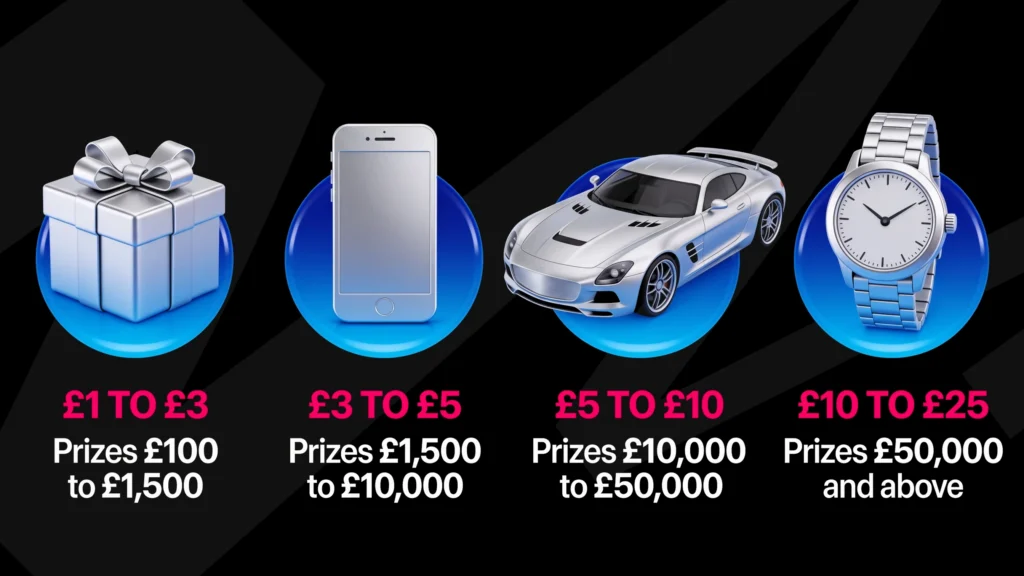
The typical UK raffle ticket price sits in one of four bands, determined by prize value and target audience:
| Price band | Prize value range | Typical niches | Ticket cap range |
|---|---|---|---|
| £1 to £3 | £100 to £1,500 | Cosmetics, lifestyle bundles, gift cards, tech accessories | 200 to 800 |
| £3 to £5 | £1,500 to £10,000 | Mid-range tech, jewellery, small cash prizes, designer goods | 500 to 1,500 |
| £5 to £10 | £10,000 to £50,000 | Cars, motorbikes, watches, large cash bundles | 1,000 to 3,000 |
| £10 to £25 | £50,000 and above | Luxury cars, property, holidays, premium watches | 1,000 to 10,000 |
Most operators land at £2, £3, or £5 because these price points balance perceived value against psychological friction. Below £1 the ticket reads as low-effort or low-credibility. Above £10 the audience pool narrows sharply and conversion rates fall faster than the price uplift compensates for.
How to price raffle tickets: the methodology in six steps
The methodology below is the same one we apply when setting pricing for a bespoke UK competition website build. It works at any scale.
Step 1: Calculate your prize cost coverage threshold
Your ticket price must, at minimum, allow the total sold tickets to cover the prize cost plus the variable costs of running the competition. The variable costs are:
- Payment processing: typically 1.4 to 2.5 percent of revenue with a specialist provider such as Cashflows
- Marketing spend allocated to the draw: usually £200 to £1,000 per draw depending on prize value and audience maturity
- Optional reserve for chargeback or refund risk: 1 to 2 percent
For a prize costing £900, processing at 2 percent, and £250 marketing spend, your break-even revenue is approximately £1,180. Below that revenue figure, the competition loses money even if every ticket sells.
Step 2: Set the ticket cap
The ticket cap is the maximum number of paid entries the operator will accept. It determines two things simultaneously: the upper bound on revenue and the odds of winning communicated to the audience.
Standard ticket cap calibration:
– Low-priced tickets (£1 to £3): 400 to 800 tickets per competition. Lower cap signals achievable odds.
– Mid-priced tickets (£3 to £5): 600 to 1,500 tickets. Balance between revenue ceiling and perceived value.
– High-priced tickets (£5 and above): 1,000 to 3,000 tickets. Higher cap needed to justify the price ceiling.
Operators who set caps too low for the price point fail to cover prize costs on full sell-out. Operators who set caps too high signal weak odds to the audience and suppress entry conversion.
Step 3: Determine the price floor
Price floor is the minimum ticket price that delivers your target margin at the chosen ticket cap, given the prize cost and variable costs.
The formula is:
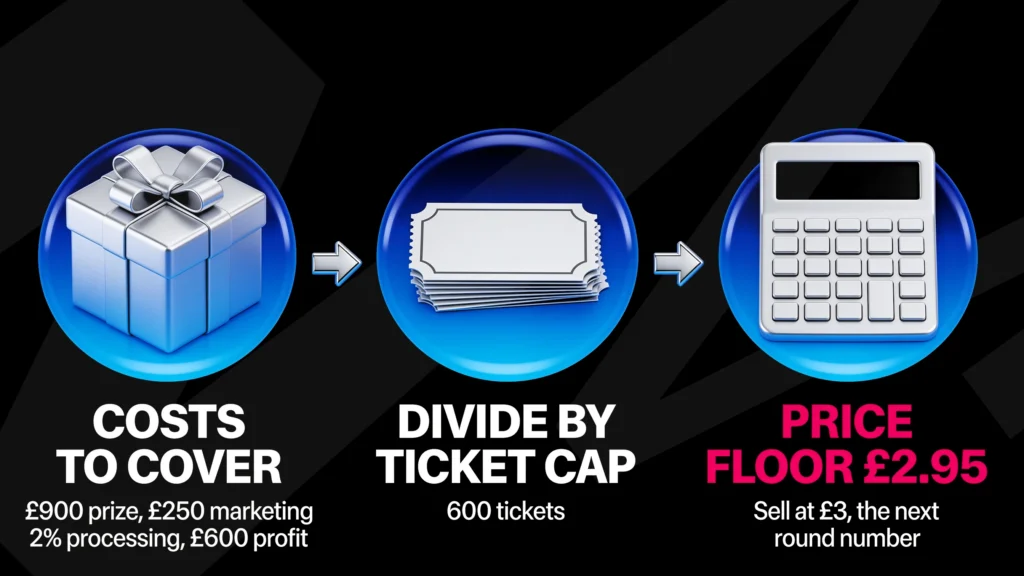
Price floor = (Prize cost + Marketing + Processing + Target profit) ÷ Ticket cap
For a £900 prize, £250 marketing, 2 percent processing, and a £600 target profit, with a 600-ticket cap:
Price floor = (£900 + £250 + 2% + £600) ÷ 600 = approximately £2.95 per ticket
Setting the actual price at £3 in this scenario delivers approximately £614 profit on full sell-out, which matches the worked example in our guide on how much it costs to build and run a competition website in the UK.
Step 4: Apply audience price sensitivity
The mathematical floor is necessary but not sufficient. The ticket must also feel right to the audience.
Audience price sensitivity rules we have validated across the UK competition sector:
- £2 and £3 ticket prices outperform £2.50 and £2.99 by approximately 8 to 12 percent in conversion. Round numbers reduce friction.
- £5 is a psychological cliff. Tickets priced £4.99 perform within 1 to 2 percent of £5 tickets, so the discount is not worth the messier maths.
- £10 is a stronger cliff. Tickets above £10 face a sharp drop in first-entry conversion rate but a higher repeat entry rate. Net effect varies by niche.
- £15 and £25 are acceptable for genuinely premium prizes (cars worth over £30,000, watches, property) where the audience expects to pay more for better odds.
Choose the closest round number above the calculated price floor that fits the audience price sensitivity rules above.
Step 5: Build the bundle pricing structure
Single-ticket pricing leaves money on the table. Bundle pricing increases average order value by 40 to 80 percent for operators who implement it correctly.
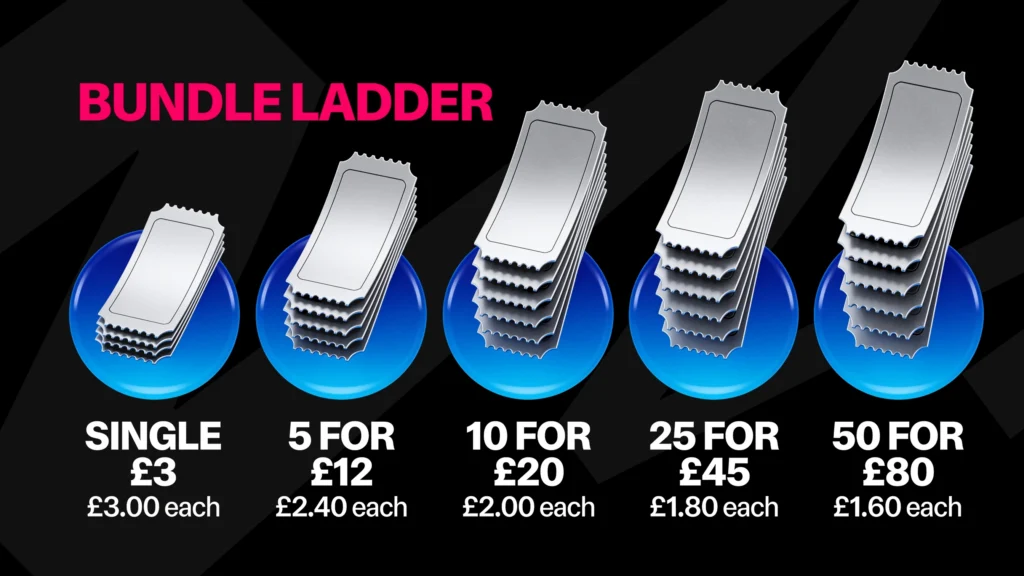
Standard bundle structure for a £3 single ticket:
| Bundle | Tickets | Bundle price | Effective per-ticket price | Discount vs single |
|---|---|---|---|---|
| Single | 1 | £3 | £3.00 | 0% |
| Starter | 5 | £12 | £2.40 | 20% |
| Standard | 10 | £20 | £2.00 | 33% |
| Premium | 25 | £45 | £1.80 | 40% |
| Power | 50 | £80 | £1.60 | 47% |
The discount curve should be steeper at the larger end. Bundles work because they:
- Lower the effective per-ticket price for high-intent buyers without lowering the headline price for first-time buyers
- Increase the average order value, which compresses payment processing fees as a percentage of revenue
- Improve perceived odds (a buyer with 25 tickets in a 600-ticket cap competition has a 4.2 percent chance of winning, which feels significantly better than the 0.17 percent on a single ticket)
Step 6: Test, measure, and iterate
Raffle ticket pricing is not a one-time decision. The right price for a £900 prize sold to a 5,000-follower Instagram audience is different from the right price for the same prize sold to a 50,000-follower audience.
Test one variable at a time. Hold prize value, ticket cap, and marketing spend constant. Test £2 vs £3 single-ticket pricing across two consecutive draws of equivalent prizes. Measure:
- Conversion rate from landing page visit to ticket purchase
- Average order value
- Final percentage of cap sold
- Profit margin per draw
Most operators reach a stable optimal price after three to five test cycles.
Niche-specific raffle ticket pricing benchmarks
These benchmarks reflect what we see working across UK competition websites we have built and supported. Apply them as a starting point, then test against your own audience.
Cars, motorbikes, and high-value vehicles
- Typical ticket price: £5 to £10
- Typical ticket cap: 1,500 to 3,000
- Typical prize value: £15,000 to £80,000
- Bundle structure: standard 1/5/10/25 with strong discount at 25
- Marketing cost per ticket sold: £1.50 to £3.00
The car niche has the highest absolute revenue per draw but the highest marketing cost per acquisition. Ticket prices need to clear the £3 floor consistently to make the marketing maths work. The deepest-pocketed operators in this niche price at £5 to £10 with strong bundle discounts to drive repeat purchases.
Cosmetics, beauty, and lifestyle bundles
- Typical ticket price: £1 to £3
- Typical ticket cap: 200 to 800
- Typical prize value: £200 to £1,500
- Bundle structure: 1/5/10/20 with milder discount curve
- Marketing cost per ticket sold: £0.50 to £1.50
The beauty and lifestyle niche has the lowest barriers to entry and is often the easiest first niche for a new operator. Audiences skew 70 percent female and respond well to £1 and £2 ticket prices. Bundles are essential because per-ticket margins are tight at low single-ticket prices once processing fees are accounted for.
Cash prizes
- Typical ticket price: £2 to £10
- Typical ticket cap: 500 to 2,000
- Typical prize value: £500 to £20,000
- Bundle structure: standard, with stronger emphasis on larger bundles
- Marketing cost per ticket sold: £0.80 to £2.50
Cash prizes have the highest flexibility because the prize cost is fixed and the perceived value matches the cost exactly. Pricing decisions in this niche are driven almost entirely by the target margin and the ticket cap. A £1,000 cash prize at a 500-ticket cap with a £3 ticket price delivers a £1,500 gross with a manageable cost structure.
Tech (consoles, smartphones, laptops)
- Typical ticket price: £2 to £5
- Typical ticket cap: 500 to 1,500
- Typical prize value: £400 to £4,000
- Bundle structure: standard
- Marketing cost per ticket sold: £0.70 to £2.00
Tech prizes work well across mid-range price points because the audience is broad and the prize is universally desirable. Apple products (MacBook, iPhone) consistently sell at higher ticket prices than equivalent-value PC alternatives because of brand perception.
Luxury (designer goods, watches, jewellery)
- Typical ticket price: £5 to £15
- Typical ticket cap: 500 to 2,000
- Typical prize value: £2,000 to £20,000
- Bundle structure: standard with premium tier
- Marketing cost per ticket sold: £1.20 to £3.50
Luxury prizes (Rolex, Hermès, designer bags) command premium ticket prices because the audience is status-driven and willing to pay more for fewer competitors. Bundles work strongly in this niche because committed buyers self-select into the premium tier.
Property and holidays
- Typical ticket price: £10 to £50
- Typical ticket cap: 1,000 to 10,000
- Typical prize value: £20,000 to £500,000+
- Bundle structure: extended bundle ladder up to 100 tickets
- Marketing cost per ticket sold: £2.50 to £6.00
Property raffles are specialist territory and not appropriate for first-time operators. The ticket prices and ticket caps are an order of magnitude above other niches, the marketing cycles are long, and the cap sell-out risk is significant. Pricing in this niche is heavily driven by the operator’s audience reach and reserves.
How payment processing fees affect your raffle ticket pricing
Payment processing fees compress your margins more at lower ticket prices than at higher ones, and the choice of payment infrastructure directly affects how low you can price.
For a £1 ticket processed through a specialist gateway at 2 percent plus interchange (effective rate approximately 2.4 percent), the operator nets approximately £0.976 per ticket. The processing fee consumes 2.4 percent of revenue. For a £10 ticket on the same infrastructure, the operator nets £9.76 and the processing fee consumes the same 2.4 percent. So far, percentage-wise, identical.
The compression appears when ticket caps and prize coverage come into play. At a £1 ticket price, the operator needs to sell at minimum 1,200 to 1,500 tickets to cover the same break-even point a £3 ticket reaches at 400 to 500 tickets. More tickets means more checkout completions, more chargeback risk, more refund handling overhead.
Stripe and PayPal compound this problem. Both routinely close UK competition accounts, and the few that survive long enough to process volume face surcharges and chargeback fees on top of the headline rate. For low-ticket-price operators, switching to a specialist competition payment provider is the difference between viable and non-viable. The reasons payment providers reject competition websites and the best UK banks and payment providers for competition sites guides cover the practical infrastructure choices in detail.
The free entry route and the stamp cost rule
UK competition operators must offer a genuine free entry route to qualify for the Section 339 exemption from gambling regulation. The Gambling Commission has a specific position on the relationship between paid ticket price and the cost of free entry that affects how you price.
If the paid ticket price is lower than the cost of a first-class stamp (currently £1.65 as of May 2026), the postal free entry route is at a cost disadvantage relative to the paid route. To remain compliant, the operator must allocate additional free entries proportionally so that no cost-based barrier prevents free entry being a genuine alternative.
The practical implication for pricing: if you set your ticket price at £1 or £1.50, you must increase the free entry allocation or change the free entry mechanism (online free entry rather than postal) to maintain Section 339 compliance. Most UK operators avoid this complication by pricing at £2 or higher, which keeps the paid and free entry routes at equivalent cost from the entrant’s perspective.
The full free entry route compliance framework is covered in how to run a raffle legally in the UK and the underlying licence position in do you need a gambling licence for a competition website.
Why we will not give entrants a free ticket, and what to do instead
Operators regularly ask us to build a buy ten get one free mechanic. We advise against it, and the reason is worth understanding before you set a price.
A free ticket is still a live entry with its own number. It is an extra chance to win that nobody has paid for. On a site running instant wins, that free ticket can land on a prize, which puts you in exactly the position the mechanic was meant to avoid: paying out against revenue you never collected. On a single prize draw it quietly dilutes the odds you advertised.
There are three better ways to give the same feeling of value while keeping every entry funded.
Automatic discount tiers reduce the price per ticket as quantity rises, so a bulk buyer feels rewarded and every ticket in the draw is still paid for. Ticket bundles package set quantities at a fixed promotional price, which works well for a short campaign. Automatic site credit tops up the entrant’s wallet after a purchase with a balance they can only spend on future entries.
Site credit is usually the strongest of the three. It protects your margin, it keeps every entry in the draw funded, and it brings the entrant back instead of discounting a purchase they were already making.
Common raffle ticket pricing mistakes
The pricing mistakes we see most often, in order of frequency:
1. Underpricing relative to prize value. Operators who set tickets at £1 for a £5,000 prize often fail to clear marketing costs even on full cap sell-out, because the cap they need to set to balance the maths produces odds that suppress conversion. The fix: raise the ticket price to £2 or £3 and reduce the cap.
2. Overpricing relative to audience price sensitivity. Setting tickets at £7.50 when the audience and prize support £5 produces a 10 to 20 percent drop in conversion rate that more than offsets the 50 percent price uplift. The fix: respect the round-number cliffs (£3, £5, £10, £25) and price at or just below.
3. Wrong ticket cap for the price point. A £2 ticket with a 200-ticket cap on a £900 prize is mathematically impossible to break even. A £10 ticket with a 5,000-ticket cap on the same prize cannot sell out. The fix: calculate the price floor at Step 3 first, then set the cap to match.
4. No bundle structure. Operators who offer single-ticket pricing only leave 40 to 80 percent of potential revenue uncaptured. The fix: implement a standard bundle ladder at launch, not as a later add-on.
5. Inconsistent pricing across competitions. Operators who price their first £900 prize at £2 and their second £900 prize at £3 confuse audiences and suppress repeat entry. The fix: lock pricing rules to prize value bands, not to individual competitions.
6. Hidden or unclear pricing on the page. Tickets priced clearly at the top of the page convert better than tickets priced only at checkout. The fix: prominent pricing above the fold, bundle structure visible, no hidden fees.
7. Ignoring the free entry equivalence rule. Operators who price below the stamp cost without adjusting the free entry mechanism risk failing the Section 339 test, which removes the gambling exemption and reclassifies the competition as an unlicensed lottery. The fix: price at £2 or higher, or offer an online-only free entry route with no cost barrier.
For a broader view of the structural mistakes new competition businesses make, the biggest mistakes new competition businesses make guide covers the surrounding context.
How ticket price affects checkout conversion
Ticket price affects checkout conversion less than most operators expect. Across UK competition websites we have analysed, the largest contributors to checkout abandonment are forced account creation, slow page load, unexpected fees, and unclear competition closing time. Ticket price ranks behind all of these.
What this means in practice: an operator who raises their ticket price from £2 to £3 typically sees a 3 to 5 percent drop in completion rate. An operator who removes forced account creation typically sees a 12 to 18 percent uplift. The price decision matters, but the friction decisions matter more.
The full breakdown of checkout abandonment causes and the fixes that work is in our guide on reducing abandoned entries on prize draw websites.
Disclosing ticket pricing in your competition terms and conditions
UK competition T&Cs must specify ticket price clearly, including any bundle pricing, the maximum number of entries per person, and any limits per household. This is a legal requirement under consumer law and a structural requirement under payment provider underwriting. Specialist providers including Cashflows review T&Cs as part of merchant onboarding, and inconsistencies between displayed pricing and T&Cs pricing are a common reason applications are delayed.
The full T&Cs requirement list is covered in what must be included in UK competition website terms and conditions.
When to change your raffle ticket pricing
Price changes should be triggered by data, not by hunch. The three signals that justify a pricing review:
Margin pressure. If your last three competitions cleared less than 10 percent profit margin on full sell-out, the price floor calculation has shifted underneath you. Re-run the price floor formula at Step 3 and adjust.
Sustained conversion drop. If your conversion rate from landing page to ticket purchase has dropped more than 15 percent across three consecutive draws while prize value and marketing spend are stable, the price is out of step with the audience. Test a £1 reduction.
Competitive pressure within your niche. If a directly comparable competitor launches a competition with similar prize value at a meaningfully different price point and outperforms you on cap sell-out, that is a signal to test their price band. Do not match it without testing.
Pricing changes should never be made in the middle of a live competition. Run the change on the next draw and measure the result against the previous baseline.
How pricing connects to the wider competition business model
Raffle ticket pricing is one of four pricing decisions a UK competition operator makes during launch. The others are prize value, ticket cap, and marketing spend per draw. Together these four levers determine whether the business hits its profit target on any individual draw. The broader business setup, including how to structure the operating company, the platform build, payment infrastructure, and compliance architecture, is covered in how to start a competition business in the UK and how to start a raffle business in the UK.
The four levers are not independent. A change to one forces a recalculation of the others. Operators who treat ticket pricing as a standalone decision tend to revise it within the first three to five draws once the interaction effects become visible. Operators who build pricing into the wider model from day one, with prize value, ticket cap, and marketing spend mapped together, reach stable optimal pricing significantly faster and avoid the most common revenue-shaping mistakes the rest of this guide describes.
Most operators copy a competitor’s ticket price and hope. Nera Marketing prices each competition against the prize value, the audience size, and the platform fees so the operator hits a sustainable margin from competition one.
Pricing raffle tickets in the UK is the single decision that determines whether a competition site runs profitable, breakeven, or loss-making. Nera Marketing has modelled the unit economics across dozens of operator builds.
Ready to build your competition website?
Every site we build is yours, no lock-in, with prize and payment infrastructure ready from day one. Packages from £2,995.
Talk to us →