
Selling Into Ireland From a UK WooCommerce Store: Multi Currency or a Second Store


TLDR
WooCommerce allows one currency per store, so selling into Ireland in euro is a second-store decision, not a plugin decision. Stripe cannot change a live account’s business origin country. On one 2026 build the site was ready in nine days and the launch then waited on a company number and a bank account.
WooCommerce holds one currency per store. A multi currency plugin changes what the customer sees, not what the store is, so the real decision is settled before you reach the plugin page. If you want euro prices, an Irish company, an Irish payment account and Irish delivery terms, you need a second store. Nera Marketing built one in 2026 for a UK aluminium glazing specialist, one of more than 50 stores we have built on WordPress and WooCommerce. The build reached a reviewable staging site nine days after the euro price list landed. Sixteen days after that the launch was still waiting on a company number and a bank account, and not one hour of that wait was development.
One store, one currency
WooCommerce treats currency as a single store-wide setting. Its own documentation is explicit: “Sets your store’s default currency. Only one currency may be selected.” Everything a multi currency plugin does sits on top of that one setting. It converts what is displayed, and the better ones take payment in the selected currency. What the store legally is underneath does not move.
That distinction is missing from almost everything written on the subject. Of the nine organic results ranking in the UK for “woocommerce multi currency” on 27 September 2026, all nine are plugin documentation or plugin listings. The top result is an installation guide. Its headings are Installation, Setup and Configuration, Currency Exchange Rates, Setup Currencies, the Currency Switcher Widget and Geolocation. Across the whole page, a legal entity is mentioned zero times, a VAT registration zero times, a payment account zero times and delivery pricing zero times. The pages answer “how do I show euros”. Nobody asks whether showing euros is the thing you actually need.
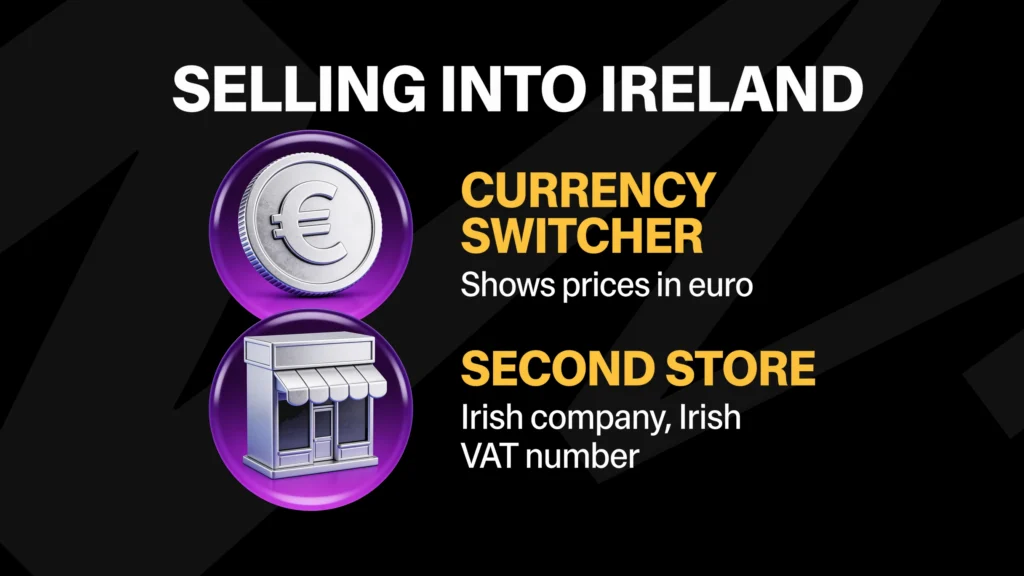
| The question you are really asking | Currency switcher on one store | Second store |
|---|---|---|
| Show prices in euro | Yes | Yes |
| Take payment in euro | Yes, if the gateway supports it | Yes |
| Trade as an Irish company | No | Yes |
| Put an Irish VAT number on invoices | No | Yes |
| Irish company details on the terms | No | Yes |
| Separate euro price list, not converted | Rarely, and awkwardly | Yes |
| Irish delivery pricing and collection point | Partly, through shipping zones | Yes |
| Separate payment account and settlement | No | Yes |
| Different products available per market | No | Yes |
| Maintenance effort | One store | Two stores, permanently |
Read the right-hand column before the left. If every row you need is in the top two, a switcher is the cheaper answer and you should stop there. Once a single row below those two matters, the switcher cannot get you there at any price. On the store in this article that was true from the start: 35 products carrying 380 separately priced combinations, so showing euros was never going to be the job.
How do I change the currency in WooCommerce?
Go to WooCommerce, Settings, General, and set the currency under Currency options. The same screen controls currency position, the thousand and decimal separators, and the number of decimals. Changing the currency changes how every price is displayed and converts nothing, so the store keeps its old numbers with a new symbol in front of them.
What is the best multi currency plugin for WooCommerce?
We will not name one, because we have not run a multi currency plugin in production. Our cross-border work has been second stores. Judge any candidate on one question before features or price: does your payment gateway settle in the currency the customer saw, or convert at its own rate on capture. If it converts, your margin moves with the rate.
The payment account decides it
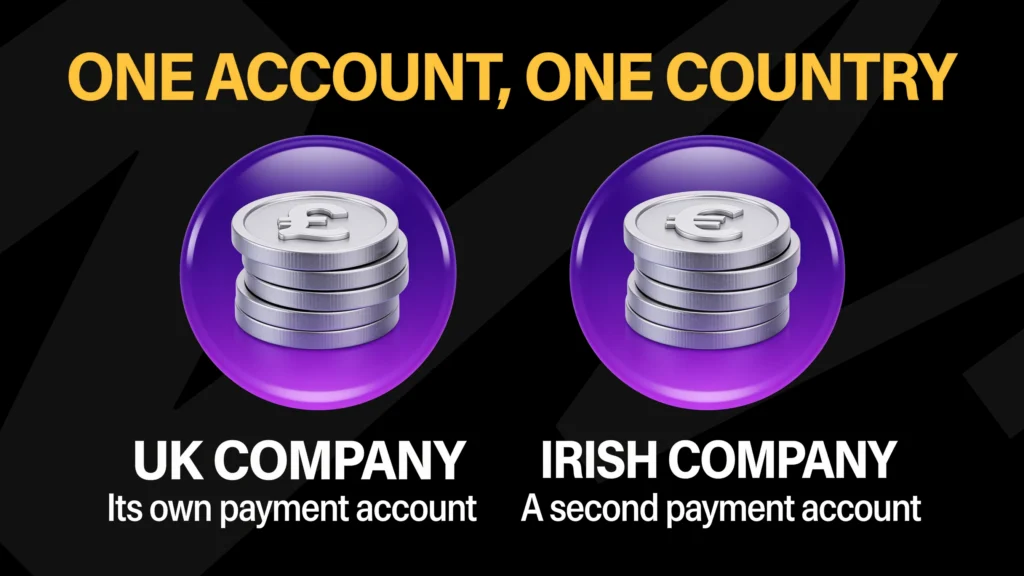
The constraint that settles most of these projects is not the website. It is the payment account. Nera Marketing holds five payment gateway partnerships, and on a cross-border build the provider’s rules decide the architecture before any code does. Stripe’s are the clearest: “After activating a Stripe service on a live account, you can’t change the business origin country. To use a different supported country as your primary business location, create a new account.”
One account, one business origin country. If the Irish sales are to settle into an Irish company’s bank account, under an Irish entity, that is a second payment account by the provider’s own rules. A second payment account needs its own keys, its own webhooks and its own test transactions before launch. Putting two sets of live keys on one WooCommerce store, routed by the customer’s address, is possible and we do not recommend it. You end up with one order table holding two companies’ sales, which your accountant will have to separate every month forever.
Can I use one payment account for both stores?
Only if both stores belong to the same company. The account is tied to one business origin country at activation, so an Irish entity means a second account with its own keys, its own webhooks and its own test transactions before launch. Running two sets of live keys on one store puts two companies’ sales in one order table.
This is why the platform decision and the payments decision cannot be taken in sequence. Our WooCommerce development work starts with the payment and entity questions on cross-border projects, because the answers dictate whether there is one codebase or two.
Do you need an Irish company to sell to Irish customers?
No. A UK company can sell to Irish customers and ship from the UK, priced in sterling. You need the Irish company when you want euro prices set independently, an Irish payment account, an Irish address on the terms and an Irish VAT number on documents. That is a commercial decision, not a technical one, and it dictates everything downstream.
It is also the part that delays launches. On this project the technical build was finished and sitting on staging on 11 September 2026. On 27 September it still had not gone live. What was missing, every item of it from the client’s side and none of it code:
- The company number, with incorporation still in progress
- The VAT number, which in Ireland is a separate registration with Revenue rather than something incorporation hands you
- The registered address for the footer, terms and invoices
- An Irish phone number and email address for the contact page and order notifications
- The Irish payment account, which could not be opened until the company existed and the business bank account was open
We shipped the build with placeholders in all five places and said so in writing. If you are planning a second-country store, start the company formation before the build, not alongside it. Formation is the long pole. A duplicate store is a matter of days.
How the second store gets built
A second-country store is a duplicate of the original with eleven things deliberately changed. We work from a fixed list, because the failure mode on this kind of project is not a broken page, it is a page that still quietly says the wrong country. Every item below was changed on this build between the brief and the 11 September staging review.
| What changes | What it became on this build |
|---|---|
| Store currency | Euro, store-wide |
| Product prices | A separate euro list supplied by the client, not converted |
| Products offered | Four standard sizes of one range at launch, rather than the full UK catalogue |
| Accessory products | One add-on sold as its own product, priced per square metre |
| Delivery | Flat €180 across the Republic of Ireland |
| Collection | Free from a Dublin depot, by prior arrangement only |
| Selling location | Restricted to Ireland, so checkout rejects other addresses |
| Customers outside the market | UK and Northern Ireland addresses pointed to the UK store |
| Services withdrawn | Supply and fit switched off for launch |
| Company details | Irish entity, company number, VAT number, registered address, on terms and invoices |
| Payment account | Separate account under the Irish company |
The selling restriction is worth dwelling on, because it is a two-line settings change that prevents a whole class of problem. WooCommerce’s selling location setting accepts All countries, All countries except, or Specific countries, and shipping can be limited to a subset of those. Set to Ireland only, the euro store cannot accidentally take a UK order at Irish prices with Irish delivery. Every store selling the same product in two markets needs that fence in both directions.
The wider range presented a second question. The client sells windows, sliding doors, rooflights and entrance doors alongside the doors being listed. Building all of it in euro for launch would have doubled the work for products with no proven Irish demand. Those ranges went on the site as enquiry routes instead, with a contact form, and the plan is to list them properly once the Irish side is paying for itself. That is usually the right call. A product page that cannot be bought is worth building only when you know people want to buy it.
Set the prices, do not convert them
Set them. A converted price moves with the exchange rate, and on a £3,000 product a two percent move is £60 appearing or disappearing from a price the customer saw last week. It also produces figures no retailer would choose to display. On this build the client sent a euro price list, and the euro prices were higher than the UK equivalents.
The first question we asked was whether they had a set list or wanted a conversion rule applied to the UK prices. A price list is the normal answer for a high-value product, and it is the opposite of what a currency switcher does by default. A set price list gives the retailer round numbers, the margin on Irish delivery, and a price that holds still long enough to advertise.
Then there is the arithmetic people miss. The Irish store went to staging with four purchasable sizes, in a band from roughly €3,000 to €3,900, with an upgraded version of each between roughly €4,000 and €5,700. Those are not four prices. Each product carries an options matrix, and on the UK store the equivalent products publish 36 priced combinations each, from three attributes multiplied together. A second price list means re-pricing every published combination, not every product.
We know what happens when one combination is missed, because it happened on the UK store in August 2026. An upgrade that should have added £4,410 to the order was selectable at no cost. The client found it, not us. Nothing in the WooCommerce admin flags a variation priced below its siblings, so the only reliable check is to read every published combination’s price after a price change, either by exporting the variations or by walking the product’s own API response. That check is now part of how we sign off a price list.
Prices shown to Irish consumers include VAT
Every price a consumer sees on an Irish store must be the total price including VAT, with delivery and any other charges made clear. The Competition and Consumer Protection Commission is direct about it. Products sold only to business customers may show prices excluding VAT, and those may be marked trade only. That single rule catches UK retailers carrying B2B habits across.
Our client’s instruction was to advertise the prices and write nothing about VAT. Read literally that sounds like a conflict with the rule. It is not, and the distinction matters for anyone building one of these stores. The obligation is that the number shown is the VAT-inclusive total the customer pays. There is no obligation to break VAT out, itemise it, or explain it on a consumer product page. So the euro prices went up as inclusive totals, delivery was stated as a flat charge, and no VAT commentary appeared on the product pages at all. That satisfies both the client and the CCPC guidance.
The place VAT does have to be right is the paperwork. Invoices, terms and the footer carry the company number and VAT number, which is exactly why those five missing details held the launch rather than the build.
One question this article deliberately does not answer. Where the goods physically move from matters as much as where the company sits, and a UK company shipping to an Irish customer is a different tax position from an Irish company selling domestically. Import VAT, duty and the paperwork that follows are decisions for an accountant rather than a developer, and they want settling before the store is built rather than after.
Delivery and collection are the parts people underestimate
Delivery is where a second-country store stops being a copy. The client’s own cost to deliver in Ireland was around €180, so delivery was set as a flat €180 across the Republic of Ireland rather than calculated by weight or zone. A single flat rate is often the right answer for oversized goods on a small catalogue. It is predictable for the customer, it cannot be gamed by a multi-item basket, and it needs no table rate rules.
Collection was added alongside it, free, from a Dublin depot, strictly by prior arrangement with times confirmed after the order is placed. That one line of copy does real work. Without it, a customer twenty minutes from the depot pays €180 to have a door delivered past it.
How do I stop UK customers ordering from the euro store?
Restrict the selling location to the market the store serves, and limit shipping to the same list. A euro store set to Ireland only cannot take a UK order at Irish prices with Irish delivery. Then put a visible notice on both stores pointing each market at the right one, and check it appears on every product rather than one.
Two further decisions completed the picture. Supply and fit was switched off entirely for launch, because there was no installation network in the market yet, and the plan is to add it later. The UK store’s product pages now carry a notice pointing Irish customers to the euro store, which is the cross-sell direction that matters most, since the UK site is the one with the existing traffic and rankings.
A duplicate store is not a redesign
The commercial risk on a second-country store is scope, and it surfaced here on schedule. The build was agreed as a duplicate using the existing content, structure and design, specifically to keep the cost down, and we reduced the price on that basis. On 15 September 2026, having seen staging, the client asked for a different layout, different navigation and a homepage unlike the UK site.
The reason given was that Irish customers should feel they were dealing with an Irish operation rather than a redirected copy. That is a reasonable thing to want. It is also a different project. We said so the next morning, set out what had been agreed and why the price reflected it, and offered two routes: launch as agreed with Irish touches added inside the existing build, or treat the redesign as its own piece of work on its own timeline. The client took the first option within twenty minutes, and added a useful sentence: once the Irish side starts paying for itself, look at a fuller redesign as a second phase.
What went in under the existing structure, agreed on 16 September and delivered by 23 September: a new hero image not used on the UK site, refreshed imagery across every page with alt text written for the new market, subtle colour accents in hover states and dividers, a nationwide delivery section with a map, product descriptions rewritten in euro, and the removal of every UK-specific element including the UK address, phone number, case studies, reviews and a payment brand not offered in the new market. Structure, navigation, layout, brand colours, logo and typography did not change. No price change, no timeline change.
Say that out loud at the start of a project like this. A duplicate store gives you a market in days precisely because the design is already decided. The moment the design reopens it is a new build at a new price, and we would rather have that conversation on day one than at launch.
What does it cost to run two stores rather than one?
The cost of the second store is not the build, it is the permanent doubling of every routine job. A promotion runs twice. A price change happens twice. A product photo, a technical document, a certification PDF, a terms update: twice. The UK store in this case carries 35 products and 380 published variations, so “update the range” is never a small job on one site, let alone two.
Divergence then arrives quietly. When we checked the live UK store on 27 September 2026, the notice pointing Irish customers at the euro store appeared on one product page out of 35, and the domain in that link did not resolve, because the Irish domain had not been confirmed when the copy was written. Both are five-minute fixes. Neither produces an error anyone notices, which is precisely why cross-store links belong on a launch checklist with the DNS, not in the copy pass.
The same applies to order notifications, the quietest failure on any store. Two stores mean two sets of transactional email, two sender domains and two inboxes that a member of staff has to actually receive. Earlier in this engagement, order notification emails on the UK store stopped reaching the client for several days. Nothing was broken on the site, and the site’s own logs showed everything sending. The address had previously bounced and sat on a suppression list, and the client’s order notifications had been routed through a forward from a legacy domain. A week of enquiries arrived late and duplicated, and one customer went elsewhere. From the client’s side that looked exactly like lost sales, which is how order emails usually fail: silently, and for days.
The lesson Nera Marketing now applies on every multi-store build is that order notifications must go to a mailbox on the store’s own domain, never through a forward from an old one, and that both stores get a test order before launch and after any DNS change. That is the sort of thing our WooCommerce development team writes into the launch checklist rather than trusting to memory, because on a two-store setup every check has to be done twice and only one of them is ever on your mind.
Ready to build your competition website?
Join hundreds of operators running prize draws with NERA's platform.
Talk to us →