Built around a brand that already worked
John and Eden did not need an audience. They needed a competition website their audience would recognise as theirs.
That ruled out the obvious route. A generic competition template with a farm logo dropped into it would have broken the one thing driving the entries, which is that people trust these two farmers. So Nera Marketing built the site around the existing brand rather than around the software.
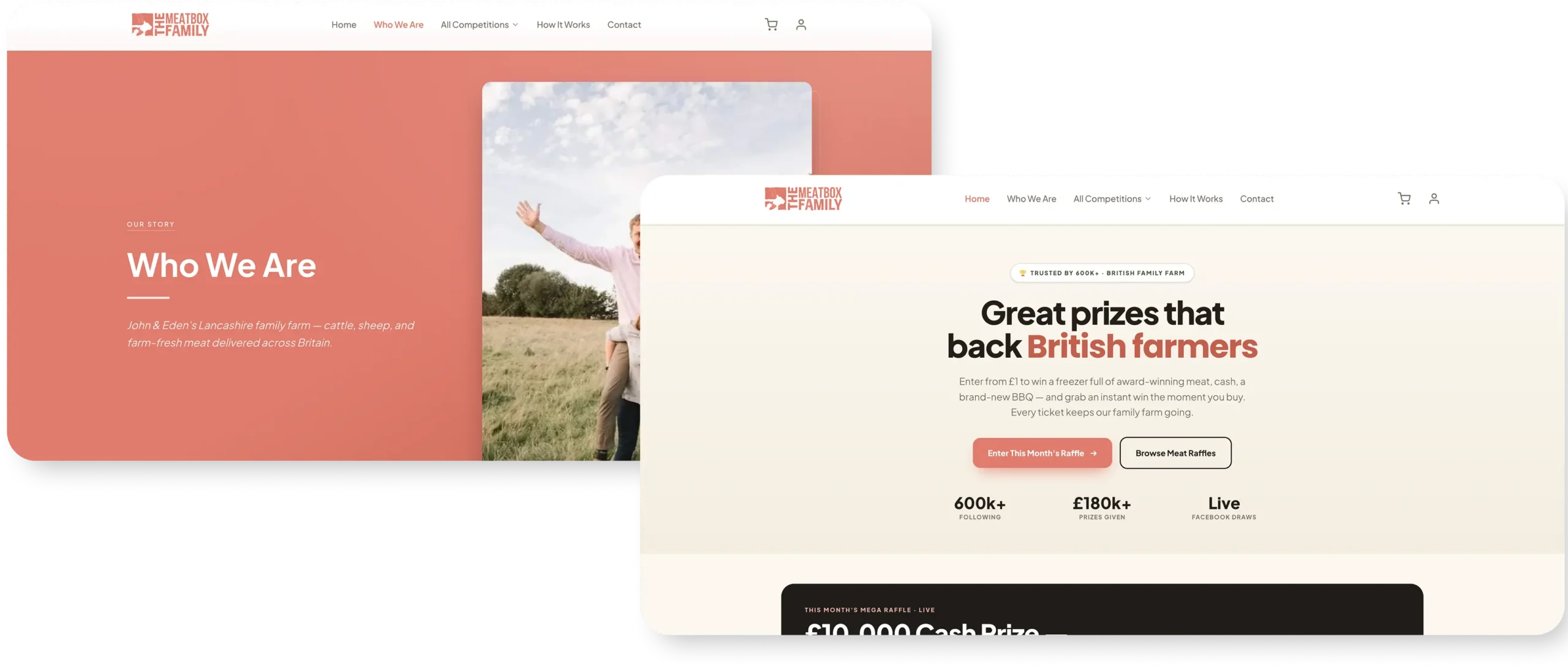
The farm story sits on the homepage next to the live competitions, not buried on an about page. The prize pages are built for quarter-cow beef boxes, whole butchered lamb, mutton and half-pig pork boxes, with the retail value shown so entrants can judge what they are entering for. The Bebas Neue type and the pink carried over from the brand. We reworked the logo into colour variations so it still reads at distance on a livestream, because livestreams and video are where John and Eden actually sell.
What the brief asked for
- Keep the Meatbox brand, not a template with a logo swapped in. Same voice, same look, readable on a livestream.
- Prize pages built for farm produce: meat boxes by weight and cut, with retail value shown so entrants can judge the odds.
- Free UK-wide delivery handled as part of the prize journey, from draw to butchery to doorstep.
- A £5 checkout that stays clear on mobile, where almost all the traffic arrives from social.
- Instant wins alongside the main draws, so there is a reason to enter on a day when nothing is closing.
- Room to add repeat entry by subscription later, without rebuilding the platform.
Payments came first, because payments stop most operators
Every competition operator we onboard hits the same wall. Stripe, PayPal and Shopify Payments all refuse competition and prize draw businesses. Operators usually find out after they have paid for a website, which is the worst possible order to discover it in. We wrote up why payment providers reject competition websites because it is the first wall every single one of them hits.
So we started the payment work alongside the build rather than after it. Meatbox Family runs on Cashflows, a specialist acquirer that underwrites competition operators in the UK and Ireland. That is not a plugin you install. It is a merchant application, underwritten on the strength of the business case put in front of it, and it needs an accurate account of how entries are sold, what the skill question does, how the free route works, what appears on the customer’s bank statement as a descriptor, and what happens when a draw closes. We prepare that evidence while we build the checkout, so the journey the acquirer reviews matches the one described in the application. When those two disagree, underwriting stalls. Our comparison of UK banks and high risk merchant providers sets out the wider landscape.
Worth being honest about timing: payment underwriting is often the launch bottleneck rather than the development work. On this project the credential and banking side ran on the client’s timeline, and John and Eden chose to wait for the new bank and portal access to be in place rather than rush it. That was the right call.
Compliance is built into the journey, not bolted on
The competition structure was decided before the design was finalised, which is how we run every build.
This is the distinction the whole sector rests on. A raffle is a lottery, and a lottery needs a Gambling Commission operating licence. A prize competition with a genuine skill element and a real free entry route does not. We cover it properly in do you need a gambling licence and skill-based competitions versus prize draws.
So the platform enforces both. Entrants answer a skill question before they can complete an entry, and we test that logic before launch, because we have seen skill question code mark correct answers as wrong on other platforms and silently reject legitimate entrants. Every competition can also be entered without payment through the published postal route, which sets out the information required, the separate-postcard rule, the deadline for receipt and the equal treatment of paid and postal entries. Postal entries are added into the draw with an allocated ticket number so they compete on the same terms rather than nominally.
The terms identify the promoter, eligibility, competition dates, the prize process and how winners are contacted. The site carries 18+ and Be GambleAware messaging. Nera Marketing is a signatory to the DCMS Voluntary Code of Good Practice, in effect since May 2026, and we build against it as standard. Our compliance work is what gets operators to that position.
That structure supports a compliant operation. The promoter remains responsible for how each individual competition is run and advertised.
What the platform is built on
The site runs on WordPress and WooCommerce, and John and Eden own it outright. The files, the database, the domain and the customer list are theirs. Nothing core is rented from us or from a SaaS competition provider, which is the difference we set out in WordPress versus SaaS competition platforms.
Some specifics that shaped the build:
Ticket progress and guaranteed odds are shown live. Each competition page displays the percentage sold against a fixed cap. A capped pool is what makes the odds knowable, and showing the sold percentage is what makes them believable. How to set that cap and the entry price is its own decision, covered in how to price raffle tickets.
Instant wins run alongside the main draws. Prizes like £10 site credit, a leg of lamb and branded merchandise are allocated against specific ticket numbers, and the win or no-win result fires at the point of purchase rather than on a later page refresh. That has to be verified on mobile in particular, because an instant win that only reveals itself after a reload reads as a broken site. The full mechanics are in our guide to instant win competitions.
Site credit needed a wallet, not a coupon. Offering credit as a prize means holding a balance against a customer account and spending it down at checkout, which has to survive a partial spend.
The £5 entry price is a load profile, not just a price. Low ticket price with high quantity generates the most orders per minute of any competition model, and instant wins concentrate them further. The failure point under that load is almost never WordPress or the page loads. It is the place-order step, usually because marketing and email tooling fires tracking calls before the order completes, so every customer waits on those tools before seeing a confirmation. We build checkout so tracking and the confirmation email fire after the order completes, which is why we treat performance hosting as commercial infrastructure rather than technical housekeeping.
The prize journey is the product
For farm produce, the prize is perishable and the delivery is the experience. That makes fulfilment part of the build.
The platform connects entry, winner contact, butchery and delivery as one sequence. Pick a competition. Answer the question and take tickets, or enter free by post. Winners are selected automatically by random number generator, and the Monthly Mega Meat Raffle draw is broadcast on social, usually TikTok. Winners are emailed whether they watch or not, and anyone can log into their account to check their tickets. The meat is then butchered and delivered anywhere in the UK free of charge.
Winners are published with the prize and its value. Three recent ones: a quarter-cow beef box worth £725, a half pig pork box worth £260, and a mega BBQ box worth £105. Publishing named winners and real values is a trust feature, not decoration, and it is central to designing a competition site that builds trust. Operators who hide winner names until a threshold is reached end up looking like they are hiding something, especially on low prize counts where the threshold is never reached.
Because the draws are broadcast, the live draw and TikTok side of the operation is part of the product rather than an afterthought.
What we deliberately did not build first
Subscription entries were the one thing we held back.
John and Eden wanted repeat entry on a recurring payment, and we could have built a custom scheduler against the Cashflows subscription API at extra cost. Our advice was to launch without it and add it once the platform had trading history behind it. Getting live earned more than waiting for a feature would have, and the platform was built so it can be added without a rebuild.
Where the platform is now
The site runs individual meat box competitions, a monthly mega draw carrying over £2,000 of prizes, instant wins, a closed prizes archive and a public winners area. A free giveaway runs every time the farm hits a new follower milestone, with no purchase needed. Cumulatively it has awarded more than £45,000 in prizes across more than 250 winners.
The prize mix has stayed tied to the farm: beef, lamb, mutton and pork boxes, site credit and branded merchandise. Nothing has drifted into unrelated generic prizes, which is how a farm-led competition brand starts looking like every other competition site. Keeping prizes on-brand is a discipline, and we cover the wider question in prize sourcing for competition websites.
The competition platform links back to the direct-sales shop, so the draws feed the wider farm-to-door business rather than competing with it. The live site credits Nera Marketing as the website designer in its footer.
“We started selling our meat direct from the farm in 2022 after realising how little we were receiving from supermarkets.”
John and Eden, founders, The Meatbox Family. Published on meatboxfamilyraffles.co.uk.
What other operators can take from this
If you already have an audience, the platform is not the hard part. Keeping the reason that audience trusts you is the hard part, and getting paid is the part nobody warns you about.
Meatbox Family works because the competition site did not try to become the brand. It gave an existing one somewhere to sell. The farm story stays visible. The prizes come off the farm. The draws are published with names and values. The free entry route is real and documented. The payment setup was solved before launch rather than discovered after it.
John and Eden own the platform, the domain, the files, the database and the customer list outright. That is how we hand over every UK competition website we build, whether the operator arrives with 650,000 followers or none.