
How to Get RMG Approval on Facebook and Instagram: Step-by-Step Guide for UK Competition Operators

TLDR
To run paid Facebook or Instagram ads for a UK competition or prize draw website, you need Meta's RMG approval first. The application requires four things: a live, compliant website with a visible free entry route and skill question; a UK-qualified gambling solicitor's legal opinion letter; a registered limited company with a verifiable trading address; and completion of Meta's RMG Questionnaire. Most applications take two to six weeks. Rejections typically add two to four weeks per resubmission cycle.
Meta will not let you advertise UK prize competitions on Facebook or Instagram without formal Real Money Gaming (RMG) approval. You cannot run a test campaign and see what happens. Meta’s automated systems flag competition language within hours of the first ad going live, and the standard outcome is account restriction or suspension before you have spent meaningful budget. The same RMG approval process applies to operators launching a raffle website platform as to those launching a competition site, because Meta classifies both identically under its Real Money Gaming policy.
The good news: RMG approval is achievable, and the process is predictable when you follow it correctly. The bad news: most operators discover what Meta actually requires only after they have already been restricted, by which point recovery takes 4 to 10 weeks instead of the 2 to 4 weeks an initial approval would have taken.
At Nera Marketing, we have taken over 50 UK competition operators through Meta’s RMG approval process. This guide covers the exact sequence that works: what to have in place before you apply, the application steps in order, what Meta reviews during the application, the most common rejection reasons, and how to maintain approval once you have it.
What is RMG approval and why does Meta require it for UK competition websites?
Real Money Gaming (RMG) is Meta’s internal classification for businesses that operate prize draws, competitions, gambling, lotteries, fantasy sports, and similar prize-based activities. Nera Marketing has taken more than 50 UK competition operators through this classification. The classification triggers an additional review layer on top of Meta’s standard advertising policies, designed to verify that the operator is licensed or legally compliant in each jurisdiction they advertise into.
UK prize competition websites fall under the RMG policy even though they are not classified as gambling under the Gambling Act 2005. Meta applies the policy globally based on the activity (prize-based participation in exchange for entry), not the local legal classification. The Real Money Gaming label is therefore not a comment on the legality of your competition. It is Meta’s internal label for the category your business sits in, and it requires you to complete their RMG approval process before any paid advertising can run on Facebook or Instagram.
Without RMG approval, your competition ads will be rejected at the policy review stage, your ad account will be restricted on first detection, and in some cases your entire Business Manager will be flagged. The Meta RMG approval process for UK competition websites is the only legitimate route to advertising a UK competition website on Meta platforms.
When to start your Meta RMG application
Nera Marketing begins the RMG application 4 weeks before a client’s planned launch date. This gives Meta enough time for its standard 2 to 4 week review window, with a buffer for clarification requests if any documentation needs to be resubmitted.
Operators who delay the application until creative is built and ready to run consistently lose 2 to 3 weeks of paid acquisition. The application timeline runs independently of website build, payment provider onboarding, and creative production. There is no reason not to start it early.
Payment provider onboarding (typically Cashflows for UK competition operators) can run in parallel with the RMG application. The two processes do not depend on each other, but both depend on the same underlying compliance structure being in place on the website.
Pre-application checklist: what you need before you apply
Submitting an RMG application without the underlying pieces in place is the fastest route to rejection. Meta will review every item below during the application, and a missing or weak element on any one of them is enough to trigger a rejection.
A registered UK limited company. Meta will not approve RMG applications from sole traders or unregistered entities. Companies House registration takes 24 hours and costs £50. Do this before anything else.
A Business Manager with a verified domain. Your Meta Business Manager needs to be linked to your competition website domain, and the domain needs to be verified via the DNS TXT method or HTML upload method. Unverified domains cannot pass the RMG review.
A compliant website. Meta reviews the live website as part of the application. The site needs:
- A free entry route displayed prominently on every competition page, at equal visual prominence to the paid entry option
- A genuine skill question that prevents a meaningful proportion of entrants from answering correctly
- Terms and conditions that cover every legally required field (the guide on what must be included in UK competition website terms and conditions covers the full list)
- A dedicated complaints page with a defined response timeframe
- Age verification implemented at account registration, not just at checkout
- A winners hub showing past draws with verifiable outcomes
- Voluntary Code compliance signals (player spending limits, account suspension tools, signposting to support services)
The Voluntary Code of Good Practice came into effect May 2026 and is increasingly referenced by Meta reviewers during the RMG application. Sites that meet the code’s standards clear the review more cleanly than sites that meet the legal minimum only.
A specialist legal opinion letter. This is the document that confirms in writing that your specific competition model does not constitute regulated gambling under the Gambling Act 2005. It must be written by a UK specialist gambling solicitor (not a generalist), and it must assess your actual website mechanics rather than confirming general principles. Nera Marketing arranges the specialist legal opinion letter for prize competitions from £1,195. Template letters from generalist solicitors are routinely rejected by Meta.
A documented draw process. Meta wants to see how winners are selected. This needs to be explained in your terms and conditions, on the competition page itself, and (ideally) demonstrated via past winners in your winners hub.
Tax registration confirmation if requested. Meta sometimes asks for confirmation that the business is registered for tax in the UK. Have your HMRC documentation ready in case it is requested mid-application.
If any of these elements is missing or weak, fix it before submitting. The 2 to 4 week application clock starts when you submit. Time spent fixing structural gaps during the application is wasted.
The step-by-step Meta RMG application process
The application happens entirely within Meta Business Manager. The process below reflects how it works as of May 2026. Meta updates the interface periodically, but the core flow has remained stable for the last 18 months.
Step 1: Submit the RMG interest form via Business Manager
Inside Meta Business Manager, the exact navigation path is: Business Suite → Settings → Authorisations and Verifications → Gambling & Gaming → follow the steps outlined. Meta will then contact you within Business Manager requesting the legal letter of opinion. The interest form captures basic business details: company name, registration number, registered address, primary website, and the jurisdictions you intend to advertise in.
For UK-only competition operators, select United Kingdom as the sole jurisdiction. Selecting additional jurisdictions extends the review timeline because Meta reviews compliance against the laws of each one. Across the 30+ UK competition site applications we have submitted, UK-only selection consistently delivers the fastest review.
One practical detail: you need a laptop or desktop to complete the application cleanly. The full Business Suite settings interface is not reliably accessible on mobile, and Meta’s document upload step expects desktop-grade file handling. Operators who start the application on phone tend to need to redo steps.
Step 2: Complete the operator questionnaire
Once the interest form is submitted, Meta provides the operator questionnaire. Typical questions include:
- What type of prize-based activity does your business operate? (Prize competition, prize draw, free draw, raffle, fantasy sports, other)
- How are winners selected? (Skill question, free entry plus paid entry with random draw, instant win, other)
- What is the maximum prize value across your active competitions?
- Do you offer a free entry route? (Yes/No, with details)
- Are you licensed by the UK Gambling Commission? (Yes/No, with explanation if no)
- Does your business comply with applicable UK consumer protection and advertising laws?
Answer truthfully and precisely. Vague or evasive answers extend the review and increase the rejection risk.
Step 3: Upload the supporting documentation
Meta requests several documents during this stage. The standard list includes:
- Companies House registration certificate
- Specialist legal opinion letter confirming the competition model is legally compliant in the UK
- Sample terms and conditions
- Sample competition page URL demonstrating the live free entry route
- Evidence of age verification implementation
Upload in PDF format where possible. Image-only uploads (screenshots) sometimes fail Meta’s automated parsing and require resubmission.
Step 4: Confirm your jurisdictions
Meta will ask you to confirm the geographic areas where you intend to advertise. For UK competition operators advertising to UK residents, the jurisdiction is the United Kingdom. Selecting additional countries means Meta will review compliance against those countries’ laws, which can add weeks to the timeline.
If you intend to advertise to Republic of Ireland residents in the future, you can add Ireland here, but be aware that payment providers including Cashflows currently restrict UK competition operators to UK and Ireland customers only. Other jurisdictions are not supported by the underlying payment infrastructure.
Step 5: Submit the legal opinion letter
The legal opinion letter is the document Meta uses to verify your competition is legally compliant. A passing letter needs to:
- Be written by a specialist UK gambling solicitor
- Reference your specific competition mechanics (skill question, free entry route, draw process)
- Confirm the competition does not constitute regulated gambling under the Gambling Act 2005
- Confirm the free entry route meets Section 339 requirements
- Confirm the skill question meets Section 14 requirements if applicable
Template letters that confirm general principles without assessing your specific site mechanics are rejected. Letters from generalist solicitors who do not specialise in gambling law are also rejected. The single most common reason RMG applications fail is the legal opinion letter not meeting these requirements. Our legal opinion letter and RMG application service is structured specifically to pass Meta’s review on first submission.
Three specific terms-and-conditions issues we have to fix on operator sites before the legal opinion letter is finalised. Each is a real Gambling Commission interpretation point that operators routinely get wrong:
- No clause that excludes free entrants if a ticket cap is reached. Wording like “If the number of entries received reaches any cap or limit before your free entry is received, you will not be entered into the random draw” must be removed. The Gambling Commission’s view is that if a competition has a limited number of tickets, or they sell out quickly so no one can enter for free, then it is not a free draw. It becomes a regulated paid-for lottery, which is exactly what the RMG application needs to avoid.
- Minimum 3 days for postal entries to arrive. The Commission has stated that a minimum of 3 days is required to receive a postal entry. Flash competitions that open and close within hours fail the free entry test because the postal route cannot realistically be used.
- Ticket price must not be less than the cost of a stamp. If your paid ticket costs less than first-class postage, free entrants are at a cost disadvantage relative to paid entrants. The fix is to allocate more tickets via the free route so the cost per entry is equalised, or raise the ticket price above the stamp threshold.
None of these need to be re-added to terms and conditions if they have been correctly removed. They do need to be respected operationally when you configure each new competition. Free entry route prominence is reviewed by Meta on every application, regardless of whether the legal letter has cleared the underlying compliance question.
Step 6: Wait for Meta’s review
Once the documentation is submitted, Meta’s RMG review team takes 2 to 4 weeks to complete the assessment. During this period:
- The application status will show as “Under review” in Business Manager
- You should not run any paid competition ads. Doing so before approval will trigger restriction even if the application is in flight.
- Meta may request additional documentation via the messaging interface inside Business Manager
Check the application status and messages every 2 to 3 days during the review period. Missing a clarification request can extend the review by another 2 weeks while Meta waits for a response.
Step 7: Respond to clarification requests
Most applications go through one or two rounds of clarification. Common requests include:
- A clearer screenshot of the free entry route on a specific competition page
- Confirmation that the skill question is genuinely difficult enough to act as a barrier
- A copy of the latest terms and conditions where Meta detected a discrepancy
- Confirmation of the responsible operator’s identity
Respond within 48 hours where possible. Slow responses signal disorganisation and extend the timeline.
Step 8: Receive approval (or rejection with feedback)
After the clarification rounds, Meta delivers a final decision. The two possible outcomes:
Approved. You receive notification in Business Manager. You can now run paid competition ads on Facebook and Instagram. Save the approval confirmation, you may need to reference it during future business identity checks.
Rejected. Meta provides feedback on what failed. The feedback is usually specific enough to address (a weak skill question, a hidden free entry route, an inadequate legal opinion letter). The Meta ad account ban recovery playbook covers how to handle a rejection in detail.
What Meta reviews on your website during the RMG application
The website review is the single biggest determining factor in whether the application passes. Nera Marketing prepares the live site against Meta’s review criteria before anything is submitted. Meta’s reviewers spend the most time on the live site, not on the documents. The elements they assess most closely:
Free entry route visibility. Meta navigates to a specific live competition page and looks for the free entry route. If they have to scroll past multiple sections of paid entry content to find it, or if they have to click through to a separate page, the application fails.
Equal prominence. Free entry must be displayed at the same visual prominence as paid entry. A small grey link versus a large yellow button fails this test.
Skill question implementation. Meta will attempt to answer the skill question. If the answer is obvious from the competition page itself, or trivially answerable (basic arithmetic, well-known facts), they record it as a failed skill barrier.
Terms and conditions completeness. The T&Cs must specify the draw method, the free entry route mechanics, the tiebreaker process, the prize details, the promoter identity, the response timeframe for winners, and the dispute resolution route. Missing any of these triggers rejection.
Complaints handling. A dedicated complaints page must exist, must be accessible from the main navigation or footer, and must include a defined response timeframe.
Age verification. Meta checks that age verification is implemented at account registration, not just via a checkbox at checkout. The verification needs to feel meaningful rather than perfunctory.
Winners hub. A dedicated winners section showing past draws with verifiable outcomes strengthens the application significantly. Operators without a winners hub face additional scrutiny on the draw transparency question.
Voluntary Code signals. Sites that visibly reflect Voluntary Code compliance (spending limits, account suspension tools, signposting to Citizens Advice, National Debtline, the Samaritans, Mind) clear the review more cleanly.
A compliant UK competition website build from our team launches with every one of these elements already in place, which is why our operators clear the RMG review on first submission rather than going through multiple clarification rounds.
The five most common reasons RMG applications get rejected
After taking more than 50 UK competition operators through this process, Nera Marketing sees remarkably consistent rejection patterns. The same five issues account for the majority of failures.
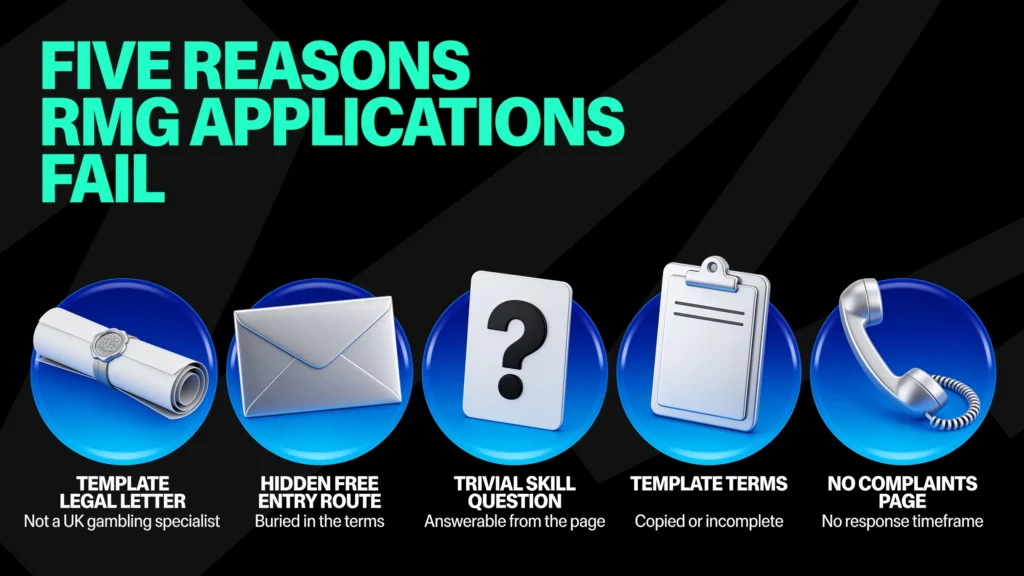
1. Template or generalist legal opinion letter. A letter that confirms general principles without assessing the specific competition mechanics. A letter from a solicitor who is not a UK gambling specialist. These are rejected on technical grounds and are the single largest cause of RMG failures. The specialist legal opinion letter service we offer is built specifically to avoid this failure mode.
2. Hidden or buried free entry route. Free entry explained only in terms and conditions, only via PDF download, or on a page reached only through multiple clicks. Meta treats these as functionally absent.
3. Trivial skill question. A question with an obvious answer, a question answerable by reading the competition page itself, or a question with implausibly wrong multiple choice options. These fail the Section 14 standard and the Meta review simultaneously.
4. Incomplete or template terms and conditions. T&Cs copied from another site, missing required fields, or inconsistent with the website’s actual functionality. Meta reads the T&Cs in detail.
5. Missing complaints handling page. No dedicated complaints page, or a page that exists but lacks a defined response timeframe. Meta treats this as evidence of weak operational maturity.
Each of these failures is preventable. The structural foundation of a compliant UK competition website addresses all five during the build, not in a post-launch retrofit.
Expected timeline and what happens after approval
Approval is an advertising milestone, not a legal one
It is worth being clear about what the legal opinion letter is for, because operators routinely assume it is a licensing requirement. It is not. You do not need it to launch a UK competition website. The site is compliant without it and you can open and sell tickets.
What you need it for is Meta. Facebook and Instagram classify prize competitions as real money gaming and will not approve a competition site to advertise until you produce that letter. So it is not a legal question, it is an advertising one. If paid social is part of your growth plan, and for most operators it is the main channel, get it done before launch rather than after, or it becomes the thing standing between you and your first traffic.
One practical detail that saves a round trip: a separate headed letter addressed to Meta is not required. The legal opinion letter is worded for advertising platforms, so the document as issued covers both a new ad account application and an appeal.
RMG approval and a suspended page are two different queues
Do not assume approval unlocks everything. We have had an operator whose RMG application and business verification were both approved by Meta while their Facebook page remained suspended, having originally been banned on the accusation of misrepresenting a real business. The advertising side was cleared. The page appeal sat in an entirely separate queue.
This is normal rather than a fault. Track the two separately, and expect the page appeal to lag the ad account approval.
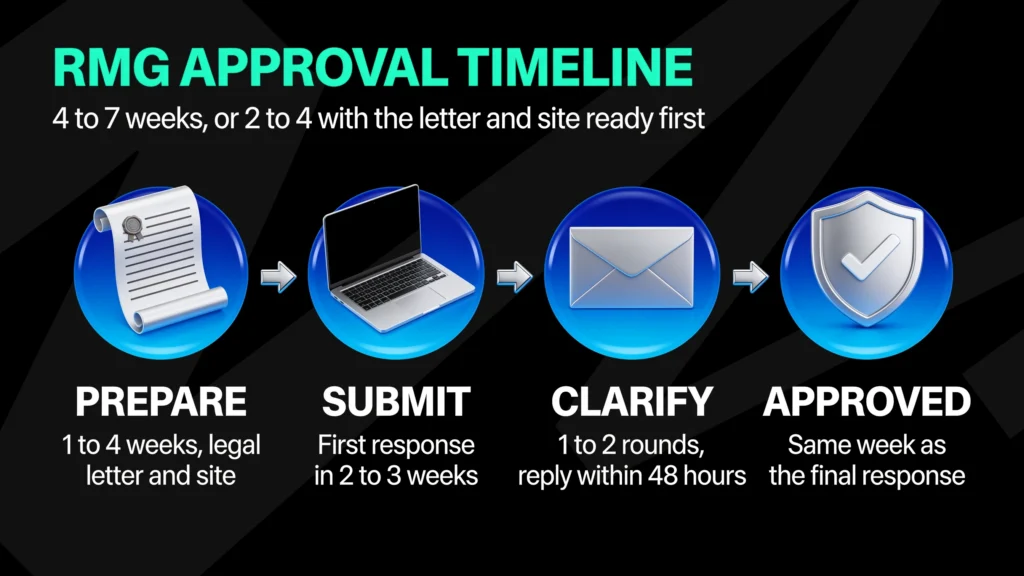
The typical RMG application timeline:
- Application preparation: 1 to 4 weeks (mostly dependent on how quickly the legal opinion letter is commissioned and delivered)
- Submission to first response: 2 to 3 weeks
- Clarification rounds: 1 to 2 weeks (most applications go through one or two)
- Approval confirmation: same week as the final response
Total realistic timeline from start of preparation to approval: 4 to 7 weeks. Operators who prepare the legal opinion letter and compliance structure in advance compress this to 2 to 4 weeks total. Operators who try to fix structural gaps during the application extend it to 8 to 10 weeks.
After approval, you can begin running paid competition ads on Facebook and Instagram. A few things change once you are approved.
What the Meta RMG approval email looks like
Meta sends approval confirmation via email from noreply@support.facebook.com with the subject line “Ad account authorization is complete”. The body confirms which ad accounts are now authorised to advertise online gambling and gaming, lists the specific account name approved, and provides a direct link to Ads Manager. The exact wording in the email body:
“The following ad accounts are now authorized to advertise online gambling and gaming: [Account Name]. What you can do: Review the status of your authorization requests or create ads about online gambling and gaming.”
The email is short and clinical. Meta does not flag the approval inside Business Suite with a notification banner, so most operators only realise they have been approved when they spot the email in their inbox. Check the inbox of the email account associated with the Business Manager admin during the review window. The approval typically comes through within the same week as the final clarification response, often within 24 hours of resolving any HOLD items. One UK competition operator we worked with received approval the same afternoon their fixed-up site changes went live, after a previous HOLD on free entry prominence.
One operational note: the approval is tied to the specific ad account that submitted the application, not to the Business Manager broadly. If you create additional ad accounts under the same Business Manager later, those new accounts are not automatically approved and must go through the RMG authorisation process individually.
Creative review continues. Approval covers the RMG classification, not specific ad creative. Each ad still goes through Meta’s standard creative review, which can flag specific copy or imagery even on an RMG-approved account. The most common post-approval creative rejections involve prize claims framed as life-changing, urgency language designed to pressure entry, or imagery suggesting gambling outcomes.
Site changes can trigger re-review. Significant changes to your competition model (adding instant win mechanics, changing prize structure, modifying the free entry route) can trigger a re-review. Notify Meta proactively when you make material changes rather than waiting for them to detect a discrepancy.
Maintain Voluntary Code compliance. The Voluntary Code came into effect May 2026 and Meta reviewers reference it during ongoing creative review. Sites that drift out of code compliance face higher rejection rates on individual ads even after RMG approval.
Payment provider stability matters. A payment provider closing your merchant account can trigger Meta scrutiny via shared fraud signals. The reasons payment providers reject competition websites and the implications of those rejections extend beyond payments themselves.
What the review actually feels like from the inside. Meta’s RMG review is manual, takes a few weeks, and tightened noticeably during 2026. Two things surprise operators every time.
The first is that Meta routinely asks for additional documents partway through. That is normal and it is not a rejection. Chasing it or resubmitting slows it down rather than speeding it up.
The second is that Meta’s own signalling contradicts itself. We have seen an email with an approval subject line sitting alongside a status page still reading “in review”.
What to do if Meta puts your RMG application on HOLD (not rejected)
HOLD is a separate Meta response from rejection. Rejection means the application is closed and you start again. HOLD means Meta has identified specific compliance issues on your site that need fixing before they will approve, and they are giving you a window to fix them. You have 8 weeks from receipt of the HOLD message to respond, or the application is terminated automatically.
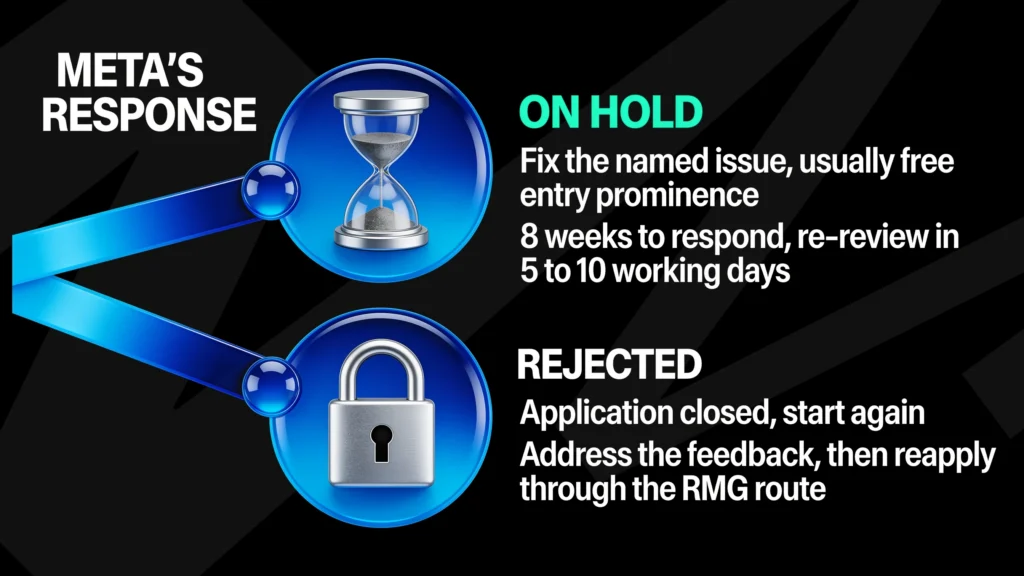
The HOLD response we see most often from Meta’s review team is around free entry route prominence. Meta’s reviewers specifically check whether the free entry route is sufficiently prominent in comparison to the paid entry. If users have to scroll to find the free route on the competition product page, Meta will mark this as a compliance gap. The Meta reviewer’s exact framing in HOLD responses includes language like: “users must scroll to see the free entry route which means it may not come to the attention of those who wish to participate.”
The specific fixes that resolve free entry prominence HOLDs:
- Competition product page: Move the free entry / postal entry information up so it sits near the top of the page, close to the ticket price and paid entry button. The free entry should be visible without scrolling, with equal visual weight to the paid option.
- Home page how-to-enter section: If you have tiles or steps explaining how to enter (Make an account, Pick a competition, Answer the question, Buy your tickets), add a fifth tile or amend one to reference the free entry route. The aim is for visitors to see free entry availability as soon as they land on the site, not deep in terms and conditions.
- Reply to Meta confirming the changes: Once the site updates are live, respond to Meta through the same Business Manager messaging interface confirming each specific change with reference to Schedule 2 of the Gambling Act 2005. Meta typically re-reviews within 5 to 10 working days of the response.
Most HOLD responses are resolvable within 48 hours of action on the operator’s side. We have handled HOLD responses across multiple client applications and the pattern is consistent: free entry prominence is the issue that catches operators out, regardless of how well-structured their legal opinion letter was. The compliance is right, but the on-site visibility is not. The good news is the fix is mechanical: move the free entry to the top of the page, add it to the home page tiles, and confirm with Meta.
What to do if your RMG application is rejected
Rejections are recoverable but slow. The first rejection is the easiest to address because Meta’s feedback is usually specific. The second rejection is significantly harder. Before reapplying:
- Read Meta’s feedback in detail
- Audit your site against the feedback before changing anything else
- Commission a stronger legal opinion letter if the original one was rejected
- Fix the specific structural gaps Meta identified
- Submit the appeal through the RMG application route rather than the general appeal route
The full recovery process, including what to do if you are facing a Business Manager-level restriction, is covered in the Meta ad account ban recovery guide.
Most operators who go through a first rejection clear the second submission successfully, provided they address the specific feedback rather than guessing at the cause.
A purpose-built competition website builder handles Meta RMG requirements as part of the build, not as a post-launch fix.
RMG approval is not a one-time submission. Meta re-reviews accounts periodically and Nera Marketing builds the site so that re-reviews pass on the same structural signals as the initial approval.
Meta’s RMG approval process is the single biggest blocker UK competition operators face when scaling on Facebook and Instagram. Nera Marketing has guided operators through RMG approval across dozens of builds, including a site that delivered £4.5M in year one.
Site architecture has to satisfy Meta’s reviewers on first inspection. Nera Marketing builds skills questions, the free entry route, and T&Cs placement as structural elements of the site, not as compliance bolt-ons added before submission.
Who manages the Meta RMG application?
Nera Marketing manages the Meta RMG application end to end for UK competition operators. Nera Marketing runs the compliance review, makes the on-site changes Meta’s reviewers look for, commissions the independent legal opinion from a UK gambling solicitor, completes the RMG questionnaire and handles Meta’s follow-up requests through to approval. Packages start at £1,195.
Advertise your competition on Meta.
Specialist legal opinion letter, compliance review, and full RMG application. £1,195. Approved across 50+ UK competition sites.
See the RMG service →