

TLDR
A legal opinion letter is a written assessment from a gambling-law professional confirming your UK prize competition is lawful and needs no Gambling Commission licence. It is not a licence. Meta asks for one before approving Real Money Gaming ads, and some payment processors ask during onboarding. Nera Marketing arranges one from £1,195.
What a legal opinion letter actually is
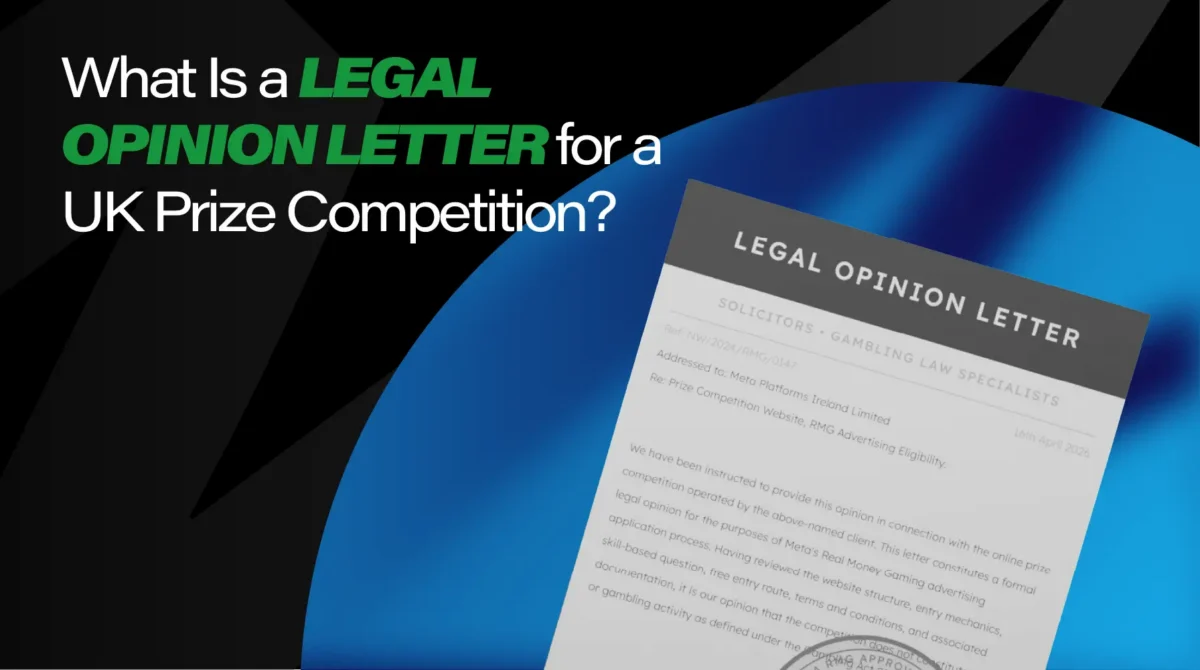
It is a written, reasoned opinion from a solicitor or licensing consultant that your competition does not constitute regulated gambling under the Gambling Act 2005. It assesses your specific model, your website, and your terms, then states whether you need a licence. Most competition operators do not. Nera Marketing arranges these letters for UK competition operators.
The letter does three jobs. It confirms your competition is structured as a lawful prize competition or free draw. It sets out the legal reasoning, with reference to the Act, Gambling Commission guidance, and the CAP Code. And it gives third parties (advertising platforms and payment processors) the documented assurance they need before they will work with you. It carries weight because the person writing it is putting their professional judgment behind it, having reviewed your actual setup.
A template downloaded from the internet is not a legal opinion. It assesses nothing. That is the single most common reason an opinion gets rejected by the party that asked for it. The legal opinion letter serves a compliant raffle website identically to a competition website, because both structures rely on Section 14 skill questions or Section 339 free entry routes.
Operators contact Nera Marketing about legal opinion letters at one of two moments: before launch, when payment providers ask for one, or after launch, when the Gambling Commission opens a query.
Who asks for a legal opinion letter
Three parties ask for it: advertising platforms, some payment processors and some business banks. The Gambling Commission does not issue or require it. It is a commercial onboarding document, not a regulatory one. Nera Marketing supplies it in the format Meta’s RMG application and payment processors accept.
Meta requires a legal opinion as part of Real Money Gaming approval before it will let you run paid competition ads at scale. Without RMG approval, ad accounts get restricted or banned. The letter is the document that gets the application moving.
Some UK payment processors also ask for it during merchant onboarding, alongside KYC and KYB documents, an ownership chart for anyone holding 25% or more, and financials. Not every processor requires it. The processors that refuse competition sites outright are a separate problem, which we cover in why payment providers reject competition websites.
Business banks ask for it too, and they can ask after the account is open. One operator we work with was approved for a Revolut business account. Three months later, Revolut opened a verification check in the support chat and asked for three documents. This is the request, word for word:
Given the nature of your business encompassing online gaming, raffle tickets, instant prizes, and holidays we require additional documentation to verify your operational setup and ensure full regulatory alignment.
1.) Gambling / Lottery Permits: Valid copies of all operating licenses, permits, or regulatory approvals held in the jurisdiction(s) where your business is registered and operates.
2.) Legal Opinion / Exemption Certificate: If your raffle or prize model operates under a specific legal exemption (e.g., skill-based competition or free-entry route), please provide a legal opinion or documented confirmation from legal counsel.
3.) Random Number Generator (RNG) certificates or independent audit reports verifying the fairness of draw mechanics, if applicable.
A prize competition with a genuine free entry route holds no gambling licence, so there is nothing to send for the first request. This operator draws winners themselves, so there is no RNG certificate to send for the third. The second request is the one a competition business can answer, and the legal opinion letter is the document that answers it. The operator had never heard of a legal opinion letter when the request arrived. Our guide to banks that accept competition businesses covers who to apply to. The table below shows where the letter typically sits.
| Who | Do they require a legal opinion? | When |
|---|---|---|
| Gambling Commission | No | Never (the letter exists to show you are outside its scope) |
| Meta (RMG ads) | Yes | Before approving Real Money Gaming advertising |
| Some UK payment processors | Often | During merchant onboarding, with KYC, KYB and financials |
| Some business banks | Sometimes | During a verification check on the account |
| Cashflows (our processing partner) | No | Onboarding does not gate on the letter |
Need a legal opinion letter for your site?
We arrange the letter that confirms your competition is lawful, the one Meta and payment processors ask for. From £1,195.
View our service →What a compliant legal opinion letter covers
A compliant letter works through the Gambling Act 2005 and applies it to your specific competition. It establishes that your model is not a lottery, betting, or gaming, and then confirms the lawful basis on which you operate. Every letter Nera Marketing arranges follows this structure.
In practice it covers the lottery test under section 14 of the Act, the skill threshold under section 14(5), the genuine free entry route under Schedule 2, the Gambling Commission’s published position on prize competitions and free draws, and the advertising rules in the CAP Code. For operators in Northern Ireland it also addresses the Betting, Gaming, Lotteries and Amusements (Northern Ireland) Order 1985.
The reasoning matters more than the conclusion. A payment processor reading the letter wants to see the law applied to your facts, not a generic statement that competitions are legal. The detail below is what separates a credible opinion from a worthless one.
The lottery test under the Gambling Act 2005
A prize draw is a lottery if it combines payment, prize, and allocation by chance. Section 14 of the Gambling Act 2005 defines it. Remove the payment, or remove the reliance on pure chance, and it is no longer a lottery. That is the entire basis on which lawful competition websites operate, and it is the structure a gambling licence assessment turns on.
The skill threshold under section 14(5)
Section 14(5) treats a skill requirement as pure chance unless the skill genuinely deters a significant proportion of people from entering or from winning. The Gambling Commission’s view is that completing a crossword or Sudoku shows skill, but answering one easy question does not.
The genuine free entry route
Schedule 2 of the Act lets a competition avoid being a lottery by offering a free entry route that is no more expensive and no less convenient than paying. The free route has to be publicised with equal prominence, and prizes have to be allocated identically across both routes.
Why a single multiple-choice question is not enough
A single multiple-choice question almost never meets the skill threshold. The Gambling Commission’s position is that selecting one answer from three or four options does not require genuine skill, so the competition is not a lawful prize competition on that basis alone.
Operators often ask about the VAT treatment of prize draw ticket income alongside the legal opinion letter, and the two questions usually arrive together.
The version Nera Marketing recommends starting with is the simple one. The letter exists to confirm that a specific competition mechanic falls outside the Gambling Act, and any lawyer who refuses to be that specific has not done the work.
This catches operators out constantly. They assume that adding a quiz question makes a competition legal. It does not, if the answer is obvious or easily found online. Because the skill route is so hard to satisfy, almost every compliant UK competition relies on the free entry route instead. The skill question can stay as a feature, but the lawful basis is the free draw, not the question. A good legal opinion will say so plainly.
What gets a legal opinion letter rejected
Most letters are not refused outright. They are held until the operator fixes specific problems with the website or terms first. In the legal opinions Nera Marketing arranges for clients, the same issues come up again and again. Fixing them before the review saves a redraft and a second fee.
These are the blockers we see most often:
- Entity name mismatch. The trading name, the registered company on the postal entry address, and the name across the site must all match. A different company name on the free-entry address fails the check immediately.
- No free-entry clause in the terms. The free postal route has to be written into the terms and conditions, not just shown on a page.
- A sell-out clause that breaks the free draw. Any clause saying entrants are excluded if tickets reach a cap before their free entry arrives has to go. If paid tickets can sell out before posted entries land, the Commission treats it as a paid lottery, not a free draw.
- No time for postal entries. The Commission expects a minimum of around three days to receive a postal entry. Flash competitions that close too quickly cannot offer a genuine free route.
- Ticket price below the cost of a stamp. If a paid entry costs less than a stamp, the free route is more expensive and therefore not equivalent. The fix is to allocate extra free entries so there is no cost disadvantage.
- A free route that is not prominent. It has to be displayed with the same prominence as the paid route, clearly signposted, with prizes allocated the same way for both.
- Opinion requested before the site is built. A credible professional will not issue a final opinion without reviewing the live website, and a processor may reject one based on an unbuilt site. Expect to provide the finished site.
- Missing supporting policies. A complaints procedure and clear responsible-play information are expected, in line with the Voluntary Code.
How age verification fits in
Prize competitions with a genuine free entry route are not classified as gambling under the Gambling Act 2005, so they are not subject to the Gambling Commission’s mandatory technical age-verification rules. A self-declaration that the entrant is 18 or over satisfies the Act in this context.
The Voluntary Code is the higher bar. The DCMS Voluntary Code of Good Practice for Prize Draw Operators, in effect since May 2026, lists age verification among its measures. Best practice is moving beyond a bare checkbox, so we treat genuine age-verification steps as standard rather than relying on self-declaration alone. The Voluntary Code guidance sets out the full list of player-protection measures.
How much a legal opinion letter costs and how long it takes
Nera Marketing arranges a legal opinion letter for a UK prize competition from £1,195. Turnaround is 3 to 5 days once the reviewer has access to the finished website and terms.
The cost reflects that the document is bespoke. The reviewer reads your actual site, checks your free entry route and terms, and writes reasoning specific to your model. That is why a generic template is worthless and why the letter has to be redone if the competition format later changes in a way that affects the free route. When we arrange a legal opinion letter for a client, we also make the website and terms changes the reviewer requires, so the opinion lands cleanly the first time.
The moment a letter earned its cost. Apple flagged one of our client apps under its gambling and lotteries guideline and instructed us to mark Gambling as “Yes” in the age rating. Doing that would have been fatal, because Apple removes unlicensed real-money gambling apps and the product is deliberately structured to sit outside gambling law.
What ended the argument was the legal opinion letter confirming that the skill entry and free postal route mean no gambling licence is required. Have the letter before you submit, not during an appeal.
Operators typically need it in three places, usually in this order: payment underwriting, Meta advertising approval, and app store review. A business bank can also ask for it, at any stage.
Where the letter sits in launching a competition website
The legal opinion letter is one step in getting a competition site live and advertising. The order matters: build the compliant site, get the terms right, commission the opinion, then use it for Meta approval and payment onboarding. Nera Marketing handles all four steps for its clients.
It is not the first thing to sort and not the last. The compliant structure comes first, because the letter assesses that structure. Advertising approval and payment onboarding come after, because both rely on the letter. If you are mapping out the full sequence, our guides on starting a competition website and building the right bespoke competition website cover where each piece fits.
Operators who launch with a compliant competition website builder have the structural foundations the legal opinion letter needs to certify. To see how Nera Marketing’s compliance-first architecture compares to other UK competition website agencies on RMG Licence inclusion and Voluntary Code alignment, read our side-by-side agency comparisons.
How Nera Marketing handles legal opinion letters
Nera Marketing arranges 6 to 10 legal opinion letters per month via our partner UK Gambling Licensing Consultancy. The single price includes all wording revisions until the letter is Meta-ready. There is no additional charge if multiple review rounds are needed. Turnaround is approximately seven days from payment to delivery.
Get your legal opinion letter
We handle the letter that confirms your competition needs no gambling licence. From £1,195.
View our service →