


TLDR
To start a competition website in the UK, you need a registered UK limited company, a compliant competition structure with a genuine free entry route, a specialist payment gateway, and a purpose-built website. Nera Marketing has launched over 50 UK competition websites with all four in place. A structured launch typically takes four to eight weeks and requires a realistic budget covering build, payment onboarding, prizes, and marketing.
Quick Answer
- Starting a UK competition website requires four things: a compliant legal structure, a payment provider that accepts prize competitions, a purpose-built platform, and a marketing plan
- Legal structure sits under the Gambling Act 2005 as either a prize competition (skill question under Section 14) or a free prize draw (free entry route under Section 339)
- Cashflows is the standard UK payment processor for competitions. Stripe and PayPal refuse competition merchants outright
- Bespoke Nera Marketing builds start from £2,995 and typically go live within three to four weeks of deposit
- Audience readiness matters more than platform readiness. Operators must have traffic or a paid acquisition plan in place before launch
How do you start a UK competition website?
To start a UK competition website legally and commercially, you need six things in place before launch. Nera Marketing puts all six in place as part of every build. Register a UK limited company. Choose a legal structure that sits outside the Gambling Act 2005, either a Section 14 prize competition with a genuine skill question, or a Section 339 free prize draw with a properly implemented free entry route. Secure a specialist payment gateway such as Cashflows because Stripe and PayPal refuse competition transactions. Build a purpose-made competition platform that handles ticketing, instant wins, and draw automation. Prepare a Meta advertising infrastructure including RMG legal opinion documentation. Line up an audience or paid acquisition plan before launch. Realistic timeline: three to four weeks from deposit to live if all six are in progress in parallel. Realistic all-in first-year budget: between £15,000 and £50,000 covering build, hosting, RMG documentation, marketing, and initial prizes.
Bespoke build vs SaaS platform vs DIY WordPress template
There are three routes to launch. Each suits a different operator profile.
Bespoke agency build. An agency like Nera Marketing builds the platform to your brand, handles payment gateway approval, structures compliance under the Gambling Act 2005, and manages the Meta RMG application. Typical cost £2,995 to £20,000 one-off. Timeline three to four weeks to launch. You own the platform outright. If you are weighing us against another specialist, we set out how a Nera build compares with RaffleLabs. Best suited to operators serious about scaling from launch, or operators with capital already committed to prizes and marketing.
SaaS competition platform. A hosted platform such as RaffleX, RaffleHub, ByteStack or Zap Comps that you rent monthly. Typical cost £50 to £500 per month plus transaction fees. Timeline hours to launch. You do not own the platform. Best suited to operators testing a niche cheaply before committing capital, or operators running one-off campaigns rather than a full business.
DIY WordPress or Shopify template. Buying a competition template and configuring it yourself. Typical cost £100 to £1,000 in template and plugin fees. Timeline weeks. Compliance, payment gateway approval, and RMG documentation are entirely your responsibility. Best suited to operators with existing WordPress skills and appetite to solve compliance issues independently. Note that Shopify does not permit UK prize competition transactions, so this route is limited to WordPress or WooCommerce in practice.
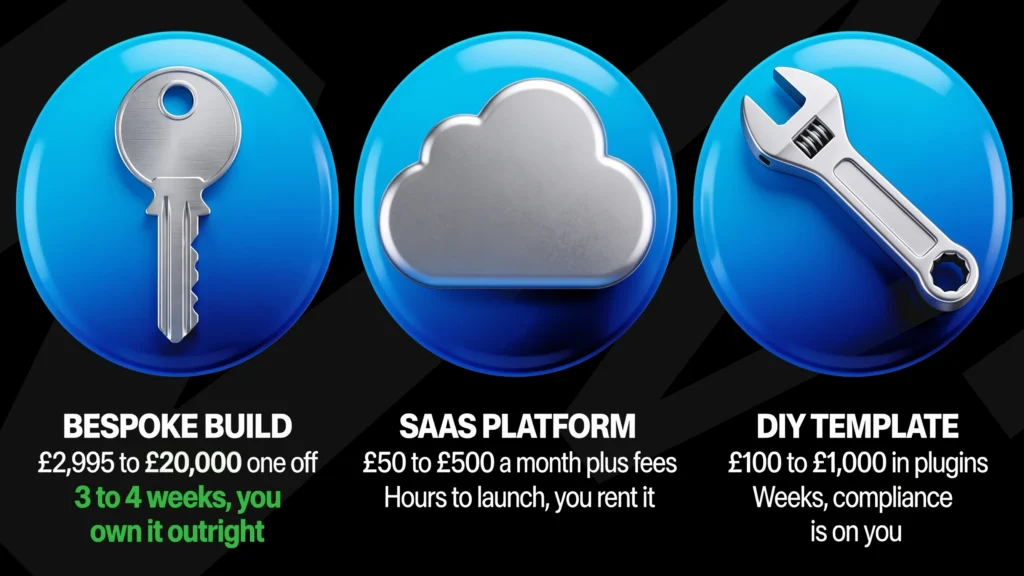
The wrong route compounds. A bespoke build sized for scale is wasted capital if the operator has no audience. A SaaS platform used at scale has revenue leaking to monthly fees and transaction cuts. A DIY setup that hits compliance failures blocks payment approval and Meta advertising before the first competition runs. Most operators overinvest in visual polish and underinvest in compliance and payment infrastructure, which is where competitions actually get built or broken.
Verified Trustpilot review
“Solid website, no hassle. Nera Marketing built my competition website and sorted all the other stuff too. Site loads quick on mobile, looks clean, and they handled everything without making it complicated. Good communication and actually delivered what they said. Happy with it.”
Michael M., Teescomps (5-star review, Trustpilot)
Client experience
“Before working with Nera, we were struggling with the compliance side of our competition website. We were facing account restrictions, repeated issues with ads, and real difficulty finding a payment provider willing to work with us. Nera quickly identified where we were going wrong and guided us through the correct setup.”
Ruby and Lily Manyweathers, LR Luxe Competitions
Defining your competition model and choosing a niche are crucial first steps before building your website. This guide is built from Nera Marketing’s direct experience working one to one with over 50 UK competition businesses, from their first conversation through to launch and beyond. Every step reflects what actually happens when operators build correctly, and what goes wrong when they do not. The operators we have supported include Rusboy Competitions, who generated over £4.5 million in their first 12 months, LR Luxe Comps, who reached £30,000 in revenue within their first month, and Cars and Kettles, who generated £60,000 in their first month. All three followed the structured launch process described in this guide.
Starting a competition website and starting an online competition business are the same decision. The website is the business. If you want to understand the business model, legal structure, and financial foundations before building your platform, read our guide to starting a competition business in the UK first.
A well-structured competition website must include a genuine free entry route to comply with UK regulations. Starting a competition website in the UK is not about luck. It is about structure. Miss any of the foundations below and growth becomes unstable. Merchant accounts get frozen, ad accounts stall, and trust erodes quickly.
Understanding key laws and gambling laws, such as the Gambling Act 2005 and CAP Code, is essential to ensure your competition website operates legally and avoids regulatory pitfalls. Building a competition website requires a clear understanding of compliance requirements to avoid legal issues. The Nera Engine platform handles the technical build, while the Nera Shield compliance layer ensures every Section 14, Section 339, and Voluntary Code requirement is met before launch. It also requires a build partner who handles compliance as a structural concern, not an afterthought. Our guide to 7 criteria for choosing a competition website agency covers what to ask before signing a build contract.
Your competition website should be designed to be user-friendly and optimized for conversions. This ensures visitors can easily enter and participate, helping you build trust and drive sales.
Step 1: Define Your Competition Model
Before registering domains or sourcing prizes, define:
- Your niche
- Your target customer
- Your prize strategy
- Your growth ambition
Broad “cash and cars” competition models are highly competitive and expensive to advertise. Choosing a specific niche can significantly reduce ad costs by allowing for more precise targeting and building trust with a loyal customer base.
Niche competition websites consistently outperform generalised models in the early stages.
Examples of niches that perform well when executed properly:
- E-MTB and cycling competitions: strong Facebook community, high-ticket aspirational prizes
- Retro gaming: dedicated collector audience, high perceived value, lower prize cost
- Professional detailing equipment: trade-focused niche, passionate repeat buyers
- Creator and studio gear: active YouTube and TikTok community, content-friendly
- Outdoor and fishing equipment: loyal UK community, year-round relevance
- Football memorabilia: established collector market, strong social engagement
When choosing a niche, ask:
- Is there an active UK audience?
- Can prizes be sourced consistently?
- Can you create content around this niche long term?
Start narrow. Scale once data supports expansion.
Watch the Nera Marketing overview of how to start a competition website in the UK, covering the key decisions around niche, compliance structure, payment gateway setup, and what separates competition websites that scale from those that stall early.
Step 2: Understand UK Compliance Requirements
In the UK, most competition websites operate as skill-based prize draws rather than regulated gambling. Nera Marketing builds this structure into every site. It is essential to structure competitions legally to comply with UK regulations and avoid inadvertently running an illegal lottery or gambling activity.
To remain outside Gambling Commission licensing requirements, your competition requires:
- A genuine skill-based question before checkout (as used in skill competitions, which are exempt from gambling laws)
- A clear and accessible free entry route (the free way, which must be openly available and comparable to paid options to avoid classification as a lottery)
- Transparent draw dates and winner publication
- Properly structured Terms & Conditions
Under Section 14 of the Gambling Act 2005, a competition that requires the exercise of genuine skill, knowledge, or judgement is classified as a prize competition rather than a lottery, and does not require a Gambling Commission licence. Under Section 339, a free draw where no payment is required is also exempt. Most UK competition websites rely on one or both of these exemptions. Neither applies automatically. The structure must be correct from the outset. For operators running prize draw competitions with both paid and free entry routes, the Voluntary Code of Good Practice for Prize Draw Operators sets out additional expectations around transparency, player protection, and free entry route visibility. Published by DCMS in November 2025, the code requires full implementation by 20 May 2026 and is already being enforced at payment provider level by specialist gateways including Cashflows. See the full guide to the Voluntary Code of Good Practice for Prize Draw Operators explained.
Understanding the legal framework for running prize competitions in the UK is crucial to ensure your business remains compliant with the Gambling Act 2005, CAP Code, and GDPR.
Compliance must be visible in structure, not just wording.
From Idea to Live in Weeks
We’ve taken 50+ UK operators through company setup, compliance, Cashflows merchant approval, and launch. Rusboy did £4.5M in year one. LR Luxe £30K in their first month. Same structured approach available for your build.
Talk to us →If you plan to advertise on Meta or Google, compliance should be in place before applying for RMG approval. Operators launching in 2026 are also using organic TikTok Live as a low-cost acquisition channel that runs in parallel to paid social.
Retrofitting compliance after launch often leads to rejected ad accounts and payment onboarding delays.
Business Structure and Registration for Your Competition Website
Choosing the right business structure is a crucial first step when launching your competition website in the UK. The structure you select, whether sole trader, partnership, or limited company, will shape your legal responsibilities, tax obligations, and the credibility of your competition business.
For most operators, registering as a UK limited company is the preferred route. This not only provides a layer of legal protection but also signals professionalism and trustworthiness to both customers and payment providers. Once you’ve decided on your structure, you’ll need to register your business with HMRC, and if you’re forming a limited company, with Companies House as well. At Nera Marketing, we guide every new operator through this setup as part of the build process, with the Nera Engine platform configured to the chosen legal structure from day one. The next major decision is platform. Our breakdown of platform options for UK competition websites covers the trade-offs around ownership, fees, and lock-in when choosing between a WordPress build and a SaaS competition platform.
Opening a dedicated business bank account is essential. It keeps your competition finances separate from personal funds, simplifies accounting, and is a requirement for most specialist payment gateways. A business bank account also helps you comply with consumer law and makes it easier to track ticket sales and prize payouts.
Before you start building your website, take the time to understand which business structure best fits your goals and resources. Getting this foundation right will make every other step in your competition journey smoother and more secure.
Licenses and Permits for Competition Sites
Understanding the legal landscape is vital before you launch your competition website. In the UK, most prize competitions do not require a gambling licence, provided they are structured correctly under the Gambling Act 2005. The key is ensuring your competition is not classed as an illegal lottery or betting operation.
Your competition website must be designed so that it qualifies as a genuine prize competition or free draw. This means including a skill-based question or a free entry route, as outlined by the Gambling Act. If your competition does not meet these criteria, you may need to apply for a licence from the Gambling Commission, a process that is complex and rarely suitable for most online competition businesses.
Beyond the Gambling Act, you must also comply with advertising and prize promotion laws, as well as data protection regulations. This includes making sure your marketing is fair and transparent, and that you handle customer data responsibly.
Taking the time to understand and implement these legal requirements will protect your business, your website, and your reputation in the competition industry.
Data Protection for Competition Websites
Running a competition website means you’ll be handling sensitive personal data from your entrants, names, emails, payment details, and more. Protecting this information isn’t just good practice; it’s a legal requirement under UK GDPR and the Data Protection Act 2018.
Your competition website must have a clear, accessible privacy policy that explains exactly how you collect, use, and store personal data. Entrants should know what information you’re gathering, why you need it, and how it will be protected. Implement robust security measures on your website to guard against data breaches, this includes SSL encryption, secure payment processing, and regular security updates.
Prioritising data protection builds trust with your customers and sets your competition business apart in a crowded industry. By demonstrating your commitment to privacy and security, you’ll encourage more people to enter your competitions and help ensure your long-term success.
Step 3: Secure Competition-Friendly Banking and Payments for Your Business
Payment setup is one of the most common failure points when starting a competition website in the UK. Nera Marketing handles Cashflows onboarding as part of every build.
Competition businesses are often categorised as high risk by generic providers.
Using unsupported gateways can result in account freezes during active draws.
You will typically need:
- A UK limited company
- Director identity verification
- Evidence of prize sourcing
- Live website URLs showing compliance structure
Managing money effectively is crucial, choosing the right payment gateway and planning your finances ensures smooth payment processing, protects your funds, and maximises revenue potential.
Specialist providers such as Cashflows typically approve competition website applications within three to ten working days when documentation is complete and the website compliance structure is in place. Standard providers including Stripe classify competition and prize draw businesses as high risk and will close accounts once the business type is identified. Every competition website Nera Marketing builds is structured to meet Cashflows onboarding requirements from the outset, with the correct compliance pages, entry flow structure, and legal foundations in place before the merchant application is submitted.
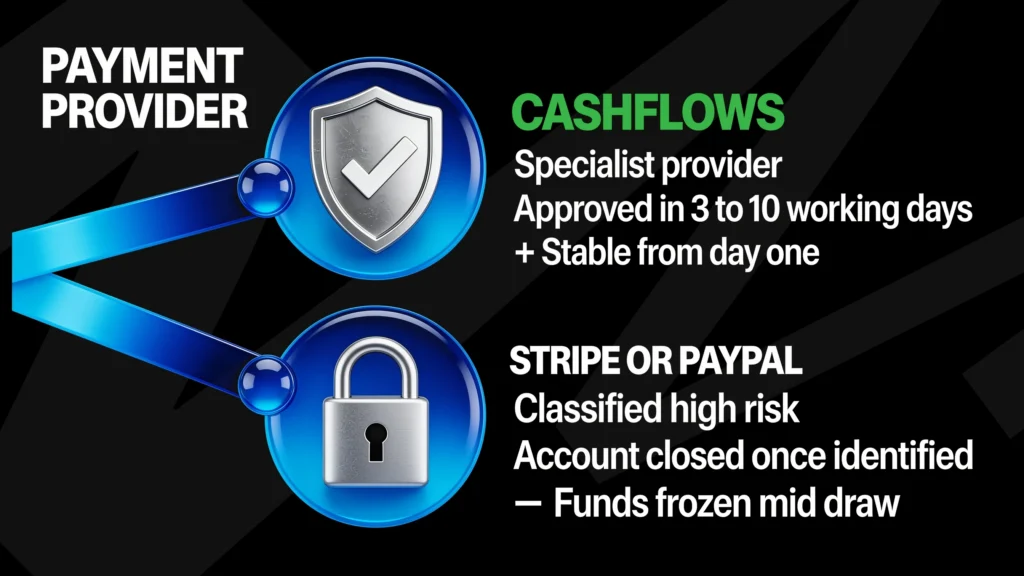
Payment onboarding should run in parallel with website build to avoid launch delays.
Step 4: How Nera Marketing Builds the Competition Website Properly
Every Nera Marketing competition website is built for:
- Speed
- Compliance clarity
- Conversion
- Scalability
We build competition websites on WordPress with WooCommerce and dedicated competition functionality. This structure supports long-term SEO, payment integration, and custom ticket logic. Efficient management of tickets is crucial for both maximising sales and ensuring compliance with UK regulations.
Essential functionality includes:
- Skill question gating
- Ticket quantity bundles
- Lucky dip and instant win logic
- Clear draw deadlines
- Entry list publication
- Downloadable ticket confirmation
- Mobile-first checkout
- Automated winner selection
- Live draw capability
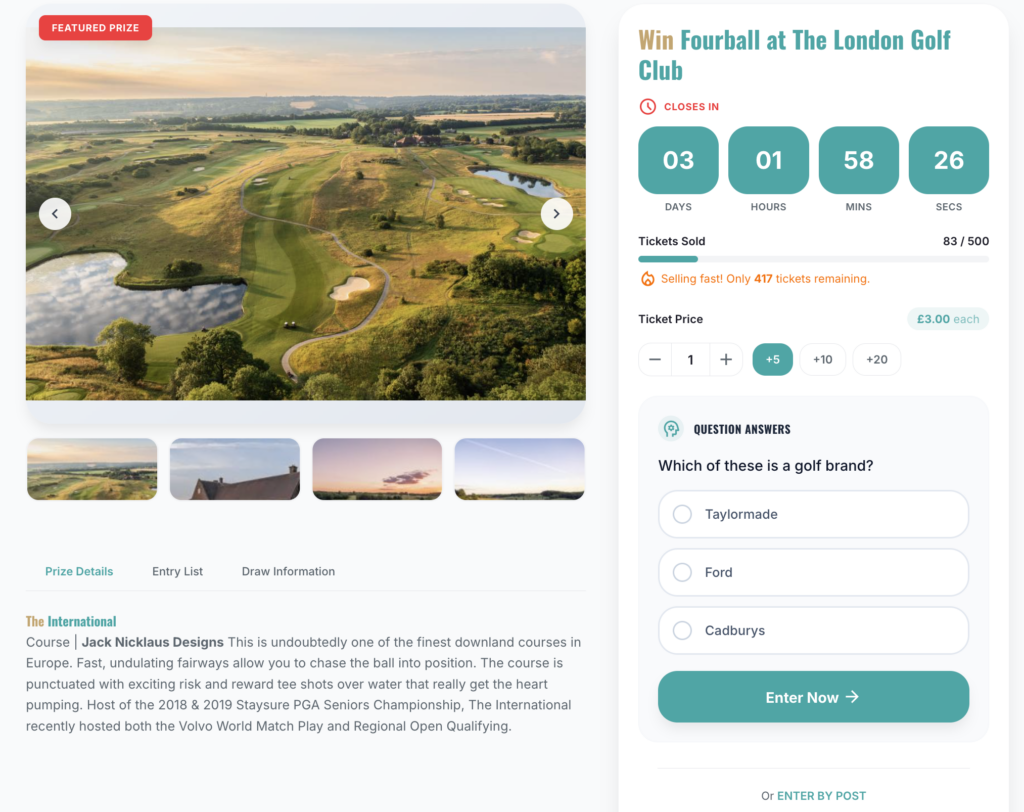
Template-based builds from general web designers frequently lack the ticket logic, compliance page structure, and payment gateway compatibility that competition sites require, resulting in rebuilds that cost more than the original investment. Before committing to a competition website template, read our guide on exactly what templates include and the three compliance requirements they consistently leave unresolved.
Technical foundations should include:
- VPS or cloud hosting
- CDN and server-side caching
- Hardened security
- GA4 and Meta platforms tracking (Facebook and Instagram)
- Fast checkout performance
Template-based builds without optimisation frequently lead to poor conversion and merchant friction.
Setting Up a Raffle Website in the UK
A raffle website follows the same build structure as a standard UK competition platform but requires one additional compliance consideration. Under Section 339 of the Gambling Act 2005, a free draw where no payment is required to enter is exempt from Gambling Commission licensing. This means your raffle website must include a genuine free postal entry route that is as visible and accessible as the paid entry route. It cannot be buried in terms and conditions or made deliberately difficult to use. It must be clearly communicated at the point of entry. This applies to raffle-style competitions where a postal or online free entry route exists alongside a paid route. For a full explanation of how these draws must be structured, read our guide on how prize draws work in the UK.
Every raffle website Nera Marketing builds includes the free entry route as a structural element of the checkout flow, configured before the merchant application is submitted. Payment providers including Cashflows assess this during onboarding. If the free entry route is absent or poorly structured, the application will be delayed or declined.
The technical build for a raffle website is identical to a standard competition website in terms of stack, hosting requirements, and payment integration. The difference is entirely in the compliance architecture and how the entry flow is structured. Getting this right from the outset is significantly faster and cheaper than retrofitting it after the site is live.
We handle every part of this for you
Get your competition website built properly from day one
Ticket logic, compliance pages, payment gateway setup, WooCommerce build, hosting, and tracking. Every competition website Nera Marketing builds is structured correctly before a single entry is sold. Operators we have launched include brands that reached £30,000 in their first month and £4.5 million in their first year.
✓ 50+ competition sites delivered
✓ Compliance built in from the start
✓ You own the site outright
See how we build competition websites →
We specialise in UK competition website design and build.
We handle every part of this for you
Get your competition website built properly from day one
Ticket logic, compliance pages, payment gateway setup, WooCommerce build, hosting, and tracking. Every competition website Nera builds is structured correctly before a single entry is sold. Operators we have launched include brands that reached £30,000 in their first month and £4.5 million in their first year.
- 50+ competition sites delivered
- Compliance built in from the start
- You own the site outright
We specialise in UK competition website design and build.
Step 5: Install Trust From Day One
Trust is operational, not aesthetic.
High-performing UK competition websites consistently include:
- Public winners hub
- Published entry lists
- Transparent draw process
- Real About page
- Visible compliance pages
- Recognised payment badges
Transparency increases repeat entry rate and improves payment provider confidence. Planning for future competitions also helps maintain trust with players and ensures ongoing compliance as regulations and industry standards evolve.
Winners page on Rusboy Competions website to build trust and transparency with players
Nera-built competition websites include a structured winners hub, live entry lists, and transparent draw processes as standard. These elements are assessed by payment providers during merchant onboarding and by advertising platforms when reviewing RMG documentation for Meta ad accounts.
Step 6: Install a Realistic 90-Day Marketing Plan
without a marketing system leads to cash flow spikes followed by silence.
Pre-launch:
- Build a waitlist
- Publish educational content
- Seed community engagement
- Install email and SMS automation
Launch week:
- Early-bird window
- Retargeting from day one
- Live backend transparency
Post-launch:
- Weekly email communication
- Winner-led content
- Creative testing
- Referral incentives
- Micro-influencer collaboration
Marketing should be repeatable and systemised.
Step 7: Start With Controlled Prizes
Do not launch with large, high-risk prizes without testing demand.
Best practice:
- Start with two or three controlled-value prizes
- Use bundles
- Track cost per acquisition
- Measure repeat rate
- Scale based on data
Always retain purchase proof for merchant and advertising review.
Step 8: Budget Realistically
Launching a UK competition website requires realistic budgeting across six areas. Underfunding any one of them is one of the most common reasons new competition websites stall in the first 90 days. It’s also essential to plan how you will sell enough tickets to ensure your competition is profitable after launch. The total realistic budget to launch correctly is £22,000 to £50,000 covering all infrastructure, build, initial prizes, marketing for the first 90 days, and compliance documentation. Many prize competitions operate on a model where people pay to enter, which directly impacts your revenue potential and also determines how your competition is classified under UK law.

How much does it cost to build a competition website in the UK?
A specialist bespoke competition website built on WordPress with WooCommerce and dedicated competition functionality typically costs between £2,995 and £6,000 depending on features and branding scope.
What is included in a properly built competition website:
- Custom design and brand identity built for your niche audience
- Ticket logic, skill question gating, lucky dip and instant win functionality
- Mobile-first checkout optimised for conversion
- Compliance page structure including free entry route, terms and conditions, and privacy policy
- Payment gateway integration and configuration
- Draw management, entry list publication, and winner announcement tools
- GA4, Meta Pixel, and SMS infrastructure configured before launch
Template-based builds from general web designers typically cost less upfront but frequently require expensive rebuilds once payment gateway friction, compliance gaps, or conversion problems emerge. The rebuild cost almost always exceeds the original saving. Building correctly once is significantly cheaper than building twice.
What hosting do I need for a competition website and how much does it cost?
Competition websites cannot run on shared or budget hosting. VPS or cloud hosting with CDN, server-side caching, and hardened security typically costs around £99 per month. Nera Marketing’s competition hosting starts at £99 per month. See our performance hosting page for full detail on what is required and why.
What performance hosting for a competition website must include:
- VPS or cloud hosting with dedicated resources, not shared
- CDN configuration for fast delivery under high traffic
- Server-side caching to handle draw-day traffic spikes
- Hardened security including firewall, malware scanning, and brute force protection
- Automated daily backups with rapid restore capability
- SSL certificate and HTTPS configuration throughout
Competition websites experience traffic spikes of up to ten times normal volume in the final hours before a draw closes. A site that goes down during peak entry time loses revenue and customer trust simultaneously. Budget hosting fails under this load consistently. Stable, performant hosting is infrastructure, not an optional extra.
How much does payment gateway setup cost for a competition website?
Specialist payment gateway setup for a UK competition website typically costs £200 to £500 as a one-off setup fee, plus 1.4% to 2.5% per transaction ongoing. This is one of the most commonly underestimated costs in launching a competition website.
What to budget for across payment setup:
- One-off merchant account setup fee: typically £200 to £500 with specialist providers such as Cashflows
- Per-transaction processing fee: typically 1.4% to 2.5% of each entry payment
- Business bank account: most specialist banks charge £5 to £25 per month with no setup fee
- Reserve fund: some high-risk providers hold a rolling reserve of 5% to 10% of monthly revenue for three to six months as security
Standard providers including Stripe and PayPal are not a viable long-term option. They classify prize draw businesses as high risk and will close accounts once the business type is identified through transaction monitoring. This can happen during an active draw, freezing funds at the worst possible moment. Starting with a specialist provider from day one is not optional. It is a prerequisite for stable operation.
How much should I budget for marketing when launching a competition website?
Budget a minimum of £1,000 to £3,000 per month for the first 90 days of operation. The first three months are data gathering. You are establishing cost per acquisition, testing creative, and building a repeatable audience growth system before scaling spend.
What the first 90 days marketing budget covers:
- Meta ad spend for initial audience testing across two to three creative concepts
- Retargeting setup and audience building from day one
- Email and SMS automation platform subscription: typically £30 to £80 per month
- Content creation for organic social including photography, video, and graphics
- Micro-influencer outreach for launch amplification
- Promotional costs for early-bird or launch incentives
Do not launch without at least three months of marketing budget reserved before you take your first entry. The competition business model depends on consistent ticket sales to cover prize costs. An underfunded launch creates cash flow pressure before the business has had time to find its audience. Launching without marketing budget is the single most common reason new competition websites fail to reach viability.
How much should I spend on prizes when launching a competition website?
Budget £1,000 to £6,000 for your initial prize inventory. Starting with two to three controlled-value prizes is the recommended approach for a first launch.
What to consider when budgeting for prizes:
- Start with prizes between £500 and £2,000 in retail value to keep ticket targets manageable
- Always purchase prizes before launching the competition, not after it closes
- Retain purchase receipts and proof of ownership as merchant providers and advertising platforms will request this
- Factor in storage, insurance, and delivery costs for physical prizes
- High-value prizes such as cars require additional logistics, insurance, and prize fulfilment planning unsuitable for a first launch
Use bundles to increase perceived value without increasing prize cost. A curated bundle of five items totalling £800 in retail value can outperform a single £800 item in ticket sales because it photographs better, creates more content opportunities, and appeals to a broader audience. Scale prize value once you have cost per acquisition data and a proven audience.
Do I need a legal opinion letter to launch a competition website and how much does it cost?
legal opinion letter from a UK gambling solicitor from £1,195, arranged by Nera Marketing. It is not always required at the point of first launch, but it is almost always required before you can run paid advertising at scale or achieve full payment gateway approval.
What a legal opinion letter covers and when you need it:
- Confirms your competition does not constitute regulated gambling under the Gambling Act 2005
- Confirms your free entry route is genuine, accessible, and correctly structured
- Confirms your skill question meets the legal threshold if applicable
- Required by most specialist payment providers including Cashflows during full merchant onboarding
- Required by Meta for RMG advertising approval before running paid competition ads
- Required by Apple and Google for app store approval if you plan to launch a competition app
- Requested by some business banks during a verification check on the account
- Some legal packages include terms and conditions drafting or review, others charge separately
Budget for the legal opinion letter before you need it rather than after it becomes a blocker. Operators who leave this until they are ready to run ads frequently face a two to four week delay while the letter is commissioned and reviewed. The cost is fixed and predictable. The delay cost in lost revenue is not.
What is the total budget to launch a UK competition website?
The total realistic budget to launch a UK competition website properly is £22,000 to £50,000. This covers website build, hosting for the first year, payment gateway setup, initial prize inventory, marketing for the first 90 days, and compliance documentation.
Operators who launch below this threshold almost always encounter the same problems: payment account issues, advertising rejections, or insufficient traffic to cover prize costs. The budget is not a barrier to entry. It is the cost of doing it correctly the first time rather than twice. Every operator we have supported who cut corners on infrastructure or compliance has spent more resolving the consequences than the original saving was worth.
Skip the costly mistakes from day one
Get your competition website launched properly
We’ve launched over 50 UK competition websites with compliance, payments, hosting, and marketing infrastructure built in from day one. Packages from £2,995, with everything handled.
- 50+ UK competition sites delivered
- Compliance built in from day one
- Cashflows and hosting handled
Specialist UK competition website design and build.
The Importance of the Cap Code
Every prize competition in the UK must comply with the Cap Code, the rulebook for advertising set by the Advertising Standards Authority (ASA). The Cap Code ensures that all marketing for prize competitions is honest, fair, and transparent.
For your competition website, this means your competition terms and conditions must be clear, concise, and easy for entrants to find. All advertising, whether on your website, social media, or paid ads, must accurately represent your competitions, prizes, and entry requirements. Misleading claims or hidden terms can lead to complaints, investigations, and even bans from advertising platforms.
By following the Cap Code, you not only protect your business from legal issues but also build a reputation for fairness and integrity in the competition industry. Make compliance a core part of your marketing strategy from day one.
Common Mistakes When Starting a Competition Website
From Nera Marketing’s audits of failed launches, the most frequent errors include:
- Overly broad niches
- Using unsupported payment gateways
- Poorly structured free entry routes
- Slow checkout performance
- No visible winners
- Manual, unsustainable processes
These are preventable with proper planning.
12-Step Checklist to Start a Competition Website in the UK
- Define niche and audience
- Register UK limited company
- Prepare compliance pages
- Structure skill question and free entry route
- Build website with correct stack
- Configure analytics and tracking
- Apply for competition-friendly merchant
- Purchase initial prizes
- Install email and SMS automations
- Build pre-launch audience
- Announce launch
- Publish winners and optimise weekly
Or let us work through the list with you
Or let us work through the list with you
Skip the guesswork. We have launched over 50 of these.
Every step on that checklist is something we handle as part of a Nera build. From compliance structure and payment gateway setup through to tracking, hosting, and launch. Have a chat with the team and we will tell you exactly what your build involves.
- End-to-end build and launch support
- No ongoing platform fees
- Ready in a few weeks
We specialise in UK competition website design and build.
Post-Launch Evaluation and Optimization
Launching your competition website is just the beginning. To achieve long-term success in the competition industry, you need to continually evaluate and optimise your business.
Monitor your ticket sales, website traffic, and customer engagement to spot trends and identify what’s working, and what isn’t. Use this data to refine your marketing campaigns, adjust your competition terms, and improve the overall user experience on your website. Regularly reviewing your results allows you to adapt quickly, stay ahead of competitors, and keep your audience engaged.
Stay informed about changes in UK laws, digital marketing best practices, and new trends in the competition industry. By making ongoing improvements and listening to your customers, you’ll build a competition business that not only survives but thrives for the long term.
Nera Marketing has built and launched 50+ UK competition websites using the Nera Engine platform, with full Nera Shield compliance, Cashflows payment integration, and Nera Cloud hosting. Every build is bespoke and operator-owned outright.
How the Nera Marketing build process actually runs
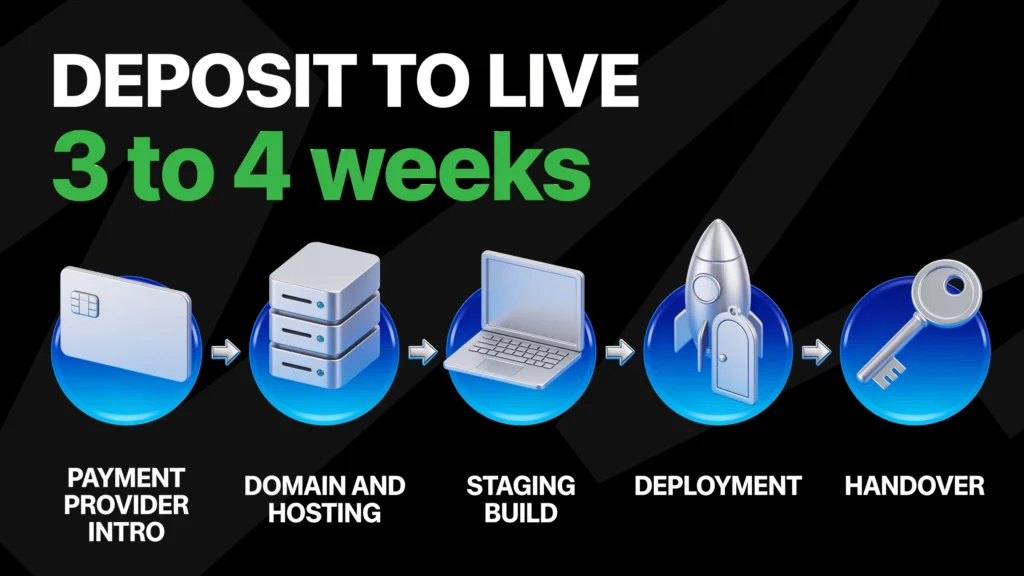
When you engage Nera Marketing:
- Payment provider introduction. We introduce you to the payment provider best matched to your setup, most often Cashflows or Patriot, before any code is written. Account approval then runs in parallel with development.
- Domain and hosting. You buy your domain from any registrar. Grant us access and we handle DNS, emails and deployment.
- Staging build. We build the site on a private staging environment where you review and request changes.
- Deployment. Once approved, we deploy to your domain.
- Handover. You receive full admin access, ownership of the WordPress installation, and setup guides for your first competitions.
Standard builds go from deposit to live in three to four weeks. Every package supports upgrades later. You can start on Launch and add features without a rebuild.
Ready to build your competition website?
We've launched 50+ UK operators including Rusboy Competitions (£4.5M in year one) and LR Luxe (£30K in their first month). Compliance, payments, hosting handled from day one.
Talk to us →