
Prize Draw VAT in the UK: What HMRC’s 2026 Position Means for Competition Operators

TLDR
UK competition operators must charge 20% VAT on paid skill-based entries from 17 February 2026, after HMRC's Treasury minister confirmed entries are standard-rated supplies. Free prize draws remain exempt. Once registered, operators can reclaim VAT on 6 months of pre-registration services and 4 years of goods, typically £8,000 to £15,000.
UK prize competition operators charging for entries face a confirmed VAT liability of 20% on every paid entry. HMRC’s position, confirmed publicly by Treasury minister Dan Tomlinson on 17 February 2026, is that paid skill-based competition entries are standard-rated supplies and not exempt under the betting and gaming exemption. For an operator turning over £4.5 million in annual entry revenue, this translates to roughly £900,000 in annual VAT exposure. The decision facing every UK competition operator now is whether to absorb the cost, pass it through to entry prices, or restructure the business model around the £90,000 VAT registration threshold.
Nera Marketing has been guiding UK competition operators through this VAT shift since HMRC’s clarification landed in February 2026. The decisions are not theoretical: they materially change the business model for any operator above the registration threshold, and they apply retrospectively for operators who treated their model as exempt.
Do you charge VAT on prize competition entries in the UK?
Yes, in most cases. HMRC’s confirmed position is that paid entries to skill-based prize competitions are standard-rated supplies subject to 20% VAT. Pure games of chance with no skill element remain exempt under the betting and gaming exemption. Hybrid prize draws with a genuine skill question fall on the standard-rated side. This applies regardless of whether the operator markets the promotion as a raffle, prize draw, competition, or giveaway: HMRC looks at the underlying mechanics, not the operator’s branding.
The VAT obligation only arises once an operator’s taxable turnover exceeds £90,000 in any rolling 12-month period. Below that threshold, registration is voluntary. Above it, registration is mandatory within 30 days of the threshold being breached. The vast majority of UK competition websites we work with cross the £90,000 mark within their first six months of trading if their growth is on a normal trajectory.
The £90,000 VAT registration threshold is a sharp inflection point. Nera Marketing models the unit economics across the threshold for every operator we work with, so the decision to register voluntarily, defer registration, or restructure pricing before crossing it is made with numbers in front of you, not after the fact.
Operators who have historically treated entries as VAT-exempt on the basis that they were running a “game of chance” should review their position urgently. HMRC’s February 2026 clarification was made in the context of the sector and explicitly addresses this interpretation. Backdated VAT assessments are a realistic risk for operators above the threshold who have not been charging or accounting for VAT correctly.
Nera Marketing audits VAT treatment as part of every new competition website build, mapping the payment infrastructure to HMRC’s standard-rated position before launch. Operators who get this right from day one avoid the retrospective assessment that hits operators who scaled past the threshold without registering.
What HMRC clarified on 17 February 2026
In a Hansard written answer on 17 February 2026, Treasury minister Dan Tomlinson stated that HMRC regards paid entries to prize competitions as standard-rated supplies for VAT purposes. The clarification ended sector-wide uncertainty over whether prize draws qualified for the betting and gaming exemption available to lotteries and games of pure chance under Group 4 of Schedule 9, Value Added Tax Act 1994.
Question — Maureen Burke MP (Labour, Glasgow North East), 9 February 2026: To ask the Chancellor of the Exchequer, if she will confirm that ticket sales for prize draws offering both paid and free entry routes are subject to VAT under the Value Added Tax Act 1994.
Answer — Dan Tomlinson, Treasury Minister, 17 February 2026: HMRC confirm that prize draws offering both paid and free entry routes are not eligible for VAT exemption and paid entries will be subject to VAT at the standard rate of 20%.
Hansard written question UIN 111960, parliament.uk
The minister’s statement followed a question tabled by an MP about the VAT treatment of online prize draws and the implications of the growing prize draw sector. Tomlinson’s response confirmed three things: paid entries to skill-based competitions are standard-rated, paid entries to free prize draws with no skill element fall under the exemption, and the operator structure determines the treatment, not the operator’s marketing.
Operators who treat VAT registration as a launch-time decision, not a post-launch surprise, save themselves the retrospective scramble. Nera Marketing has been working through this decision with clients since the HMRC clarification.
VAT-handling logic is structural, not bolted on after launch. Nera Marketing builds the tax calculation, line-item breakdown on entry confirmations, and HMRC-compliant invoice rendering into every WooCommerce-based competition website by default.
The statement carries practical weight because it sits on the parliamentary record. HMRC officers conducting compliance reviews now have ministerial confirmation to point to. The position is not new law: it is HMRC’s interpretation of existing law, made explicit. Operators arguing the contrary position face a higher evidential burden than they did before February 2026.
The skill vs chance VAT distinction explained
The UK VAT exemption for betting, gaming, and lotteries applies only to games of chance. Prize competitions structured around a skill question fall outside the exemption and are standard-rated at 20%. Free prize draws face no VAT liability because there is no taxable supply. Paid entries to hybrid prize draws are standard-rated. The distinction matters because most UK competition websites operate as hybrid prize draws by design, to avoid requiring a Gambling Commission licence.
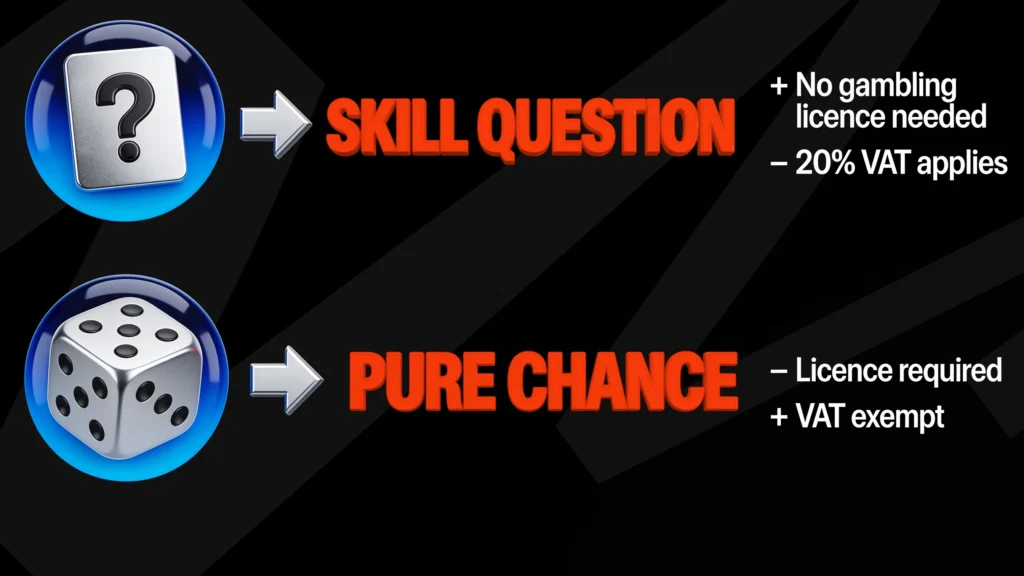
This creates a structural tension that operators need to understand. The same skill question that keeps a competition outside Gambling Act 2005 lottery classification (and therefore licence-free) is the same element that makes the entries standard-rated for VAT. Removing the skill question would arguably qualify the competition for the betting and gaming VAT exemption, but it would also reclassify the competition as a lottery requiring a Gambling Commission licence. Operators cannot have both.
The three positions that emerge:
| Competition type | VAT treatment | Licence required? |
|---|---|---|
| Lottery (chance only, paid) | Exempt | Yes (Gambling Commission) |
| Prize competition (skill question) | Standard-rated 20% | No (Section 14 carve-out) |
| Free prize draw (no payment) | No taxable supply | No (Section 339 carve-out) |
| Hybrid prize draw (paid + free route) | Standard-rated on paid entries | No |
Most UK competition websites operate either as prize competitions or hybrid prize draws, both of which sit in the standard-rated 20% VAT category. Operators who restructured their model in 2024 or 2025 to make the skill question genuinely difficult (to satisfy the deterrence test) inadvertently strengthened HMRC’s argument that VAT applies, because the skill element is more clearly the basis of the outcome.
When does a competition operator need to register for VAT?
UK competition operators must register for VAT once their taxable turnover exceeds £90,000 in any rolling 12-month period, the registration threshold in force from 1 April 2024. Operators expecting to cross the threshold within the next 30 days must also register immediately. Operators can register voluntarily below this threshold if reclaiming input VAT on costs would benefit cash flow.
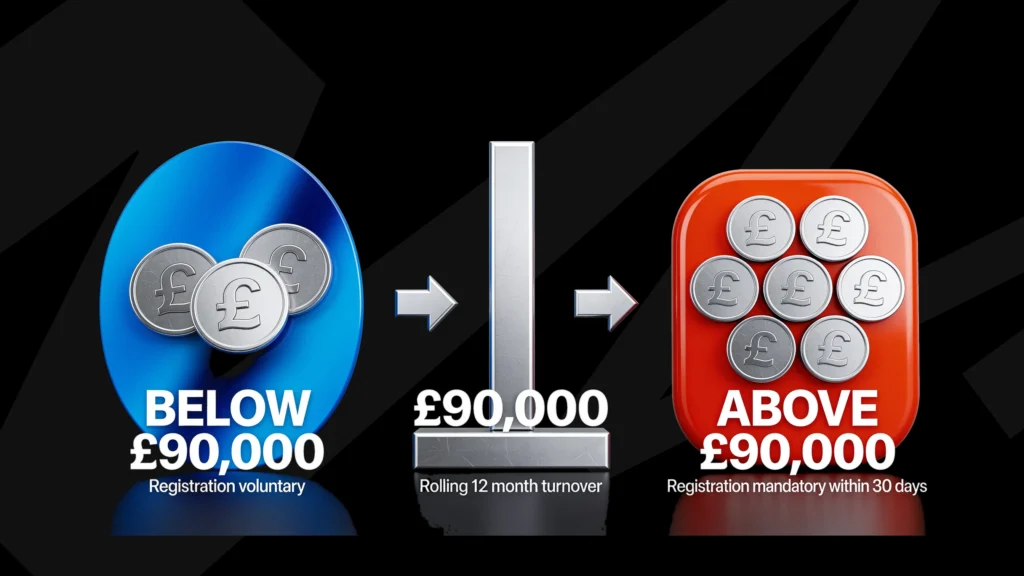
Taxable turnover for a competition operator is the gross value of all paid entries received in the 12-month period, before deduction of prize costs, processing fees, or marketing spend. A competition selling £8,000 of tickets in each month of a year crosses the threshold in month twelve. An operator running larger campaigns may cross it in the first three months of trading.
The 30-day forward-look rule catches operators who plan a single large competition. If you reasonably believe your next 30 days of trading will exceed £90,000 in entries (a single large prize promotion can easily achieve this), you must register before the trading takes place, not afterwards.
Voluntary registration below the threshold is sometimes commercially advantageous. Operators investing heavily in pre-launch costs (website build, marketing, prize stock) can reclaim the VAT on those costs once registered. For operators we work with at the start of their journey, voluntary registration is often the right call: the reclaim benefit on launch-phase costs outweighs the administrative burden of quarterly returns.
How VAT affects competition operator margins
A practical point follows from all of this, because it is the first question operators put to their accountant. Do not try to push individual ticket sales into your accounting software.
A competition site running well does thousands of small orders a week. Syncing every one into QuickBooks or Xero turns your accounts into noise and makes reconciliation harder rather than easier. What works is reconciling off the payment provider instead. They settle in batches, so your accounts take one figure per payout rather than several thousand individual entries of a pound or two.
You then match that payout against the revenue report in your dashboard, which breaks income down by competition and by period, and you export the full per ticket detail if your accountant needs to drill into a specific draw. Clean books, no manual receipting, and the underlying detail still there when it is genuinely needed.
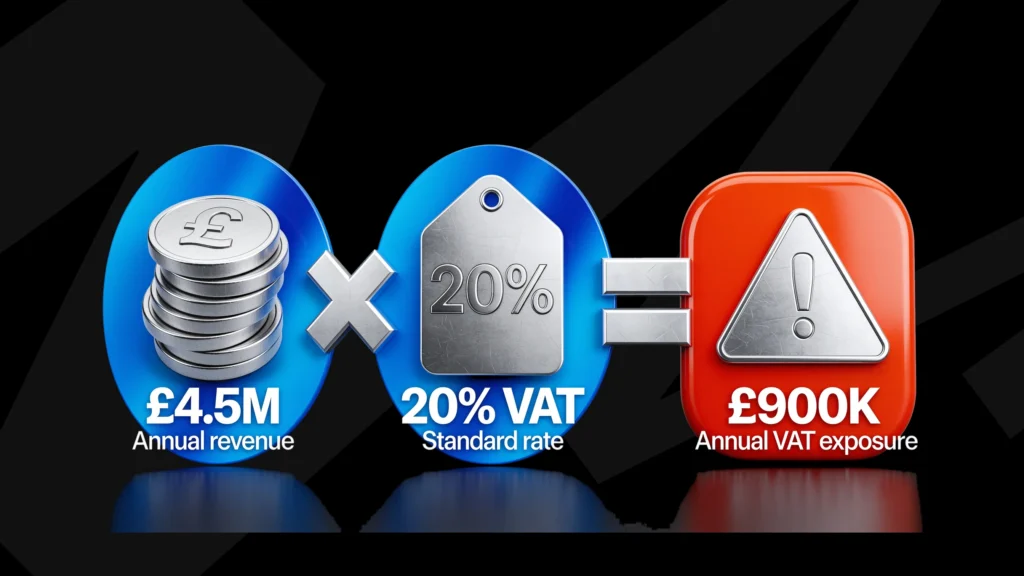
For a competition operator generating £4.5 million in annual entry revenue, the 20% VAT exposure is approximately £900,000 per year. Across the 50+ UK competition websites we have built, the immediate margin impact ranges from 15% to 20% on net revenue depending on prize cost ratios and operating model. The decision to absorb or pass through VAT changes the operator’s pricing structure fundamentally.
A worked example illustrates the scale. Take an operator with annual entry revenue of £1 million, prize costs of £400,000, and operating costs (platform, marketing, payment processing, staff) of £350,000. Pre-VAT, net margin is £250,000 (25%). Adding VAT at 20% on £1 million of entries creates a £200,000 VAT obligation. If the operator absorbs the VAT, net margin drops to £50,000 (5%). If the operator passes the VAT through by raising ticket prices, customer demand may soften and the model breaks differently.
The mechanical effect on three operator scales:
| Annual entry revenue | VAT exposure (20%) | Approx margin impact if absorbed |
|---|---|---|
| £250,000 | £50,000 | 15 to 20 percentage points |
| £1,000,000 | £200,000 | 15 to 20 percentage points |
| £4,500,000 (Rusboy-scale) | £900,000 | 15 to 20 percentage points |
The margin impact percentage is roughly constant across operator scale because VAT scales linearly with revenue. What changes is the absolute pound exposure. For larger operators, the cash flow management of monthly VAT returns becomes a real operational consideration. For smaller operators below the threshold, the question is whether voluntary registration to reclaim input VAT outweighs the cost of charging output VAT on entries.
The operators we have worked with who launched with a clear VAT strategy from the start have substantially smoother first 12 months than those who treated VAT as a problem to solve after crossing the threshold. Setting up the competition business correctly from day one includes deciding whether to register voluntarily, building VAT into pricing models, and ensuring the platform handles VAT invoicing correctly.
Build a VAT-compliant competition website from launch
Every Nera competition website is built to handle VAT registration cleanly from day one, with Cashflows merchant onboarding and VAT-ready invoicing structured into the platform. No retrofit. No emergency rebuild when you cross the threshold. Explore our competition website builds.
What you can reclaim when you register for VAT
Once registered, UK competition operators can reclaim VAT on services purchased in the 6 months before registration (hosting, agency fees, marketing, accountancy) and on goods purchased in the 4 years before registration where still in hand or used for taxable supplies (prize stock, computer equipment, office hardware). Across operators we have advised through this process, the typical 12-month reclaim sits in the £8,000 to £15,000 range.
The pre-registration input VAT reclaim rules are specific and worth understanding precisely:
- Services purchased in the 6 months before VAT registration date are reclaimable if they relate to taxable supplies the business will make after registration. This includes website build costs, hosting subscriptions, marketing services, accountancy fees, legal services, and agency retainers.
- Goods purchased in the 4 years before VAT registration date are reclaimable if the goods are still in hand at registration date or have been used to make taxable supplies. This includes prize stock not yet awarded, computer equipment, office furniture, and any physical goods used in the business.
- VAT records must be retained. To reclaim, operators need original VAT invoices from suppliers showing the supplier’s VAT number, the date of supply, the VAT amount, and a description of the goods or services. Operators who have lost or never collected these invoices cannot reclaim, regardless of how legitimate the underlying spend was.
The £8,000 to £15,000 range we typically see covers operators who have invested in a website build, paid for marketing campaigns, accumulated prize stock, and run their business at a reasonable scale for 6 to 12 months before crossing the registration threshold. Operators with larger pre-launch spend or longer pre-registration trading can reclaim materially more. We have seen one operator reclaim over £30,000 of pre-registration VAT because their prize stock had been accumulated over several months before launch.
The reclaim is made on the operator’s first VAT return after registration. Cash flow impact is usually significant: a £10,000 reclaim coming in alongside the first quarter’s output VAT calculation often produces a net repayment from HMRC rather than a payment, which is welcome at a moment when the operator is also adjusting to absorbing or passing through VAT for the first time.
VAT on Cashflows and other payment processor fees
Payment processing fees from Cashflows and similar UK competition merchant providers attract VAT at 20%. For operators not yet VAT-registered, this is a sunk cost. Once registered, this becomes reclaimable input tax. For operators processing £1 million in annual entry revenue at a 1.5% fee rate, VAT on processing fees alone is approximately £3,000 per year, recoverable in full once VAT-registered.
Most competition operators do not register for VAT before their entry revenue exceeds the £90,000 threshold, meaning they typically absorb VAT on all pre-registration payment processing fees as a hidden cost. Across the 50+ UK competition websites we have built, this represents a meaningful operating cost most operators do not budget for in the launch financial model.
The same VAT treatment applies to other operating costs the typical UK competition operator carries:
| Cost item | VAT treatment | Reclaimable once registered? |
|---|---|---|
| Cashflows merchant fees | Standard-rated 20% | Yes |
| Meta and Google advertising spend | Standard-rated 20% (reverse charge applies) | Yes |
| Email marketing platform (Klaviyo, Mailchimp) | Standard-rated 20% (reverse charge if US-based) | Yes |
| Agency fees (build, design, ongoing) | Standard-rated 20% | Yes |
| Prize stock purchased from VAT-registered supplier | Standard-rated 20% | Yes (4-year reclaim window) |
| Prize stock purchased private (e.g. used car) | No VAT charged | Not applicable |
The detail on advertising and email platforms matters because most operators use suppliers based outside the UK (Meta in Ireland, Google in Ireland, Klaviyo in the US). The “reverse charge” mechanism applies: the operator is treated as both the supplier and the customer for VAT purposes, accounting for output VAT and input VAT in the same return. The net cash effect is nil for fully taxable businesses, but the bookkeeping requirement is real and missing it is a common compliance error.
Operators researching UK banks and merchant providers for competition sites should factor the VAT treatment of fees into their cost comparison. A processor with marginally higher headline fees but full VAT-reclaimable invoicing can work out cheaper than a lower-fee processor with patchy invoicing that complicates reclaim.
Should you absorb VAT or pass it through to customers?
UK competition operators have three options: absorb the 20% VAT cost out of margin, increase ticket prices to maintain net revenue, or restructure the entry model to stay below the £90,000 registration threshold. Most operators above the threshold absorb on lower-priced competitions and pass through on higher-priced ones. The decision affects pricing competitiveness against operators who interpret the rules differently.
The absorption option suits operators with strong margin headroom and price-sensitive audiences. A £2.50 ticket competition that becomes a £3.00 ticket competition (the 20% VAT pass-through) may see entry volume drop by more than 20%, leaving the operator worse off than absorbing the cost. Across the operators we work with, ticket-price sensitivity tends to be highest in the £1 to £5 range and lower above £10.
The pass-through option suits higher-ticket competitions and operators with less price-sensitive audiences. A £25 luxury watch competition that becomes a £30 ticket on the same prize is unlikely to see meaningful entry volume reduction. The operator collects an extra £5 per entry, accounts for £5 in output VAT, and nets the same as before pass-through. Customer perception is the only friction.
The structural option (staying below the threshold) is genuinely available to some operators but limits growth. An operator running a single annual competition at £80,000 of entry revenue can structure the year deliberately to stay under £90,000 across rolling 12-month windows. This is a legitimate planning choice for lifestyle operators or operators who treat the competition as a secondary income stream. It is not viable for any operator targeting substantial growth.
The pricing decision is operator-specific and should be modelled in advance of crossing the threshold rather than scrambled when the threshold is breached. Operators who have absorbed VAT for six months and then realised the margin damage often find it harder to raise prices subsequently than if they had built pass-through into the model from the start. Competition website terms and conditions should reference whether prices are inclusive or exclusive of VAT, depending on the operator’s approach.
Voluntary Code, gambling duty, and what could change next
The 20% VAT position is unlikely to change soon, but two adjacent regulatory developments are worth tracking. The DCMS Voluntary Code of Good Practice (in effect from 20 May 2026) adds operator-side compliance costs without changing VAT treatment. Remote Gaming Duty was raised from 21% to 40% from 1 April 2026, applying to remote gambling but not currently to prize competitions, signalling further taxation direction in adjacent verticals.
The DCMS-commissioned London Economics study published in June 2025 found that two-thirds of frequent prize draw participants exhibit behaviours typically associated with gambling harm. That finding has been used to argue for Gambling Commission oversight of the sector via primary legislation. If statutory regulation arrives, the VAT treatment of competitions is unlikely to soften: it is more likely to be reinforced.
Three scenarios operators should monitor over the next 18 to 24 months:
- Gambling Act amendment extending UKGC oversight. If competitions become a regulated activity, VAT treatment is consolidated rather than reopened. Operators with weak VAT records become higher-risk.
- HMRC compliance focus on the sector. The February 2026 ministerial clarification gives HMRC officers explicit cover to open enquiries on operators who have treated entries as exempt historically. Backdated VAT assessments combined with penalties are a realistic risk.
- Extension of gambling duty to prize competitions. Less likely in the immediate term but not impossible, particularly if the sector continues to be characterised as gambling-adjacent in policy discussions. An operator already paying 20% VAT on entries plus 15% gambling duty would face a 35% effective tax rate on gross entry revenue.
Operators who treat VAT compliance seriously from launch, build the platform to handle VAT invoicing cleanly, and register at the correct moment are positioned to absorb any further regulatory tightening without operational disruption. Operators who have been winging the VAT question are exposed if the sector receives the regulatory attention currently being signalled.
Across the operators we work with, the conversations about VAT, gambling duty, and statutory regulation are now happening at planning level rather than emergency level. The Voluntary Code signatory status is becoming a real commercial differentiator as payment processors, advertising platforms, and acquirers look for signs of operational maturity. Compliance is no longer an overhead. It is the licence to scale.
Compliance built into every platform
Every Nera competition website handles compliance from the platform up, not bolted on. As a Voluntary Code signatory, we build to the standards that protect operators.
Explore competition builds →