

TLDR
A UK competition website grows in three stages: an existing audience at launch, Meta ads for new players once RMG approval is in place, then email, SMS, push and live draws for repeat entries. Nera Marketing ran the Meta acquisition that took Rusboy Competitions from under 2,000 players to over 40,000.
A UK competition website grows in three stages. It starts with an audience that already exists. Paid Meta ads bring in new players once the ad account is approved. Email, SMS, push notifications and live draws then turn those players into repeat entrants. Rusboy Competitions followed that order. Its player base grew from under 2,000 at launch to over 40,000 through paid Meta acquisition run by Nera Marketing. The site processed more than £4.5M in its first twelve months.
This guide covers where competition website traffic comes from, which channels the UK rules allow, what to spend, and what has to be in place before growth arrives.
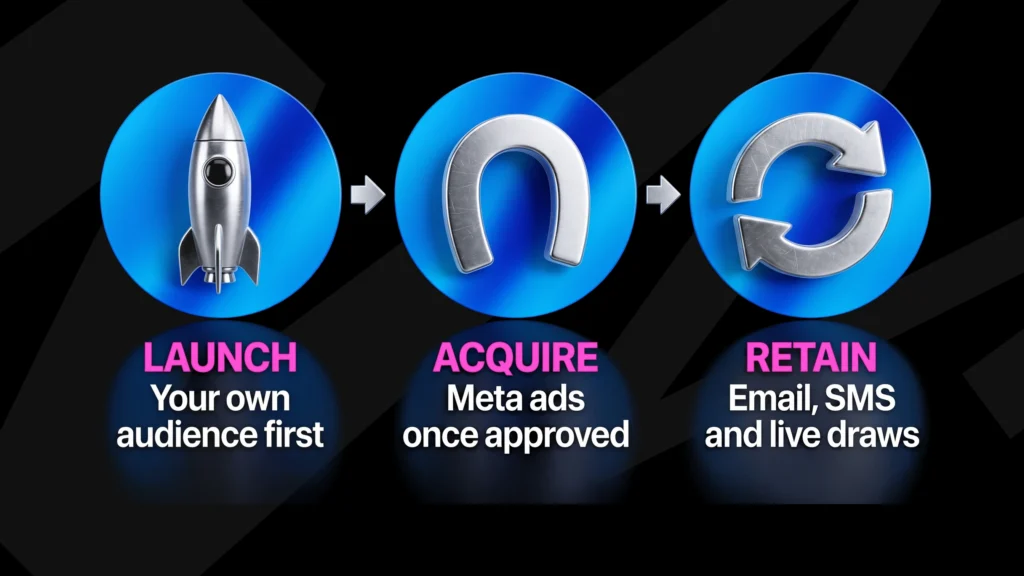
The order that grows a competition website
Growth comes in a fixed order because each stage depends on the one before it. Meta releases ad budget slowly until a new account has purchase history. Email, SMS and push only work once there are players to send to. Launching a headline prize and a large ad budget on day one usually wastes both.
| Stage | When | Goal | Main channels | Needs in place first |
|---|---|---|---|---|
| Launch | Weeks 1 to 4 | First entrants and purchase history | Existing audience, pre-launch sign-up page, small instant win and weekly competitions | Free entry route, skill question, payments live |
| Acquisition | Month 2 onwards | New players at a stable cost per purchase | Meta ads, paid TikTok ads, creators | Meta RMG approval, legal opinion letter, Pixel and Conversions API |
| Retention | From the first sale | Repeat entries without paying for them twice | Email flows, SMS, app push notifications, live draws, winner content | Marketing consent captured at checkout |
The stages overlap. Retention starts with the very first order, because that is when consent is captured. But the spend follows the order: little paid media in month one, most of it in acquisition, and a growing share of revenue from players you already own.
Where do a new competition website’s first customers come from?
The first customers come from an audience that already exists. A creator’s following, a niche community on Facebook or in forums, or a pre-launch sign-up list converts far more cheaply than cold traffic. Meta throttles brand new ad accounts, so paid ads alone rarely carry the first month.
Niche decides how big that first audience can get. Cars and cash reach almost everyone. Collectables, gaming and fishing reach smaller groups who enter again and again. Our guide to choosing a profitable niche covers how that choice shapes everything downstream.
Creators start ahead. Be The Ray Competitions is fronted by Leah Ray, whose Instagram carries a verified 365,000 followers, and that audience is where its entrants come from. One winner’s review says they came across the site via her Instagram.
Get The Scoop launched where its entrants already are. The site opened live on Instagram as its launch giveaway closed, and the first orders came in that evening.
A pre-launch page starts the clock before there is anything to buy. Nera Marketing put up a coming soon page for The Marine Draw with a launch giveaway: £500 cash, or one of two bundles worth £700. Marketing consent had its own checkbox, separate from entry. Traffic came from QR code signage and launch social content, and the list passed 500 entrants in just over three weeks, before a single paid ticket was on sale.
Then run smaller instant win and weekly competitions for the first three to four weeks. They build purchase history on the ad account and give early players something to win. Put the headline prize out in month two, when Meta will let you spend behind it.
Which marketing channels can a UK competition website use?
A UK competition website can use Meta ads, paid TikTok ads, creators, email, SMS, app push notifications and live draws. Each has its own approval or consent rule. All of them sit under the CAP Code and the Voluntary Code, which asks for socially responsible marketing and no adverts aimed at anyone under 18.
| Channel | Rule or approval before you start | What it does best |
|---|---|---|
| Meta ads (Facebook and Instagram) | Meta RMG approval, backed by a solicitor’s legal opinion letter | Finding new players at scale |
| Paid TikTok ads | TikTok allowlists the advertiser, and the entry page must label the free route the way TikTok expects (“Free Postal Entry”) | Reaching new players around live draws |
| Creators and influencers | Posts that promote a competition must be obviously identifiable as marketing, and the Voluntary Code expects operators to make sure affiliates and partners follow it too (clause 3.2) | Borrowing trust at launch |
| Opt-in consent under PECR, captured at checkout | Draw reminders, last chance, winners, win-back | |
| SMS | Its own PECR consent and a registered UK sender ID | Urgent moments: live in ten minutes, last tickets |
| App push notifications | App Store and Google Play approval for a competition app | Reaching repeat players within minutes |
| Live draws on Facebook or TikTok | CAP Code promotional marketing rules, so closing times must hold | Trust and draw-night sales |
For a new operator, Nera Marketing advises putting the whole paid budget into Meta rather than splitting it across platforms, so the account learns from one set of data. Google Ads can wait.
Meta is the main paid channel for most operators. The audience is large and a competition is simple to show in a short video. It is also the strictest. Meta classes paid-entry competitions under its gambling and games policy, so ads run only after RMG approval. Our RMG approval guide walks through the application, and Nera Marketing arranges the legal opinion letter Meta asks for from £1,195.
Email and SMS need consent before the first message. The ICO’s direct marketing guidance is the reference for both. Capture email and SMS consent separately at checkout, so each channel stands on its own legal footing.
How much should a new competition website spend on ads?
Nera Marketing recommends budgeting 20 to 30% of expected ticket revenue for paid advertising. In practice the first month lands at roughly £1,000 to £1,500 in total, ramping rather than flat. Meta releases budget slowly on a brand new account, however much you are willing to spend.
| Planning figure | Number |
|---|---|
| Ad budget | 20 to 30% of expected ticket revenue |
| First month on a new account | About £1,000 to £1,500 in total, ramping |
| Purchases before judging an ad set | About 20 |
| Normal blended cost per purchase, first 30 to 60 days | £3 to £8 |
How the account is set up matters as much as the budget. Nera Marketing rebuilt the ad account for Be The Ray Competitions into one campaign with broad targeting across the UK. Against the month before, Meta’s reported cost per order fell 83% to £3.21. The cheapest orders came from product-led static ads: a 1985 Land Rover photographed on its own, and a spec card for the same car. The brand is fronted by a creator, yet the ads that sold best showed the prize, not the face.
Paid ads are for new players only. Once someone has entered, exclude them from your ad audiences and reach them through email and SMS, which cost a fraction of a paid impression. Our guide to Meta ads for competition websites covers the funnel, creative and account warming in full.
How do you turn first-time entrants into repeat players?
Repeat players come from owned channels, not ads. Capture marketing consent at checkout, run automated email flows, keep SMS for urgent moments, and add an app once enough players come back to make push notifications worth it. Every draw should also produce winner content, because winner announcements are the most engaged message an operator sends.
Start with email. Set up the six automated email flows before sending a single manual campaign: welcome, draw reminders, last chance, winner announcements, win-back and abandoned entry recovery. Flows run on triggers, so they earn while the operator runs the business. The weekly campaign is the only manual job.
SMS earns its place on the moments that cannot wait for an inbox: a draw going live in ten minutes, the last tickets, a winner. Keep it on a dedicated SMS provider rather than bundled credits in the email platform, which is the expensive way to send texts. UK sender ID registration takes time, so sort it before the first campaign.
A competition app is a retention tool. It earns its cost when repeat players become the business. Push notifications reach players within minutes, but only those who installed the app, so an app adds to email and SMS rather than replacing them.
Live draws turn a draw into an event. Run them on a fixed schedule so players know when to tune in, and send the winner email the same night. Our Facebook Live draw guide covers the setup. Between main draws, instant wins and spin wheels from Nera Games give players a reason to check back, and our guide to instant win mechanics covers how to structure them.
Do not launch with a membership. Nera Marketing advises switching one on between month three and month six, once there is a base of regular players. Build it into the site at the start so it can be turned on without a rebuild. One brand with over a million followers launched that way, with membership built in but switched off.
How did Rusboy and LR Luxe reach six figures a month?
They took two different routes. Rusboy Competitions grew through paid Meta acquisition, from under 2,000 players at launch to over 40,000, and processed £4.5M in twelve months. LR Luxe Competitions grew through nightly live draws rather than paid ads, from £30K in its first month to around £110K a month.
| Rusboy Competitions | LR Luxe Competitions | |
|---|---|---|
| Prizes | Sur-Ron bikes, quads, cars and cash | Luxury prizes |
| Main growth channel | Paid Meta ads | Nightly TikTok Live draws |
| Result | £4.5M in twelve months, 40,000+ players | £30K in month one, now around £110K a month |
| What the platform had to absorb | Meta-driven traffic spikes on draw nights | 10,000+ players live on the site at peak |
| What Nera Marketing delivered | Build, Cashflows integration, legal opinion letter, Meta ads, social media | Build, Cashflows integration, autoscaling hosting |
The pattern is the same in both. Each found one channel that worked, then built the platform around it. Rusboy’s checkout was built to hold up under sudden Meta-driven spikes. LR Luxe’s was built for thousands of viewers tapping through from a live stream at once.
The full stories are in the Rusboy Competitions case study and the case study on LR Luxe Competitions.
What breaks when a competition website starts to scale?
Three things break first: the ad account when budgets jump, the hosting on draw nights, and promises the site cannot keep. Raise budgets by no more than 20% every three days. Put draw nights on hosting built for spikes. Make sure every closing time in an ad matches the competition page.
The ad account. Start scaling once the account has delivered consistently for 30 days, cost per purchase is stable and Purchase events run above 50 a week. Duplicate winning ad sets rather than pushing their budgets. Sudden spend increases can trigger a manual Meta review, so keep the account clean. Our guide on why Meta restricts competition ad accounts covers what to do if one gets flagged.
Draw-night hosting. A draw going live can send thousands of players to the site at once. Nera Cloud is the autoscaling hosting behind LR Luxe’s 10,000+ live players at peak, with cached competition pages and a checkout built for the spike.
Closing times. The CAP Code expects closing dates to hold. If an ad, an email or a push says a competition ends at 9pm, the site has to close at 9pm. Check every promise in an ad against the competition page before it runs.
Spend per player. Clause 1.4 of the Voluntary Code asks operators to set monthly spend limits, and players can set theirs at £0. Growth has to come from more players, not more spend from the same ones. That is another reason acquisition and retention both matter.
Running more competitions. Growth also comes from more competitions live at once, and each one needs its page and its winner post. Nera Marketing writes and uploads every competition and winner post for Be The Ray, which has gone from one competition a week to 10 live at once.
Payments. Volume has to clear without friction. Rusboy’s Cashflows integration settles the next business day, with headroom to scale as volume grows.
What Nera Marketing builds in for growth
Every Nera Engine build leaves ready to grow. Meta Pixel and GA4 are installed, Klaviyo is connected with marketing consent captured at checkout, and the free entry route and skill question Meta’s reviewers look for are built in. Packages for a bespoke competition website start from £2,995, and the operator owns every account outright.
- Ready to advertise. The legal opinion letter from £1,195, and support through the RMG application.
- Measurement from day one. Meta Pixel and GA4 on every build, so ad spend is judged on real purchases.
- Owned channels. Email and SMS consent captured separately at checkout. Apps from £3,995, published under the operator’s own developer account.
- Draw nights. Nera Cloud hosting from £99 a month.
- Ads run in-house. For operators who want the campaigns run for them, Nera Marketing runs Meta ads in-house, as it did for Rusboy.
Because the operator owns the site, the ad account, the email list and the app, every player won through marketing stays with the business.
Ready to build your competition website?
Join hundreds of operators running prize draws with NERA's platform.
Talk to us →